
Peloni: Rather than inviting instability in the region as is what has taken place under Oslo, a Two State Solution in Lebanon would render the region more stable. It would also free the Lebanese Christian community from its current state of dhimmitude under the Hezbollah run trainwreck of Lebanon, allowing the Lebanese Christians to once again flourish.
Daniel Greenfield | Dec 4, 2025
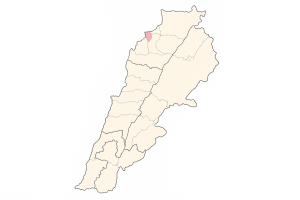 District map of Lebanon. By George Saliba – Wikipedia, CC0, Wikipedia
Pope Leo visited Lebanon, where the proportion of the indigenous Christian population continues to decline even as the Muslim colonial population grows, and called for a two state solution. Not to create a Christian state in Lebanon, but to create a Muslim one in Israel.
While a ‘two state solution’ that would create an Islamic terrorism state inside Israel has been repeatedly tried and failed, Lebanon is a much better candidate for a two-state solution.
And it may be all that can save the largest Christian population in the Middle East.
Christians in Lebanon have declined from a demographic majority to a minority. Christian politicians may officially hold high and, in some cases, reserved positions in the Lebanese government, but they are often little more than fronts and puppets for Islamic terror groups.
Eventually enough Christians will be driven out of Lebanon that the facade will end and what was once the most ‘western’ of the Arab countries will become another Iraq or Iran.
A two state solution would not be some unprecedented innovation, but a return to the ‘Mount Lebanon Mutasarrifate’ that the Ottoman Empire was forced to accept after Western outrage at the brutal Muslim massacres of Christians in the region under the dying ‘caliphate’.
Ottoman reforms had rolled back some of the Koranic doctrine of Islamic supremacy at the heart of any true ‘caliphate’ and allowed Christians, Jews and other indigenous minorities to successfully compete with the Muslim settler population. Under the Islamic colonial system, churches could not be higher than mosques, nor could a Christian’s home be higher than a Muslim settler’s home, any violation of this systemic Islamic racism was swiftly put down.
Maronite Christians in what would become Lebanon, like the neighboring Jews in Israel, began to dream of a free state independent of Islamic rule. And Muslims responded in both Lebanon and later Israel with ruthless massacres, asserting the privileges of Islam to repress all non-Muslims. The atrocities, in which churches were burned and ten of thousands Christians killed, resemble the ongoing Muslim genocide of Christians in Nigeria.
The wave of Islamic violence, timed to the Islamic festival of ‘Eid’ (often a season of Islamic violence against non-Muslims), spread into Damascus as Muslim settler mobs rampaged shouting “kill them”, “butcher them”, “plunder”, “burn”, and “leave not one” Christian alive.
Thousands of Christians, men, women and children, were massacred, over 500 churches were burned and and hundreds of bodies of women and girls, many of whom had been raped, littered the road to the biblical city of Sidon, under Islamic occupation.
Colonel Charles Henry Churchill, the British consul in Damascus, (Winston Churchill was a member of the same large family) who had worked on plans for the rebirth of Israel and a Christian state in Lebanon, described “the violation of women, the ravishing of young girls – some in the very streets amid coarse laughs and savage jeers” while “the churches and convents, which, in the first paroxysm of terror, had been filled to suffocation, presented piles of corpses, mixed up promiscuously with the wounded and only half dead.”
In events reminiscent of modern Muslim attacks on American diplomatic facilities in Tehran, Cairo and Benghazi, the Jihadist mobs attacked the American consulate.
Mikhayil Mishaka, a local Protestant convert serving as the American vice consul, fled the Muslim mobs waving swords at him, and survived battered and beaten, along with his children, and sent urgent word of the horrors taking place. The year was 1860 and America was in the middle of a presidential election with a civil war soon to come. But other Western powers intervened and the weakened Ottomans created the ‘Mount Lebanon Mutasarrifate’ that allowed Christians a measure of independence and paved the way for Lebanon to become a nation.
Mount Lebanon established a Christian majority by removing many of the areas that form the modern Lebanon and the resulting Christian area remained relatively stable under Christian rule apart from WWI when the threat of French intervention that had paused the Muslim violence was temporarily no longer a factor. The French liberation partitioned Lebanon and made it a state with boundaries that included a Muslim population that a Christian state could not govern in the long term. Israel’s Jewish majority struggled with a similar problem, but it has shown an ability to defeat Islamic invading armies and insurgencies by the Muslim settler population.
Lebanon’s Christians have lost that momentum. The Shiite Islamic takeover of Iran, the growth of Islamic terrorist groups in the region, and the spread of regional Shiite Jihadism out of Tehran has effectively turned Lebanon from a Christian country into an Islamic puppet regime.
A two state solution could preserve a Christian state in Lebanon. The idea of stepping back from ‘Greater Lebanon’ to a sustainable Christian state is not a new one. Like Israel, Lebanon’s religious geography makes a two state division into a tricky proposition, and will require some measure of population exchange, with Muslims leaving some traditionally Christian areas, and Christian minorities having to leave Muslim majority areas.
A plausible arrangement would preserve the historically Christian coastal cities that are at the heart of Lebanese civilization, cede portions of the border regions, especially the Bekaa Valley, a stronghold of Hezbollah, as a separate Shiite state, or turn them over to Syria, whose new Sunni Al Qaeda government would have to grapple with that particular problem. Southern Lebanon’s Shiite Muslim population would have to move north and east, restoring the old link between Lebanon’s Christian population and Israel’s Jewish population for a secure border.
Many of the Lebanese Christian refugees in the South Lebanon Army who fought against Islamic colonialism and fled to Israel when the Clinton administration and its puppet prime minister, Ehud Barak, surrendered the Christians to Islamic rule, are still waiting to return home..
“I was born in Southern Lebanon in a little Christian village called Debel. I think it’s 25 minutes from the border. It’s beautiful, really tiny village, green, very clean,” Maryam Younnes, a member of a Christian refugee family described. “We had to leave Lebanon because we were given two options by Hezbollah: Or to stay and be killed, pay the price as they said, or to leave Lebanon and never come back. So we left Lebanon, I was five years old. I still remember that night. My dad called my mom, and he was like, ‘take the girls and go to the border.’”
After the Oct 7 attacks, Maryam said, “we knew like, like the moment they… I heard that they are inside, I knew that it’s just going to be the most horrendous – you know – killing spree. This is just like what happened in Lebanon, you know, during the 60s and 70s and 80s. Like, we faced the same things.”
The rising power of Islam means that the fates of the Christian and Jewish populations are intertwined in the Western world and in the Middle East. The story of Lebanon in the 19th century is a forcible reminder that Christian and Jewish rights anywhere in the Muslim world depend on the political and military fortitude of Western nations. Ideally, those nations might have the courage of their 19th century counterparts to step in and make Lebanon, Christian.
But in the absence of such a willingness to directly intervene and remove a colonial Muslim settler population back to its original territories, a two state solution could preserve a Christian Lebanon which is otherwise likely to disappear within a generation. Silence will make it so.
In Lebanon, Pope Leo offered no direct criticism of Hezbollah or Islam. He visited and prayed at the Port of Beirut, where a Hezbollah weapons explosion killed over 200 people, many of them Christians, and the blast damaged churches and devastated families.
Pope Leo avoided placing blame, claiming instead that it’s natural to be “paralyzed by powerlessness in the face of evil”, but urged Lebanese Christians to “cast off the armor of our ethnic and political divisions, open our religious confessions to mutual encounter and reawaken in our hearts the dream of a united Lebanon.” This is actual powerlessness in the face of evil.
Lebanese Maronite Archbishop Paul Abdel Sater had a blunter message. “Our beloved martyrs and victims of the Aug. 4, 2020 explosion, you remain in us, and we remain faithful. We will not forget, we will not tire, and we will not remain silent, for your sake, for our sake, and for the sake of our homeland, Lebanon. The blood of the innocent cries out to God for justice.”
What Pope Leo calls ‘ethnic divisions’ may be the only hope for a Christian future in Lebanon.



I despair of this Pope. I’d hoped for better, after the dreadful moral muddle left by Frankie, but no, we have business as usual, pusillanimous caving in to evil and just telling people to be nice to one another and the world’s problems will go away. We need a Pope with the moral clarity and intellectual abilities of Pope John Paul II or Pope Benedict XVI. They knew the difference between good and evil and the need to fight on the side of good.
@liz44
If the British could revamp the shape of the Middle-East and rename all or most of its original countries, all with the stroke of a pen, I don’t see why this approach can’t be used once again to redefine the structure of the Middle-East.
I guess he didn’t trust himself to visit Israel with his suggestion/demand for a two state solution. He would probably taken into protective custody.