
Peloni
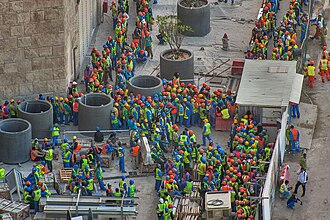 Foreign workers crowding the exit of the Qatar Petroleum District Project in West Bay, Doha. Photo by Alex Sergeev (www.asergeev.com) – asergeev.com, CC BY-SA 3.0, Wikipedia
An in-depth investigation by Israel Hayom by Shachar Kleiman reveals a stark contrast between Qatar’s polished international image and the harsh reality faced by its migrant workforce and political dissidents. Despite global attention following the 2022 FIFA World Cup, systemic exploitation, repression, and human rights violations persist in the Gulf state, driven by the entrenched Kafala (sponsorship) system and a legal framework that prioritizes state and employer control over individual worker’s rights.
Migrant workers constitute approximately 90% of Qatar’s 3.1 million population, forming the backbone of its economy yet living under conditions described as “modern slavery.” Although the government officially abolished the Kafala system in 2020, the current Israel Hayom report details how its abusive practices remain fully operational. This existing system grants employers disproportionate power over its migrant workers, effectively trapping them by making it nearly impossible to change jobs without employer consent. This lack of employment mobility, in turn, leads to widespread salary delays, forced labor, and the inability to protest without fear of arrest or deportation.
The article highlights the testimonies of former residents who have exposed the depth of exploitation in the country. While explaining that a similar system is utilized in other countries in the region, the author details that only in Qatar does it appear that the system is exploited to treat the migrant workers as modern day slaves. For instance, Ahmad Awwadallah, an Egyptian national who lived and worked in Qatar for years, recalls the grueling working conditions, including stretches of three consecutive months without a single day off, even during the COVID-19 pandemic, particularly on projects related to the World Cup infrastructure. Recounting his personal ordeal which came about following a romantic relationship with a U.S. citizen which led to legal entanglement and profound injustices. He explains the breakdown of trust led to him writing a public letter condemning the state’s racism and xenophobia, and addressed to one of its most powerful figures in the country, Sheikha Moza bint Nasser.
Similarly, Hassan Abd al-Sadiq, a Sudanese accountant, relates severe abuses which he experienced while working in Qatar. Despite a contract promising decent accommodation and medical care, he was forced to live in a room used as a garbage collection point, which lacked basic appliances while having to pay for his own medical services. Working 12-hour shifts, six days a week, he was also fined for using his phone. When he dared to file a complaint with the labor office, his residency permit was immediately canceled, and he was escorted to the airport for deportation without any investigation into his claims. His then former employer threatened legal action if he ever returned to the country.
Beyond labor exploitation described above, the report provides exposure of a broader climate of repression in the country. Political opponents and minorities face severe persecution. The case of Remy Rouhani, a prominent Qatari businessman and head of the Bahai community, is cited as he describes being sentenced to five years in prison for social media posts while advocating on behalf of gender equality. He was charged with “casting doubt on the foundations of Islam” and human rights organizations report that Rouhani was denied legal representation. The status of women in Qatar is also severely restricted by guardianship laws, requiring male approval for marriage and other life decisions. The penal code criminalizes sex outside marriage, leading to the imprisonment of a Dutch tourist who was drugged and subsequently raped, but her assault was treated as a moral crime.
The LGBTQ+ community in the country faces extreme danger, as homosexuality is criminalized in the country. The report mentions the arrest of a foreign worker who was lured through a Grindr app, believed to be a police sting operation. Furthermore, the state is supports terrorist groups like Hamas while simultaneously attempting to project itself as a champion of human rights on the international stage, a duality which is highlighted by its failed UN human rights bid of an ambassador who previously made anti-Semitic and homophobic remarks.
The article concludes that despite significant investments in PR and diplomacy, Qatar’s regime operates with brutality and impunity, crushing dissent while exploiting millions of foreign workers. The reforms introduced for the World Cup are described as being both insufficient as well as poorly enforced. This leaves the country with a rising risk of backtracking, something which was demonstrated in the proposal to reinstate exit permit requirements. Human Rights Watch describes the legacy of the World Cup to characterized by thousands of unexplained worker deaths, rampant wage theft, and exorbitant recruitment fees, with no meaningful compensation provided. The message from those who lived through these abuses is clear: the West’s willful blindness has been bought with wealth and influence, providing Qatar with the means in which a system of modern-day slavery flourishes.
As American diplomats, politicians, businessmen, bureaucrats, and more recently social media influencers as well as political commentators, more and more make their way to visiting this modern day metropolis, built and run upon a system employing modern day helots, they return from their visits completely silent on the repressive employment practices while praising the country and its leadership as if none of what is described in this report exists. More than this, the US govt has seen fit to provide the governing regime an umbrella of security while failing to openly demand any reform of these brutal practices. While the Trump administration has acknowledged that it is not responsible for the regimes and immoral practices adopted in foreign lands, it is simultaneously failing to appreciate its complicity in protecting regimes such as Qatar whose practices of repression as described in the Israel Hayom report should gain the disgust and rejection of the US govt.


Leave a Reply
You must be logged in to post a comment.