
by Ahmed Charai • Gatestone Institute • January 5, 2026
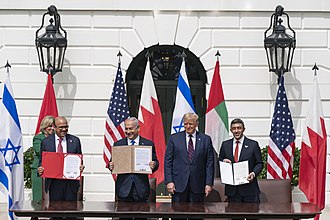 One cannot fight terrorism while empowering regressive Islamist movements that capture governing institutions. One cannot defend the Abraham Accords rhetorically while eroding their foundations in practice. The Abraham Accords can still shape the Middle East’s future, but only if those who benefited from their promise accept the cost of clarity. History will not record intentions. It will record strategic choices. Pictured from left to right: Bahrain Foreign Minister Abdullatif al-Zayani, Israeli Prime Minister Benjamin Netanyahu, US President Donald Trump, and UAE Foreign Minister Abdullah bin Zayed Al-Nahyan participate in the signing of the Abraham Accords in Washington, DC on September 15, 2020. Photo by The White House from Washington, DC, Public Domain, Wikipedia
- The second [challenge to the Abraham Accords] is more insidious. It comes from states that speak the language of counterterrorism while enabling movements tied to the Muslim Brotherhood. They denounce extremism while empowering ideologues inside “legitimate” institutions; they praise stability while tolerating and even sponsoring destabilizing networks under the protection of state recognition.
- For those states supporting violent Islamists, including the Muslim Brotherhood, ambiguity must end. Strategic clarity is not moral theater; it is survival logic. One cannot oppose the Muslim Brotherhood while enabling its advance. One cannot fight terrorism while empowering regressive Islamist movements that capture governing institutions. One cannot defend the Abraham Accords rhetorically while eroding their foundations in practice.
Some media commentators were quick to dismiss Prime Minister Benjamin Netanyahu’s meeting last month with President Donald J. Trump, depicting it as driven by domestic politics, legal pressures, or media optics. But that is a mistake. This meeting comes at a time of profound regional fragility and converging pressures.
On one front lies Iran’s aggressive proxy network, stretching from Gaza to Lebanon, from Yemen across the Red Sea. On the other lies a quieter but no less corrosive danger: the strategic incoherence of actors who present themselves as partners of the United States while sustaining, through action or omission, the ecosystems in which extremism regenerates. This dual pressure — external aggression and internal contradiction — defines the strategic reality confronting Washington and its allies.


Leave a Reply
You must be logged in to post a comment.