
US and UK express opposition to security cabinet decision to expand Israeli control over Judea and Samaria

Peloni:  First, there is no annexation taking place, and the land in question is actually called Judea and Samaria.  Second, the repeal of antisemitic laws should be celebrated by all descent thinking people, and this should include the leadership in the US, even if it can not include those in the British leadership.  It is no wonder that Trump has yet to be so bold as his antisemitic equal in the UK, who personally endorses antisemitic standards as an ultimate good.  Indeed, only rank depravity could find support for the continuation of the antisemitic standards such as Jordan’s Law #40 which were overturned in the Land Reform measures adopted earlier this week.

Statement by British foreign office appears to impose borders of Palestinian state in contradiction to Oslo Accords
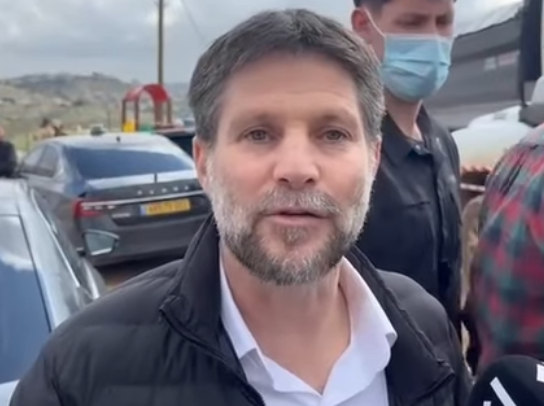
Bezalel Smotrich, Israeli Finance Minister. Screengrab via Youtube https://www.youtube.com/watch?v=3VCVQ726ve0Bezalel Smotrich, Israeli Finance Minister. Screengrab via Youtube 

Following the announcement by Finance Minister Bezalel Smotrich and Defense Minister Israel Katz of moves designed to strengthen Israeli control over Judea and Samaria – known internationally as the West Bank – U.S. and UK authorities issued condemnations on Monday evening.

A White House official on Monday reiterated U.S. President Donald Trump’s opposition to Israel annexing the West Bank, Reuters reported.

“A stable West Bank keeps Israel secure and is in line with this administration’s goal to achieve peace in the region,” the official was quoted as saying.

This statement is in line with previous statements by officials from the administration of President Donald Trump.

In October, Vice President JD Vance expressed opposition to an attempt by the Knesset to impose annexation on parts of Judea and Samaria.

“The West Bank is not going to be annexed by Israel,” Vance said at the time. “The policy of President Trump is that the West Bank will not be annexed. This will always be our policy.”

However, the statement did not directly address the actual measures approved by the security cabinet, which largely involved opening territory in Judea and Samaria to private purchasers. The decisions would allow potential buyers to look up current landowners in registries, and initiate contact regarding purchase offers.

Previously, special licenses were required to buy land in Judea and Samaria, and only companies or other entities were allowed to make real estate purchases. Additionally, a Jordanian-era law, prohibiting the purchase of land in Judea and Samaria by non-Arabs, was repealed.

The British government released an even stronger statement than the U.S. The Foreign, Commonwealth and Development Office (FCDO), “strongly condemned” the security cabinet decision in a statement released on Monday evening.

“The major changes to land, enforcement, and administrative powers proposed in the West Bank will harm efforts to advance peace and stability,” it claimed.

The FCDO statement also said that “any unilateral attempt to alter the geographic or demographic make-up of Palestine is wholly unacceptable and would be inconsistent with international law. We call on Israel to reverse these decisions immediately.”

The declaration of Judea and Samaria as Palestine in the FCDO statement would appear to an unlawful attempt to stipulate the borders of a future Palestinian state. According to the Oslo Accords agreement between Israel and the Palestine Liberation Organization (PLO), the borders of such a state can only be determined by negotiations between Israel and the Palestinians.

“A two-state solution remains the only viable path to long-term peace with a safe and secure Israel living alongside a viable and sovereign Palestine,” the statement concluded.

Earlier Monday, foreign ministers from Jordan, the United Arab Emirates, Indonesia, Pakistan, Turkey, Saudi Arabia, Qatar, and Egypt released a joint statement condemning the security cabinet decision, which they described as “illegal Israeli decisions and measures aimed at imposing unlawful Israeli sovereignty.”

European Union spokesman Anouar El Anouni also criticized the move, calling it “another step in the wrong direction.”

However, Israeli journalist Amit Segal praised the government’s decision to move gradually, and for choosing to tackle the issue of real estate purchases as the next step in extending greater Israeli control over the disputed territories.

Segal said such a move “avoids a dramatic confrontation” over the controversial topic of applying Israeli sovereignty, and at the same time, “makes it harder for international and domestic opposition to coalesce against all of the minor policies.”

“It will be more difficult to mobilize foreign opposition against repealing antisemitic real estate laws than it was to stop the countdown to Netanyahu’s annexation in 2020,” he wrote in a post to social media.


February 11, 2026 | 6 Comments »

Leave a Reply

6 Comments / 6 Comments

  1. When I attended paralegal school in the ’80s, in defining terms, the lawyer-instructor in one course humorously gave as an example of an oxymoron, “Mexican economy.”
    Now that so much of the American economy, such as automobile manufacture, has moved there, I think that illustration is outdated.

    A much better one would be “international law.”

    • is international law a good joke or a bad joke

      Whether international law is a “good joke” (valuable, even if imperfect) or a “bad joke” (useless and hypocritical) is a central debate in international relations, with arguments supporting both perspectives based on context. It is generally seen as a functional, albeit limited, system that operates more as a diplomatic tool than a binding, police-enforced set of rules.
      The “Bad Joke” Argument (Ineffectiveness & Politics)
      Critics often argue that international law is a “bad joke” because it is rarely enforced against powerful nations, making it appear hypocritical or merely political.
      Lack of Enforcement: Unlike domestic law, there is no global police force to compel compliance, meaning states can often violate or withdraw from treaties without serious consequences.
      Power Politics: Powerful nations often ignore international legal rulings when they conflict with national interests, treating them as “cheap talk”.
      Uneven Application: The legal system is often seen as biased, protecting the interests of stronger states while penalizing weaker ones.
      The “Good Joke” Argument (Functionality & Norms)
      Conversely, many argue that calling international law a “joke” ignores its daily, crucial role in global society, making it a “good” or necessary, if flawed, system.
      Daily Functionality: International law underpins essential, everyday activities like international flights, trade agreements, mail, and communication, which are largely followed.
      Norm Setting: Even when broken, international law sets standards of behavior that stigmatize bad actions (such as the use of landmines or torture), making it harder for states to act with total impunity.
      Constraint on Power: While not always preventing conflict, it can force states to justify their actions legally, which can slow down aggression or make it more costly.
      Conclusion
      International law is best described as a hybrid system that is indispensable for cooperation but weak in preventing conflict. It is not a “bad joke” in the sense of being totally useless, but it is often a frustrating one when it fails to prevent massive violations of human rights or, as some argue, a “good joke” that provides a framework for humanity to aspire to, even if that aspiration is often unfulfilled.

      – AI Overview

        • On September 6, 1970, Captain Uri Bar-Lev was preparing to pilot an El Al plane full of passengers from Amsterdam to New York. It was the second leg of a trip that started in Tel Aviv.

          Just before takeoff, a security officer at Schiphol airport told him that there were four passengers who seemed suspicious: two had Senegalese passports that contained consecutive numbers, and the other two had Honduran passports. All of these passengers booked their tickets right before the flight.

          Bar-Lev made sure the Senegalese passengers couldn’t board, and asked for a thorough security check of the other two passengers – but, unbeknownst to him, it never happened.

          He thought that when the “Hondurans” boarded the plane that they were cleared. But just to be safe, he asked a security officer, Avihu Kol, to accompany him to the cockpit instead of sitting in first class. There had been many hijackings on different flights lately, and Bar-Lev didn’t want to take any chances. El Al was the only airline to have security officers on their planes; this rule was instated after an El Al flight to Algeria had been hijacked in 1968.

          As the flight was climbing at 29,000 feet, the emergency light went on in the cockpit. Bar-Lev knew right away that the plane was being hijacked and that the “Hondurans” were responsible.

          A flight attendant announced on the intercom that two people with guns and grenades wanted to get into the cockpit, and if they couldn’t, they would kill everyone on board. When flight engineer Uri Zach looked through the peephole, he saw a hijacker holding a gun to a flight attendant’s head.

          The hijacker was Patrick Argüello, who was part of the Popular Front for the Liberation of Palestine and a Nicaraguan-American Sandinista supporter. The flight attendant said Argüello was going to kill her if Bar-Lev didn’t open up the cockpit and let him and the other hijacker inside, Leila Khaled.

          Bar-Lev had to think quickly. El Al had trained its pilots to give into the hijackers’ demands instead of trying to be a “hero.” A crewmember urged Bar-Lev to let the hijackers in.

          But Bar-Lev, who was a teenaged pilot in the 1948 War for Independence and served in the 1956 war, knew he couldn’t do that. If he did, they might kill everyone on board. He announced: “They will not hijack my plane.”

          He then made a move like the “Split S” combat maneuver used during World War II, initiating a nose dive. This would knock the hijackers off their feet and protect the passengers who were strapped in. This dive would also ensure that a grenade explosion or bullet would not be as dangerous. The plane dove 10,000 feet in just one minute. The hijackers were thrown to the ground. When Bar-Lev completed the dive, Kol quickly killed Argüello.

          Leila Khaled, a Palestinian who had hijacked other planes, rolled out a grenade down the aisle but it didn’t go off. She passed out and was arrested by British authorities. (She was released a month later in exchange for hostages who were taken in another hijacking.) The whole incident happened in two and a half minutes.

          Read the full article: https://aish.com/the-only-pilot-to-thwart-a-hijacking-29000-feet-in-the-air/

          https://m.facebook.com/story.php?story_fbid=pfbid037BV8VYKJyDaPxKW8833XEpMCG3YTTq5du81VWMB4TykNmMsP5YUGCnjKgRQEwd29l&id=100064679741770

          • Where is Leila Khaled now

            As of early 2026, Leila Khaled, now in her 80s, resides in Amman, Jordan. She remains an active member of the Popular Front for the Liberation of Palestine (PFLP), frequently participating in international conferences and continuing her advocacy for Palestinian liberation, particularly focusing on the right of return.
            Key Details
            Location: Amman, Jordan.
            Current Status: She is a member of the PFLP’s Central Committee and Political Bureau, holding positions she has maintained for decades.
            Activity: Despite her age, she continues to travel and speak on behalf of the Palestinian struggle.
            Family: She lived with her husband, physician Fayez Rashid (who passed away around 2023), and their two sons in Amman.
            Recent reports from late 2024 and early 2025 confirmed her continued involvement in political activism and international solidarity movements.

            AI Overview

            • “Leila Khaled helped murder my fellow pilgrims”

              Tony Larroy | 27 November 2024
              Tony Larroy, a survivor of Lod Airport massacre, appeals to ANC not to honour those responsible for killing his girlfriend, 20, in 1972

              Dear City Manager of Johannesburg, Floyd Brink,
              My name is Juan Antonio Larroy Rodrfguez, also known as Tony Larroy, and I am 80 years old. 1 come from Arecibo, Puerto Rico, and I am a Christian. I am also a survivor of the Lod Airport massacre, a day that changed my life forever. Seventeen of my countrymen, including my girlfriend, were killed that day. Leila Khaled had a hand in that tragedy, and l’m writing to make sure you know the truth about what she did.
              I recently heard through international news that the Johannesburg City Council is considering renaming Sandton Drive to Leila Khaled Drive. l’ve never been to South Africa, but I believe my story-so personal and painful to all Puerto Ricans-matters and should be considered in your discussions. 1 hope sharing this with you will help guide your decision.
              Leila Khaled is known around the world as a high-ranking member of the Popular Front for the Liberation of Palestine (PFLP). Between 1969 and 1972, she played a direct role in planning violent attacks, including hijacking planes like TWA Flight 840 and EI Al Flight 219. During the EI Al hijacking, her hijacking partner, Patrick Argüello, was killed, but thankfully, the passengers survived.

              While these facts are public knowledge, I want to share what Leila Khaled’s actions did to me and my family personally.
              As I mentioned, l’m a Christian, and on May 30th, 1972, I arrived in Israel on a pilgrimage with a group from Puerto Rico, including my girlfriend, Carmen Crespo. We had traveled so far to walk where Jesus once walked, to see the holy sites we had only read about in the Bible. lt was our first time visiting the Holy Land.
              When we landed at Lod Airport, we joined other passengers in the arrivals hall. Around 200 people were there – travellers from other flights and people picking up loved ones. Some were at baggage claim. Back then, airports weren’t like they are today; there wasn’t much security, and no one was checking bags thoroughly.
              Then, out of nowhere, gunfire erupted. Three men with machine guns were shooting at everyone in sight. They were also throwing grenades. We later found out they had smuggled the weapons in their luggage.

              I was shot in the leg. lt was terrifying, but I was lucky-the bullet didn’t go deep. Pastor Jose Vega-Franqui, who was in our group, only survived because the bullets hit the Bible he was carrying. But my girlfriend, Carmen, wasn’t as fortunate. She was standing next to me when she was shot several times, including once in the head. She died instantly. She was only 20 years old.
              All around me, people were lying on the ground, injured or dead. Blood was everywhere-on the floors, on the luggage. lt was a nightmare that l’ve carried with me every day since.
              That day, 26 people were killed – 17 of them were from our Puerto Rican pilgrimage group, 8 were Israelis, and 1 was Canadian. More than 80 others were injured. The loss was devastating for our families and our entire community. The 30th of May is now a national Memorial Day in Puerto Rico to honor those we lost.
              The attack was organized by Leila Khaled’s group, the PFLP. They trained and sent the three attackers. Khaled herself took part in a propaganda film, Red Army/PFLP: Declaration of World War, which was used to help recruit the men who carried out the massacre. The PFLP claimed that the attack was in honour of Patrick Argüell. They still celebrate this horrific event to this day. When one of the terrorists involved in supporting the attack were released from prison, Khaled personally phoned them to congratulate them. When asked why they killed innocent Puerto Rican pilgrims, the PFLP said we weren’t innocent and that visiting Israel for tourism was “siding with the enemy.”

              This is a lie. We weren’t soldiers. We weren’t there to take sides in any conflict. We were on a pilgrimage to the Holy Land for religious reasons, to walk in peace, not to harm anyone.
              We didn’t deserve to be murdered. We only wish for peace to come to all the people of that blessed land.
              South Africa is known around the world as a country that stands for freedom, democracy, and human rights. lt would be a tragedy if such a legacy were tarnished by having the name of Leila Khaled darken its streets. Like South Africa, Puerto Rico has suffered from war, colonization, and struggles for justice. But naming a road after someone with the blood of innocent people on their hands doesn’t help build peace, unity or justice for any country.
              For us, the survivors of the Lod massacre, and for all Puerto Ricans, the idea of honoring Khaled in this way is painful beyond words. No country in the world has ever built a monument to her. lt’s hard to believe this is even being considered in Johannesburg. lf this renaming happens, 1 fear it will create a lasting wound between our two nations. There are so many South Africans who have fought bravely for real justice and freedom. 1 beg you not to cheapen their struggle by honoring Leila Khaled.
              l’m submitting this letter as my official comment for your deliberations. 1 also want to acknowledge those who helped me, as a Spanish speaker, translate this letter into English. 1 have sent a copy to the Jewish community in Puerto Rico to make them aware of my stance.
              May God bless you, and may peace be upon you from Puerto Rico.
              Signed
              Tony Larroy

              https://www.politicsweb.co.za/documents/leila-khaled-helped-murder-my-fellow-pilgrims#google_vignette