
Peloni: J.E. Dyer offers an important context in the below analysis. Pay particular attention to the section beginning just above her comments regarding Spencer’s article. Restoring balance between Shia and Sunni while returning control of Iraq to the Iraqis would be an important part of the potential benefits which can be leveraged in this historic moment which should also include offering the people of Iran their moment to take back control over their own lives and destinies.
Listen with your ears.
J.E. Dyer, a retired Naval Intelligence officer, blogs as The Optimistic Conservative, February 24, 2026
 Feature image: The rabbit’s going down. Only a remnant remains of the regime that mobilizes children to shout death threats. (That turn at Albuquerque will get you every time. Twitter, @fpleitgenCNN video)
[There’s so much noise out there it can be hard to make the data cutoff and just post already. In my judgment there are good grounds for hearing the sound of info ops in the mash-up of data points that seem to have aircraft carriers popping up hither and yon like giggling gremlins, and Trump’s senior military officers – who brought off a flawless action recently in Venezuela – suddenly afraid of Iran, calendars, and stopped-up toilets. Never has a nation’s government seemed to play so dead during a military build-up. “Yes, we keep bringing in more and more to the theater, but we think this is a really bad idea!” Listen with your ears, folks. It doesn’t parse. – J.E.]
This is a somewhat odd communication from the Chief of Naval Operations, Admiral Daryl Caudle, reported from a group session with selected media representatives in January 2026.
The report-out is from The War Zone on 14 January 2026. During the session, ADM Caudle apparently complained about the potential for extension of USS Gerald R Ford’s (CVN-78) deployment, a deployment that began in June 2025 and so far has taken the carrier to the Eastern hemisphere and the Caribbean, via a double-back transit in October. Ford had been deployed for nearly eight months; the admiral expressed his concern to the reporters at the annual symposium of the Surface Navy Association (held in Crystal City 13-15 February 2026).
What strikes me as odd, seeing his comments for the first time in retrospect, is that he spoke bluntly of “push back” against the president’s tasking, should it involve a deployment extension for Ford.
According to TWZ: “‘I think the Ford, from its capability perspective, would be an invaluable option for any military thing the president wants to do,’ Caudle explained. ‘But if it requires an extension, it’s going to get some push back from the CNO. And I will see if there is something else I can do.’”
Huh. Caudle reportedly doubled down: “‘The fact that the Ford is currently operating in the Southern Command’s area of operations is fine with me,’ Caudle posited. ‘It is the extensions that bother.’”
It’s a relief that the president’s tasking is fine with the admiral. It’s a bit curious, however, that Caudle felt quite so free to put matters in the terms he did. His disquisition on the rigors of planned maintenance schedules seems to have been rather lengthy, coming off with a “tales out of school” tone that hasn’t been characteristic of the tight-lipped, comms-disciplined Trump 47 Department of War. The CNO’s job is indeed to stay on top of such problems, bringing them to the attention of his DOW chain of command. But jawing about them to reporters hasn’t typically been part of that deal.
There’s more. It stands out to me, both as a peculiar way for a CNO to talk at any time (“POTUS’s ops tasking is interfering with my maintenance schedule, and I’m not taking that lying down” – seriously?), and as a public statement from an officer working for Trump and Hegseth. It’s not a “leak.” It’s a straightforward, on-the-record public complaint that doesn’t have the sound of military discipline.
But it doesn’t seem to have bothered anyone. It arguably spilled some beans on weak links in maintenance for the fleet, sending a signal about vulnerability to adversaries (China, Russia, Iran). It makes the U.S. Navy sound mismanaged, to a taxpaying public and those same adversaries.
It was rolled out in such an unqualified manner, and with no walk-back I can find, that my first thought is that it had to be an info op. The CNO spoke these words at exactly the same time the new tasking for USS Abraham Lincoln (CVN-72) was announced in January, rerouting Lincoln from the South China Sea to CENTCOM. With context included, it looks more like the DOW was building a narrative that Lincoln might be heading for CENTCOM, but it would be a real stretch, in the short run, for the Navy to send much more than that one strike group.
The reported confirmation of a massive toilet back-up on Ford, which was most recently reported off Souda Bay, Crete (Greece) on 23 February, has added a general air of festive merriment to the info atmosphere. It’s not clear what’s going on, but info-incontinence seems to be the order of the day. Images of Ford near Gibraltar, Crete and Haifa have been circulating on social media, and it appears to all be in good fun. I’m waiting to see photos with port-a-johns in the hangar bay. The picture of a brokedown USS Gerald R Ford is unmistakable, but if we’re putting out such a narrative, it’s not from haplessness but from purpose.
That message would shape Iran’s expectation’s to be optimistic for the regime’s interests (and commensurately pessimistic for ours). The timing of Admiral Caudle’s declarations – 13 January – is as noteworthy as anything else: obviously, the re-tasking of Lincoln, reported on 13 January, would cue such a discussion with the CNO, but Ford’s subsequent activities are interesting as well. Ford headed afterward to a port visit in St. Thomas, Virgin Islands, which took place 21-26 January. On 26 January 2026, a single (and in my view questionable) automated update from Ford appeared to put the carrier south of St. Thomas and heading toward Venezuela.
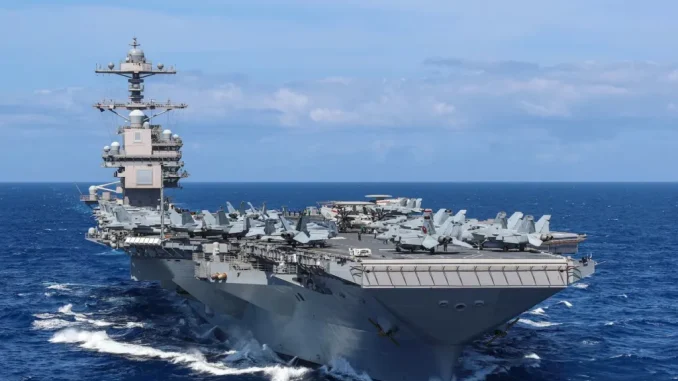 USS Gerald R Ford (CVN-78) set to depart for an earlier deployment in 2022. USN image.
Since then, Ford appears to have taken a leisurely stroll to the Strait of Gibraltar, where signs indicated the carrier entered the Mediterranean on 19 February. That arrival date was a good two weeks longer than it had to take if Ford got her tasking around the time she left St. Thomas. But Ford wasn’t seen or heard from anywhere in the Caribbean after departing port on 26 January, so it’s a reasonable question where she was between that date and 19 February
There were prior signs that Ford arrived outside the STROG a couple of days earlier than 19 February, and it was unclear to me why she waited to enter the Med. It’s possible she was waiting on other Navy ships to catch up, though that too is a bit hazy, as Ford’s air defense Aegis escort was presumably with her all the way across the Atlantic. That and the oiler were the ships that had to be with Ford. It wouldn’t have been particularly important for anyone else in the group to pass through the strait at the same time.
One possibility is that a single replenishment oiler is presumably servicing everyone, and Ford and her escort wouldn’t dart forward with the oiler until everyone had had a drink after the Atlantic crossing.
At any rate, the Big Clue about Ford going through the strait was an AIS signal from an escort warship in the STROG on 19 February. Understandably, OSINT trackers jumped right on that.
Before proceeding, I want to re-up my sense from the Abraham Lincoln transit in January that Lincoln may have never gone through the Strait of Malacca. A set of supposed AIS emissions, purporting to be from Lincoln and escorts, seemed to show CVN-72 moving into the southern Strait on 18 January, in company with escorts, and emerging to the north on the 19th. But no reporting indicated Lincoln was actually seen in the Strait.
Besides the carrier being hard to miss among the SOM traffic, there’s the celebrity aspect of an aircraft carrier transit, especially one that the whole world is expecting. Avocational ship-watchers get out with their cameras and wait, looking for carriers from the U.S., India, and the UK, and taking note of Chinese and Japanese and South Korean naval task units headed to and from the Horn of Africa. At a time when the U.S. Navy’s move of Lincoln to CENTCOM was front-page news in Indonesia, Singapore, and Malaysia, it’s unlikely that Lincoln transited the SOM without being seen or informally reported, with happy snaps.
Ships can bypass Malacca by going through straits in the Indonesian archipelago further south. As with Ford in the Caribbean, the last actual visually confirmed location of Lincoln in the South China Sea was on 8 January 2026, days before the re-tasking to CENTCOM was announced. There’s no way to confirm this proposition, but it’s possible that Lincoln, which wasn’t observed visually at all along the transit route indicated by her supposed AIS transmissions, went south sometime earlier than 13 January and quietly moved in a darkened nighttime transit through a strait other than Malacca.
I wouldn’t insist on that as what happened. But it could have, and it’s made more likely by the lack of detection in the SOM.
It is quite noteworthy how much lower an operational profile our Navy warships have kept during both Trump administrations, as opposed to the Biden and Obama years. It’s not actually normal for U.S. warships to put out AIS emissions making it clear where they are – even using the relative anonymity of generic designations like “US Government.” Internet sleuths bit down hard on the info-deficient updates appearing to be from U.S. Navy combatants in relation to the Lincoln transit, but all it looked like to me was weird, uncharacteristic manifestations seemingly designed to create a transit narrative, which probably wasn’t what was actually happening.
The Trump-Hegseth Department of War is using all its tools for shaping the strategic and operational battlespace, with better comms discipline than we saw from the military in the Biden and Obama years. (That’s a good thing.)
We have every reason to expect a much lower incidence of “leaks,” and a more intentionally managed and operationally advantageous “information” picture, than the previous Democratic administrations achieved. If they’re doing it right, we should expect in-transit “updates” on our aircraft carriers to support our narrative of national purpose, rather than being inconvenient to it.
That’s something to keep in mind as we see an Air Force major from CENTCOM’s Air Force command (AFCENT) seeming to complain about “Twitter randos” tracking military platforms like warplanes and warships and posting updates on them. Ponder who’s got the jump on whom, here.
If Twitter randos are participating unwittingly in an info op being run by DOW, are military spokespeople going to encourage the Rando Commandos with public affirmation and complaint? You bet they are.
And sending a female officer to look peeved about it is a stroke of genius. It’s an epic nod to confirmation bias for the mostly-male Twitter rando contingent and its followers. Always keep in mind, this is the Hegseth/Caine War Department. They’re not being whipsawed by “DEI” officers speaking for them. They maintain tight comms discipline (as they should). Girlfriend would know better than to “complain” publicly, just as Admiral Caudle would. Notice that neither one has been yanked for making the military look weak, lame, and lazy.
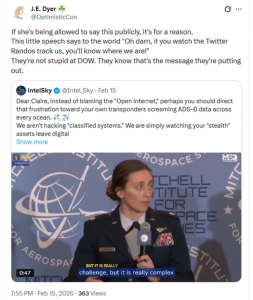 Major Claire Randolph says her piece. Link in text.
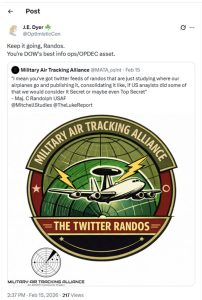
If military spokespeople are talking about this publicly at all, it’s because the military wants to draw attention to it for a DOW info purpose. It’s not to complain because it’s a vulnerability. It’s much more likely to be because it’s serving DOW’s purpose of shaping the battlespace by creating a narrative that’s to our advantage. The Twitter randos then amplify it.
So we’ll see. Assuming the depiction of Ford’s transit is on the up-and-up, the next hard wicket is the Suez Canal. (Incidentally, the Ford passage through the STROG fits reasonably well, though I noted on seeing the first image posted of the actual strait transit that it looked wrong. The carrier was headed the wrong direction relative to the Gibraltar seawall. Ford made the passage the other way back in October, and my guess was that the image first posted on 19 February was from that event. In the days since, a very brief phone video has surfaced seeming to show Ford in the STROG. It honestly isn’t much more convincing as contemporary than the first image, but the BBC and other major media outlets appear to vouch for it.)
The likelihood of Ford being observed in the Med as she transits east is also high (see above). I’ve seen reports that we’re considering keeping her in EastMed rather than sending her through the Canal to CENTCOM, which would obviate a Suez transit. (And Ford has been reported since that last sentence as being in Souda Bay in Crete. There’s the big story about backed-up toilets, which I wouldn’t say lacks a foundation of truth, but which may explain the appearance of multiple tasks being undertaken while Ford is pierside.)
What lies ahead?
The last point brings us to the larger purpose of this article, which is to lay out some thoughts on what we could be preparing to do. It looks like the amount of supplies and materiel staged so far is well in excess of a brief bombing campaign limited to hitting some ballistic missile facilities in Iran, and perhaps some regime and IRGC command targets.
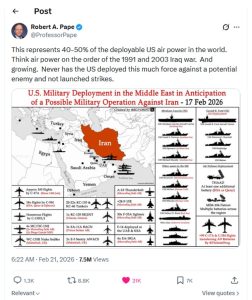 Update from University of Chicago Professor Robert A. Pape as of 17 February. Link to post at X.
 Graphic credit: Robert A. Pape. Click to enlarge for legibility. See original X post here.
I’ve alluded to some of that in X posts. John Spencer, an Army War College instructor who’s an excellent commentator on military affairs, wrote an op-ed for the Miryam Institute this past week which I recommend, and to which I responded a few days ago in the separate forum I sometimes allude to.
I’m copying below (with a few edits) the response I made to the Spencer article. It’s a brief and rough summary of thoughts, but I’m not going clean it up or expand on it much further. It’s more important to get it out there as a thinking aid.
The key reason for that is that it’s not a “war” the Trump administration has in mind. Iran can’t even fight a war with the U.S. A war is not what would happen if we mounted a set of focused raiding operations, including both strikes and short-lived, small-footprint operations on the ground.
Iran can’t fight a war. It’s important to get that clear in your mind, because it governs everything else. Iran can’t fight a war with the U.S. Iran’s dictators can only hope a U.S. operation ends quickly, and can be ended without the regime having to surrender and depart.
My comments:
Spencer is always very good and he is here. But we need to give a sense of how very large the military movements are in scale and implication, and what resonates as the intended operations profile.
I don’t think it’s all about Iran’s military programs. I think we have to look at what Trump did with Venezuela: change the whole controlling dynamic of a global situation by removing Maduro and thwarting the drug trade. The op to do that was huge, relative to what people had imagined. The significance of the purpose justified it, even though it seemed like a small objective.
The US DOW went in with the formal purpose of shutting down the standard profile of the cartel drug trade to our south. Even Maduro’s removal was made on that basis: as an arrest for wielding the drug trade as an attack on the US and a form of terrorism. But the ensuing reverberations have disrupted the arrangements of China, Russia, and Iran in both their own hemisphere and ours.
Trump doesn’t think small. He appoints advisors to do that. If you look at everything he could potentially do “in Iran” (or “about Iran”), he had it all in motion at least 5 weeks ago well before the airlift “buildup” began. Few recall now that in mid-January, he put three civil ops units, all of which deploy with Army Airborne formations (two from Ft Bragg, one from Alaska), on alert for possible deployment to Minnesota. They never went to Minnesota. But they were put on alert. That was at the same time ABE was being re-tasked from INDOPACOM to CENTCOM.
If I had to guess what all the massive number of C-17 airlift flights have been for, I’d stick with my original gut on that. The support for an airborne op has been moved into theater. I don’t think it’s even (much) about Iran. I think it’s about Iraq. Iran minus Iraq is imprisoned by a disadvantageous force posture for its ballistic missile and drone ops.
At the very same time the Trump administration started its other preps (early January), it entirely pulled out the vulnerable US forces at Al-Assad air base in Anbar. They’d be too hard to defend if there’s a beat-down on the militias. Which there would probably have to be, because Iran won’t surrender the militias easily, and they don’t want to lose their privilege with the intimidated Iraqi government.
[Note (addendum): Much of the force grouping from Al-Assad was moved to Al-Harir near Erbil in northern Iraq. That includes elements of the 101st Airborne, which arrived from Anbar the first week of January. See below for discussion of that as Kurdish-dominated territory. – J.E.]
If Trump doesn’t intend to eradicate the militia option in Iraq for the Iranian regime, he’s making a pretty good false show of it.
Another use of an airborne raid would be seizing the uranium storage sites in Iran and extracting the uranium ourselves, rather than waiting for Iran to start pretending to do it. Can we hold the sites, dominating the threat envelope around them, long enough to do that? Yes. (It’s mainly Natanz and Isfahan. The actual uranium at Fordow is still inaccessible.)
[Note (addendum): this is a bigger flyer than other potential operational goals. It would take longer and require substantially more of us than any other goal. But I’m including it because it would directly address one of our top concerns, and it is within our power to do. – J.E.]
We’d need the combined capabilities of ground-support strike-fighters, short-range air/missile defense, airborne units, combat engineers, airlift, and special forces (Delta Force, SEALs, Air Force super-special Red Horse task units that secure and prepare or repair locations for whatever landing and takeoff needs might arise, and then snatch it all up and vanish). We have the advantage of watching Iran rebuild makeshift protection for its highest-value facilities since June 2025. We have a good idea where things are.
We could do other things like gently smack some heads in Riyadh and Dubai and get KSA and UAE to collaborate on relieving Yemen of the Houthis. We could use a few moves to enable the Kurds as a force to make common cause in Syria, Iraq, and Iran. ISIS has to be stifled, and Turkey shouldered aside.
And, of course, we could dominate the info and electronic warfare environment in Iran so the regime goes in terror and the people are emboldened and empowered. We don’t have to usurp the Iranian people in changing their own regime. They can do it themselves if we impose enough disadvantage on the regime. Arming the people, on a responsible basis, wouldn’t come amiss. But there has to be vision for a purpose, not just an unleashing of crossfire.
BTW, we have a big stock of prepositioned equipment in Kuwait. Several thousand troops there in a theater reserve (in total we have about 13,500 troops in Kuwait, comprising the reserve and a logistics hub). We also have prepo in Israel. We could deliver armed Marines flown in from stateside, even without an amphibious shipping task force.
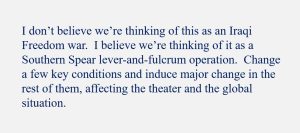
I don’t believe we’re thinking of this as an Iraqi Freedom war. I believe we’re thinking of it as a Southern Spear lever-and-fulcrum operation. Change a few key conditions and induce major change in the rest of them, affecting the theater and the global situation.
It’s amazing how many conditions will evaporate just from smacking down the proxy militias in Iraq, removing the uranium, and bombing the ballistic missile infrastructure to bits. Imagine that: just what Rubio’s been shopping to the mullahs as our requirements.
[End comments]
Adding to this, I think we’d let Israel take care of most of the destruction of ballistic-missile producing infrastructure in Iran, and the extant missile and launcher inventory. Israel would likewise deal with threats to Israel arising from Syria, Lebanon, and Gaza. For missile and drone defense of Israel, U.S. assets (e.g., Aegis offshore and Patriot) would contribute support as usual. Israel would also need, as we would, to suppress and eliminate air defense assets in Iran.
Something we don’t think much about, but which is a real concern, is the ability of the Iraqi PMFs to launch missiles and drones supplied by Iran from Iraq, against Israel as well as against U.S. forces in Iraq. Working with the Kurds in northern Iraq and Syria is an important element of shaping the PMFs’ battlespace to inhibit, contain, and squelch their operational latitude used on behalf of Iran.
The U.S. force profile in the north, in Erbil and nearby locations, is the military force that remains the most potentially vulnerable. Besides the base build-up at Al-Harir, we opened a much-expanded U.S. consulate compound in Erbil in December 2025. So there are U.S. interests to guard, in an area not far from where Iran was building missile storage inside Iraq starting about 10 years ago (apologies for the missing maps at the link).
This level of Iranian penetration of Iraq is something the U.S. could significantly degrade in a few days of bombing, especially in conjunction with the local Kurds. Dealing with local Iraqis as the PMFs are picked off is something the civil ops units referenced above would be ideal for. I think we would work all this through cooperative officials in Iraq, not cruising the countryside trying to “own” the project ourselves. But it would knock the supports out from under the PMFs.
And the payoff from killing the Iran-backed PMF model would be exceptionally high. It would remove the condition that makes Iraqi governments in Baghdad beholden to the regime in Iran. Cutting that cord would transform the dynamics of radical Shiism in the two nations, weakening the Iranian regime’s overall footing and opening the way to restore balance in Sunni and Shia influences in Iraq. While Iranians marched toward a new government of their choosing, Iraq’s 95-year-old Ayatollah Ali Sistani could spend his final years being once again (as he was before 2014 or so) an Iran-skeptical curmudgeon.
The outcome we and the world need
These are some thoughts to stimulate pondering and discussion. It appears we are going to act sooner rather than later, and that’s a good thing. We will not be embroiled in a quagmire in Iran. Trump and Hegseth have shown they can and will do better than that.
We can achieve quite a bit, in a short time, that will knock down existing conditions with reverberation – if we follow through, rather than letting the Iranian regime make a deal in the middle of it.
The worst position we could end up in is having the mullahs as our “partner” in some supposedly stabilizing deal. They have to go, if we get this started. We cannot spend the next few years in the position of guaranteeing the vile, bloodthirsty Iranian regime’s continuation, if it demonstrates “good behavior.”
The appalling dysfunction of that is almost inexpressible. It would be an utter distortion of what the United States is about. Drive them out, or talk them out. They’re a terrorist regime that has killed far too many Americans, as well as its own people.
No putting America on the hook for their preservation in power. We’re past any window for that now. President Trump: Don’t do it. This one needs its end-state to be an access of transformative moral relief. This one has to do what only America can do. This one, we have to win.
Toe tag
Coda: Keir Starmer’s UK is losing the battle with itself over how to handle Diego Garcia, and late last week told the U.S. we won’t be allowed to use it for operations against Iran. I’m sure Trump won’t act stupidly about this, as a former POTUS-in-Chief would have put it. But there’s an overriding strategic imperative that needs serving, aside from any connection with Iran, and now looks like the time to serve it.
The U.S. can’t leave these prizes unclaimed in a bin, not even for old loyalties’ sake. If Starmer won’t do the right thing in Diego Garcia, we must. The proximate muscle movement at issue is the UK’s attempt to turn over control of the Chagos Islands, which include Diego Garcia, to Mauritius, an island nation off Africa just east of Madagascar. The UK gets a 99-year lease on Diego Garcia out of it, and has promised that U.S. use of the island can continue uninterrupted.
In the big picture, the U.S. would benefit from stepping in, negotiating our own deal with Mauritius, and having Mauritius explain to London that the UK deal is off the table. This approach would give us a special relationship with Mauritius and control of the Chagos Islands, both of which are what we need in the project of countering China in the Indian Ocean and Oceania. ([Note: see update below.] The UK’s lingering claim to the Chagos Islands would be best adjusted with the already-proposed turnover to Mauritius. If Starmer really wants to dispute our negotiation of something his government was prepared to relinquish anyway, good luck with that. The Complaints window is down the hall.)
Monetary benefits for Mauritius would no doubt be involved. We can afford it. We’re a way better partner than CCP-China in anything, and it’s better for everyone if we put down a stake in both Mauritius and the Chagos chain.
We could then allow the UK continued access to Diego Garcia, but not be under any potential veto from London on our use of it.
Merely advising Starmer quietly of our intention would probably cause a flurry of retreat – disguised, of course, as a 24-hour principled stand against Trump’s high-handedness – and turn ultimately into the outcome we want, with some face-saving measure for our cousins across the pond. They have a lot of things to work out right now. Their domestic roadwork shouldn’t be orange cones blocking our access to Diego Garcia.
Update (Monday night, 23 February): Chagossian leader informs U.S. via video and X post that his (admittedly few) constituents in the Chagos Islands are very much in favor of the U.S. using Diego Garcia for air ops targeting Iran.
Misley Mandarin is part of a movement to repopulate the Chagos Islands and styles himself the First Minister of the returning population. His group, which appears to seek its own Chagossian accommodation to guarantee the future of the islands, rather than a deal made by the UK with Mauritius, reentered the islands just days ago after a judge blocked an order to remove the Chagossians. The whole situation seems to be up in the air, but susceptible to a quick resolution if we faint not.
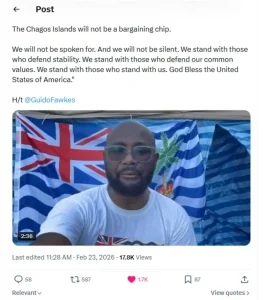 An option emerges. See here for the original X post with transcript.
I had understood the Chagos to be uninhabited at the time the UK took control of them. But inhabiting them to serve the right patron’s purpose is never out of style.
Never a dull moment. Anecdotal history, as opposed to canned outcomes written by bureaucrats, makes a return.


Very much more interesting than Qatarlson’s visit to Ben Gurion. This looks much more like a chessboard.
I agree.