
Peloni: The Iranian people will of course have the final word on who leads them post-Khamenei, but the push should be to have Pahlavi lead his nation towards a better tomorrow, in either a short term or long term position of leadership in Iran. I think this article gives some good background info on some of the more obscure forces and leaders which will be pushing to take Khamenei’s place.
| All Israel News | Published: March 1, 2026
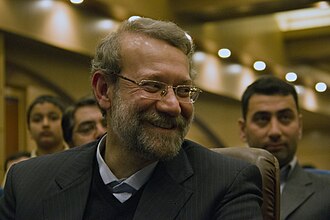 Ali Larijani is an Iranian philosopher, conservative politician and the current chairman of the Parliament of Iran. Larijani was the Secretary of the Supreme National Security Council from 15 August 2005 to 20 October 2007, appointed to the position by President Mahmoud Ahmadinejad, replacing Hassan Rouhani. Photo by Mostafameraji – Own work, CC BY-SA 4.0, Wikipedia
After almost half a century at the helm of the Islamic regime in Iran, including 36 years as the Supreme Leader, Ali Khamenei was killed by an Israeli airstrike on February 28, 2026. Several potential successors were eliminated as well.
The situation is still highly fluid but essentially boils down to two questions: Who will be the next leader of the Islamic Republic; and will its regime even survive?
With this in mind, we will take a look at some of the potential candidates to lead Iran in the future – including those from within the regime, and those hoping to return to Iran if the Islamic regime is indeed completely destroyed by U.S. and Israeli forces.
Regime figures
Days before the war, a New York Times report cited Vali Nasr, an expert on Iran, who said Khamenei was “expecting to be a martyr.” The report added that the ayatollah had personally appointed four layers of succession for the senior military commanders, and designated a small circle of confidantes with the power to make decisions in certain fields should he be cut off from communications or be killed.
Last year, he also reportedly named three candidates who could succeed him, though this list was never published, and it is uncertain that his orders will be obeyed after his death.
In addition, Iran’s leadership reportedly prepared three candidates who could become Iran’s “Delcy Rodriguez,” meaning a leader able to be seen as “pragmatic” during a period of transition and (involuntary) engagement with the West. The report named the chief of the National Security Council, Ali Larijani; Speaker of Parliament, Gen. Bagher Ghalibaf; and former President Hassan Rouhani.
On Sunday, March 1, Iranian President Masoud Pezeshkian announced that a temporary leadership council was formed to assume the supreme leader’s duties until a successor is elected, as per Article 111 of Iran’s Constitution. It will consist of Pezeshkian; the chief justice of the Supreme Court, Gholam-Hossein Mohseni-Ejei; and the senior cleric, Ayatollah Alireza Arafi.
However, the chaotic situation with Khamenei’s assassination coming at the start of a potentially protracted war makes it less likely that the constitutional procedures to elect a senior cleric – like Ayatollah Arafi – as the new Supreme Leader, will be followed.
In fact, soon after Khamenei’s death, reports suggested that the Revolutionary Guard Corps (IRGC) was already pushing to quickly replace him outside of the legally prescribed procedures, arguing that the massive, ongoing airstrikes made it impossible to convene the Assembly of Experts responsible for the selection.
Ali Larijani
In recent weeks, several reports have suggested that the country’s true leader these past months has not been the ayatollah, anyway, but Ali Larijani, making him a prime candidate to either shepherd the transition or take power himself.
Over his long career, Larijani held numerous key political and military roles, including senior IRGC officer. He is currently the country’s top national security chief and was reportedly the main official responsible for the extraordinarily bloody crackdown against the recent protest wave.
Since then, he reportedly led efforts to prevent new outbreaks of dissent; conducted shuttle diplomacy with Russia, Qatar, and Oman; oversaw the failed nuclear talks; and led preparations for war with the United States.
Larijani also comes from a powerful clerical family, with his younger brother, Sadeq Larijani, even being named as a possible successor to Khamenei in the past.
Generals
According to CIA assessments ahead of the war, Khamenei would likely be replaced by a hardline leader from within the IRGC, two sources told Reuters. Purely based on his status as the new leader of the IRGC, Gen. Ahmad Vahidi could be a possible candidate to take power.
One possible version of this scenario is that a figure with broad influence over the IRGC could claim power and transition the country either into a military dictatorship or a hybrid system combining republican, nationalistic, and Islamist elements, somewhat similar to today’s Pakistan.
The Revolutionary Guards have long served as Khamenei’s central tool for exercising his vast power.
The son
According to Saeid Golkar, Iran expert at United Against Nuclear Iran (UANI), “The Islamic Republic today functions as a theocratic security regime organized around Ayatollah Ali Khamenei and his family. Power is structured in concentric circles… Immediately surrounding this core is the Beit-e Rahbari, or Office of the Supreme Leader,” which Golkar says is “a vast and opaque parallel state that sits above the constitution, parliament, and presidency.”
“Khamenei governs through trusted individuals embedded across the state. The Beit also serves as the primary channel through which Khamenei’s family, particularly his sons, exercises influence, turning it into both an institutional and familial center of authority.”
This would automatically put Khamenei’s sons in a prime position to take their father’s mantle. Fifty-five-year-old Mojtaba Khamenei has reportedly long been a power broker in the inner circle of the regime and has close personal connections to several key figures within the IRGC.
A mid-ranking cleric, he could theoretically either be nominated as the clerical Supreme Leader or take power as a strongman, basing his support on the IRGC – somewhat like his father, who also didn’t have the necessary religious qualification upon his selection as leader.
“There is evidence that some parts of the Iranian establishment seek to inflate Mojtaba’s religious credentials –some, albeit few, media reports even refer to him as an ayatollah, a rank he does not have,” according to UANI.
Khamenei is rumored to have been behind the election victory of Mahmoud Ahmadinejad and the bloody crackdown against the Green Movement demonstrators, leaving his imprint on recent Iranian regime policy. However, in addition to his middling rank, critics often noted the rejection of the succession of power from father to son by regime founder Ruhollah Khomeini.
At the time of publication, there were reports that he had been killed alongside his father, though without confirmation from Israel or Iran.
The Speaker
Another candidate to leverage his influence into taking power with the IRGC’s support is the aforementioned Brig.-Gen. Mohammad Bagher Ghalibaf, formerly an IRGC Air Force commander and currently the speaker of the Iranian parliament.
According to UANI, he is suspected of being deeply corrupt but has demonstrated ideological loyalty to the revolution by repeatedly calling for protests to be brutally suppressed.
Ghalibaf also “strongly supported Hamas’s attacks against Israel on October 7, 2023, and has sought to maintain a relationship with the regime’s terrorist proxies,” indicating that he would likely continue a hardline foreign policy that is hostile to Israel and the West.
A recent New York Times report stated the Khamenei designated Ghalibaf “as his de facto deputy to command the armed forces during war,” however, it is not clear whether he indeed assumed command of the military after the outbreak of war.
Opposition leaders
The opposition groups can be divided into internal and external actors. Incidentally, the most prominent internal critic of the regime and leader of the “reformist” movement is President Pezeshkian.
However, he is widely seen as powerless, sidelined, and discredited within the regime, as can be seen in the prominent role taken by Larijani, rather than him.
The opposition’s main problem is the regime’s efforts that “systematically repressed all attempts to organize political opposition in Iran – by banning entities, imprisoning leaders, and disrupting or fully dismantling even nonpolitical NGOs such as charities and unions with spurious politicized charges,” as Maryam Alemzadeh, associate professor of Iranian History at the University of Oxford, told Foreign Policy.
Only last month, the regime launched a round of arrests against “reformist” leaders, among them former associates of Pezeshkian, who have been criticizing the regime from within to advocate moderation.
This has caused most serious opposition leaders to flee the country, though it is yet unclear whether they will play a role in Iranian leadership soon.
The Shah-in-waiting
The most well-known opposition leader is Reza Pahlavi,theson of the former Shah, who actually claims to be Shah-in-exile since 1980 and has oscillated between being the figurehead and the leader of the monarchist restoration movement over the decades.
While many experts have long doubted his popularity inside Iran, the most recent protest wave clearly showed it to have strengthened. For the first time in the more than 40 years that he has been laying claim to the throne, protests inside and outside Iran featured explicit and relatively widespread calls for the return of the monarchy.
But Pahlavi has now also become the face of an uprising that ended in unprecedented bloodshed, opening himself up to accusations that he is partly to blame for sending the people to their deaths.
If successful, Pahlavi has always stressed that he wants to shepherd the nation toward democracy rather than restoring his father’s absolute power. He has also vowed to make peace and invest in good relations with Israel.


Leave a Reply
You must be logged in to post a comment.