
Peloni: We Jews have many rights to the land of Israel. Indigenous rights, ancestral rights, historical rights and Biblical rights among others, but the only basis which we can expect others to acknowledge entirely without debate is our legal rights to the land, which secures our rights in common recognition to the basis on which other nation states have been founded. And of course, as Dr. Alex Grobman explains so well, this is why our enemies work so hard to ignore the importance of what was achieved at San Remo. The obvious question arises as to why we ourselves do not make this point more often, at the diplomatic and international level? Indeed, when was the last time we heard this pivotal element of history and international law referenced on the world stage by PM Netanyahu or is ministers? To be certain, we have heard it referenced By Min. Ben Gvir, and yet, his portfolio is restrained to a diminished control over the internal policing of the state. Hence, such ignorance of reality, truth, history and law is not just the fault of our enemies, but of ourselves for not standing on this firm foundation on which the recognition of the reconstitution, and thereby our other rights, to the land of Israel was secured more than a century ago. It has been long enough. This is the battle which we need to fight, and routinely referencing the victory won at San Remo is how we can actually win it.
At San Remo in 1920, the Arabs were not dispossessed of a state in Palestine. There was none. They were granted multiple states across the region. The Jews, by contrast, were allocated one small territory-their historic homeland. Historical review.
Jun 26, 2026
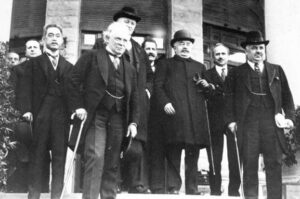 By Unknown author – eipa.eu.com, Public Domain, Wikipedia
The claim that the United States created Israel overlooks the foundational legal and diplomatic history of the modern Middle East, which was actually shaped by the global community through European powers. In April 1920, in the aftermath of World War I, the victorious Allied powers-Britain, France, Italy, and Japan-met in San Remo, Italy, to redraw the map of the collapsed Ottoman Empire.
What emerged was not an improvised political gesture, but a binding legal framework that still underpins the modern Middle East. Through this formal global decision, Great Britain-not the United States-was entrusted with the Mandate for Palestine and charged with reconstituting a national home for the Jewish people. Israel was not an accident. It was not a colonial experiment. It was the result of a formal international decision.
At San Remo, the Allies incorporated the Balfour Declaration into international law.
This was the critical shift-from political promise to legal obligation. The powers entrusted Britain with the Mandate for Palestine, explicitly charging it with implementing “the establishment in Palestine of a national home for the Jewish people,” while safeguarding the civil and religious rights of non-Jewish communities.
That language matters. It was deliberate. It recognized Jewish national rights-but not Arab national rights in Palestine. That omission was not accidental; it reflected the geopolitical reality of the time. The Arab population was understood as part of a broader Arab nation, which was simultaneously being granted vast territories across the Middle East-what would become Iraq, Transjordan, Syria, Lebanon, and Saudi Arabia.
In other words, the Arabs were not dispossessed of a state in Palestine. They were granted multiple states across the region. The Jews, by contrast, were allocated one small territory-their historic homeland.
Even within the Allied camp, there was resistance. The French representative, Philippe Berthelot, pushed to roll back support for a Jewish national home. But Britain held firm. Lord Curzon, despite his own reservations about Zionism, made a blunt point: the Jews themselves were the best judges of what they needed. The French ultimately relented-not out of conviction, but because they lacked the leverage to oppose Britain on the ground.
That framing is critical. San Remo did not “grant” Jews something new. It recognized and legalized an existing historical claim-the reconstitution of a national home in the land of Israel.
The subsequent League of Nations Mandate formalized this framework. It explicitly affirmed “the historical connection of the Jewish people with Palestine” and the grounds for reestablishing their national home. This was not vague rhetoric-it was the legal architecture of sovereignty.
Equally important is what did not exist at the time: a distinct Palestinian Arab national identity. Prior to the 1920s, the area was widely regarded as part of southern Syria. Local Arab leaders initially demanded incorporation into a larger Syrian state. Only after that project collapsed-when the French crushed the Arab Kingdom in Damascus-did a separate Palestinian Arab political identity begin to emerge.
As historian Daniel Pipes has argued, Palestinian Arab nationalism did not precede Zionism-it developed in response to it. Without the Jewish national movement, there is little evidence that Palestinian Arabs would have been seen as a separate political entity at all.
This is an uncomfortable reality for modern narratives, which retroactively project a fully formed Palestinian Arab nationalism into a period when it simply did not exist.
The borders themselves reinforce the point. The modern Middle East was not shaped by ancient ethnic divisions or organic national movements. It was carved up by imperial powers, often with little regard for demography or geography. Kurds were split across four states. Shiite and Sunni populations were fragmented. Druze, Alawites, and other minorities were scattered across artificial borders.
Israel is not an exception to this system-it is a product of the same system. To delegitimize Israel on that basis is to undermine the legitimacy of the entire post-World War I order.
Even the term “Palestine” did not carry the meaning it does today. For centuries, it was a geographic expression, not a sovereign entity. Jewish institutions proudly used the name: the Palestine Post, the Palestine Electric Company, the Palestine Symphony Orchestra. Only after 1948 did the term suddenly become exclusively associated with Arab nationalism.
So why does San Remo still matter?
Because it is the legal foundation that modern critics prefer to ignore. Unlike later United Nations resolutions-many of which are non-binding recommendations-San Remo was a binding agreement among the world’s leading powers. It created what was effectively a “title deed” for the Jewish national home.
More than that, it established the framework for the entire region. Lebanon, Syria, Iraq, and Transjordan all trace their modern political existence back to the same set of decisions. If San Remo is invalidated for Israel, it is invalidated for everyone.
The implications are obvious-and that is precisely why the conference is so often omitted from contemporary discourse.
The debate over Israel’s legitimacy is frequently framed in moral or ideological terms: colonialism, occupation, displacement. But those arguments collapse when confronted with the legal record. Israel’s existence is not the result of a historical anomaly. It is the outcome of a formal international consensus, grounded in both historical connection and legal recognition.
San Remo is the moment when the international community acknowledged that the Jewish people were not foreign interlopers in their own land-but a nation returning home.
That is not a narrative built on sentiment. It is one built on law.
And that is exactly why it continues to be ignored.
Dr. Alex Grobman is the senior resident scholar at the John C. Danforth Society, a member of the Council of Scholars for Peace in the Middle East, and on the advisory board of The National Christian Leadership Conference of Israel. He holds an MA and PhD from The Hebrew University of Jerusalem.


“Concerning The Jews”
“If the statistics are right, the Jews constitute but one percent of the human race. It suggests a nebulous dim puff of star dust lost in the blaze of the Milky Way. Properly the Jew ought hardly to be heard of, but he is heard of, has always been heard of. He is as prominent on the planet as any other people, and his commercial importance is extravagantly out of proportion to the smallness of his bulk. His contributions to the world’s list of great names in literature, science, art, music, finance, medicine, and abstruse learning are also away out of proportion to the weakness of his numbers. He has made a marvellous fight in the world, in all the ages; and has done it with his hands tied behind him. He could be vain of himself, and be excused for it. The Egyptian, the Babylonian, and the Persian rose, filled the planet with sound and splendor, then faded to dream-stuff and passed away; the Greek and the Roman followed, and made a vast noise, and they are gone; other peoples have sprung up and held their torch high for a time, but it burned out, and they sit in twilight now, or have vanished. The Jew saw them all, beat them all, and is now what he always was, exhibiting no decadence, no infirmities of age, no weakening of his parts, no slowing of his energies, no dulling of his alert and aggressive mind. All things are mortal but the Jew; all other forces pass, but he remains. What is the secret of his immortality?”
Mark Twain
https://ohr.edu/judaism/concern/concerna.htm
“Mark Twain and the Jews” by Mark Feldberg, PhD
https://jewishvirtuallibrary.org/mark-twain-and-the-jews
August 10, 2026
https://allisraelnews.com/colombia-recognizes-israeli-sovereignty-over-golan-heights-becoming-2nd-country-in-the-world-alongside-us
https://allisraelnews.com/paraguay-seeks-deeper-israel-ties-as-beef-exports-surge-and-israeli-technology-draws-interest
Without Israel, there’d be no America!
Must read
On Amazon Kindle for $1.99.
Without the Yishuv and the Jewish Legion, Britain would have lost Egypt, Germany would have gotten all the oil it needed.
https://youtu.be/spyFBty7i_8?is=14klOeNJDwmGUiUf
A world willfully BLIND to the evidences.
What is the purpose of History if ignored by the RESPONSIBLE people!
Ignorance is bliss, willful ignorance is criminal.
When it keeps repeating, it is INSANITY!
The Arabs were given a state as a gift from the UK. Today it’s called The Hashemite Kingdome of Jordan. In order to fix this, Jordan should be given back to the Jews. Not even Vance can do that.
JD Vance is detestable.