
Peloni: We are told that the era of the old pre October 7 Conceptzia is dead, that lessons learned from the cauldrons of tragedy on October 7 and the long road since that terrible day will prevent the return to October 6, and thereby prevent a similar slaughter in the future. Yet, is this what we are witnessing taking place today? Is today’s policy of feeding Iran with access to billions in cash different from feeding Hamas with billions in cash which led to October 7? I think the consequences of keeping our enemies alive represents a serious threat to the survival of the Israeli people, but also to the survival of Western civilization.
Of course, support from and for Washington’s hand on the lever deciding regional policy was always a motivating factor in what led to the formation of the October 6 Conceptzia, and such a dependency for and offshoring of Israel’s national interests seems to still be well vested in the current dilemma in which new revenue streams are being provided to an even more menacing terror entity in Iran than existed in Gaza. Hence, such realizations beg the question, how is what is taking place today in Iran different from what led to October 6?
Is the new Conceptzia being acted upon today really different from the old Conceptzia which we were led to believe was dead? We live in an age of miracles, where a tiny nation stand strong against the 8-front war being waged against us. Yet, will the most pivotal miracle of all be encapsulated in the reality that keeping our enemies alive to serve foreign interests is the guiding principle which ties the Old Conceptzia to what replaced it?
Victor Satya
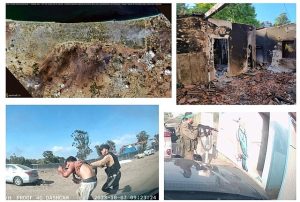 October 7 Collage by Hnuden – Own work, CC0, Wikipedia
Sheket was the dream: pay Hamas enough and they might choose prosperity over pogroms. The suitcases rolled in. October 7 rolled out. Having awakened from that particular slumber, Israel is now politely asked to watch Washington cut the same deal with a bloodied Iran. Old illusions, new luggage.
For years, Israeli governments stuck with this strategy. Quiet was the national craving. If only the right amount of Qatari cash could be funneled to Hamas, the thinking went, the rockets might fall silent and the ideology of annihilation might soften into something manageable. The suitcases arrived monthly from 2018: $15 million at a time, negotiated with Israeli approval, delivered in theatrical bundles. Prosperity would tame the beast. Or so the illusion ran.
The illusion died screaming on October 7, 2023. Hamas, fattened on those very funds and the taxation rackets they enabled, unleashed the worst massacre of Jews since the Holocaust. The group had not been domesticated; it had been subsidized. The funds, far from purchasing moderation, sustained tunnels, rockets, and an apparatus built for one purpose.
Then something remarkable happened. Israel woke up.
The old strategy of managed calm was retired with brutal clarity. In Gaza, the IDF dismantled Hamas as an organization, killed thousands of its fighters including much of its senior military leadership, and carved out buffer zones that made another October 7-style breach far harder. Hezbollah, Iran’s most potent proxy, was brought to its knees. The pager operation, Israel’s masterpiece of supply-chain subversion, maimed and killed hundreds of operatives in a single coordinated blow, shattering their sense of security and paving the way for the elimination of Hassan Nasrallah himself. Direct strikes on Iran followed, degrading the regime’s nuclear and military infrastructure in ways once deemed unthinkable.
These were not the actions of a nation sleepwalking toward the next ceasefire. They were the moves of one that had finally retired the suitcase strategy.
And then Washington, in its infinite wisdom, decided it was time to pack new luggage. After coordinated strikes in late February 2026 that severely damaged Iran, including the death of Ayatollah Ali Khamenei, the United States, under President Trump, moved swiftly toward a memorandum of understanding. Ceasefire, reopened Strait of Hormuz, deferred nuclear talks, and the promise of sanctions relief and access to frozen billions. Jerusalem expressed concerns before eventually offering endorsement, but the architecture of the deal echoes the old temptations with even higher stakes.
This is sheket purchased at one remove. Iran, bloodied but intact, stands to regain economic oxygen. History offers little comfort here. The previous nuclear framework released tens of billions that, by multiple expert assessments, helped sustain Iran’s military buildup and its network of proxies rather than transforming the regime. Funds flowed to the IRGC, to Hezbollah, to Hamas. The same pattern now risks repeating: money that rebuilds what American and Israeli strikes had degraded, rearming the very forces sworn to Israel’s destruction. The MOU has glaring omissions, no firm dismantling of enrichment capacity, limited or absent curbs on ballistic missiles, and crucially, no meaningful restraints on proxy patronage.
The contradiction is glaring. The United States has never lived with the daily consequences of this bargain. Its citizens do not send their children to schools within range of rockets funded by sanctions relief. Its borders are not breached by sadistic killers who trained under the cover of economic “quiet.” Israel has paid that price repeatedly. The pre-October 7 mentality treated enemies as rational actors responsive to incentives, ignoring the ideological engine driving Hamas and Hezbollah. Feeding the apparatus of jihad did not produce moderation; it produced October 7. Yet here we are again, watching suitcases, diplomatic this time, being packed in Washington.
The recurring metaphor reveals itself: the suitcase. Once literal cash wheeled across Israeli territory to Gaza. Now metaphorical briefcases of relief heading to Tehran. Both promise calm. Both conceal the means for future violence. Western elites often prefer comforting fictions to uncomfortable facts; here the fiction is that ideological movements bent on elimination can be bought off like disgruntled unions. The facts, recovered from Gaza, from interrogations, from the battlefield, tell a different story. Hamas’s own documents show diversion on an industrial scale. Prosperity did not moderate; it enabled.
Israel’s post-October 7 campaign demonstrated what clarity achieves. Degrading Hamas as a military threat, humbling Hezbollah, striking at the Iranian heart, these restored deterrence where purchase had eroded it. The pager explosions alone exposed the hollowness of the enemy’s confidence. That spirit of offensive defense, not managed decline, kept the suitcase strategy at bay.
Yet strategic autonomy is now tested. Israeli leaders face pressure to align with an American deal that prioritizes regional de-escalation and economic reopening over the full dismantling of threats. The temptation is understandable: war is exhausting, quiet seductive. But Israel cannot outsource its survival to Washington’s shifting calculations. The US can afford experimental diplomacy with distant adversaries. Israel cannot afford the next massacre.
True sheket, the kind worth having, does not arrive in suitcases. It is imposed by strength so unmistakable that enemies calculate the costs of breaking it as prohibitive. Israel learned this the hard way once. The suitcases of 2018 delivered not peace but prepared the ground for slaughter. The diplomatic suitcases of 2026 carry the same risk, wrapped in fresh rhetoric. Whether Israel navigates this moment with the clarity it showed on the battlefield, or slips back into the comfortable pre-October 7 slumber, will determine if the next massacre remains a memory or becomes a sequel.
For those cheering the memorandum and lecturing Jerusalem on the virtues of strategic patience, explain to the next Israeli family at a graveside why this time the billions will surely fund hospitals rather than Hezbollah’s rockets.
Of course this time will be different, we are solemnly assured, because nothing says “fresh start” quite like handing billions back to the regime that arms every proxy from the River to the Sea.


Leave a Reply
You must be logged in to post a comment.