
Peloni: While I am hesitant to advocate Saudis demonstrating a keen ability on the battlefield, they are gaining the support of American advanced hardware systems, American military protection, and more than just access to influencing the President of the US. So why would the US President not insist on the Saudis doing what they have yet to successfully do, act in such a way that actually demonstrates their military partnership with the US.
Jonathan Schanzer
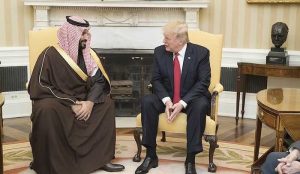 President Donald Trump speaks with Mohammed bin Salman, Deputy Crown Prince of Saudi Arabia, during their meeting Tuesday, March 14, 2017, in the Oval Office of the White House in Washington, D.C. (Official White House Photo by Shealah Craighead)
Saudi Arabia’s Crown Prince Mohammed bin Salman reportedly called President Trump on Saturday and implored him to hold off on striking the Islamic Republic of Iran.
Trump acquiesced and punted on a massive American bombing raid that could have potentially turned the tide of the war.
Admittedly, Saudi Arabia is in a tough spot: The Iranian regime continues to hammer the kingdom with drones and missiles, threatening its oil and water resources.
But the Saudis have not gone unprotected. American warfighters and even Greek air defense teams have ensured the safety of the Saudi state throughout this conflict.
Yet rather than aligning more closely with us, the Saudis have started to gravitate toward an alliance of basket cases in the Middle East.
Time to step up
The alliance is now referred to as “STEP”: Saudi Arabia, Turkey, Egypt and Pakistan.
These are all theoretically American allies. But they are not exactly working for American interests right now.
They view the weakening of the Shiite regime in Iran as an opportunity to reassert Sunni state dominance in the Muslim world.
At the same time, they are not eager to see the widening of the war because it would wreak more havoc, which is why they keep calling for diplomatic agreements.
By now, however, it should be clear that the Iranian leadership is not interested in a diplomatic agreement.
Every time one is brokered, the regime carries out aggressive actions in the Strait of Hormuz or it attacks our Persian Gulf Arab allies. And that’s not likely to change. So when the Saudis ask America for restraint, they need to offer clear alternatives, not platitudes.
Better yet, the Saudis should join the fight.
Admittedly, the Saudis last month launched one strike against Iran-backed militias in Iraq.
And according to recent reports, the Saudis may be preparing for military action against the Iran-backed Houthis in Yemen, particularly if the group tries to shut down Saudi shipping in the Red Sea.
The Saudis have a history of conflict with the Houthis; Riyadh launched a war against the group in 2015.
That war garnered a huge amount of criticism from US lawmakers, primarily due to errant strikes that led to high civilian casualties.
But that was then and this is now. A wider war has erupted across the Middle East.
Iran and its proxy network are fighting America and its allies on multiple fronts, and America should not be expected to fight on its own.
The Israelis have stepped up when asked. They’ve put skin in the game.
It’s time to ask the Saudis to do the same.
The kingdom boasts a vast arsenal of American-made planes, helicopters, tanks and other weapons.
Saudis must decide
Its forces are clearly equipped to fight, even if questions linger about the readiness of Saudi fighters, who have not seen much action on the battlefield.
In the end, however, it boils down to will.
Now, whenever the war heats up, the Saudis seem to want to cool it down — a significant shift from the beginning of the conflict, when Saudi officials quietly backed Trump’s effort.
With the war at an impasse, and the Iranian regime looking increasingly emboldened by that, Saudi Arabia must be put to a choice.
There’s no time for fence-sitting.
The president should send our allies in Riyadh a clear message: It’s time to either join the fight, foot the bill, or get out of the way.
Jonathan Schanzer is executive director at the Foundation for Defense of Democracies, a nonpartisan think tank in Washington, DC.


Leave a Reply
You must be logged in to post a comment.