
UPDATE: Board of Peace Gaza envoy Nickolay Mladenov warns that Full, verified implementation of Board of Peace Gaza plan is ‘the only guarantee’ that October 7 tragedy won’t recur. He goes on to argue that the undefined “verification mechanism” and not trust is what the Board of Peace plan is based around, and that “None of the plan that we are preparing limits Israel’s options to react to a threat if it’s imminent and if it’s really endangering its troops.” Noting the not too subtle overtly limiting qualifications of “if it’s imminent” and “if its really endangering” IDF troops, Mladenov highlights the inherent negotiable nature of Israel’s position going forward. He also insists that a step by step process of small sectors be disarmed while Israel retreats from these individual sectors, which is clearly contrary to the designed plan in UNSCR 2803. Netanyahu is correct to have changed his position in working with this Roadmap. It is untenable, and betrays the original 20 Point plan, which was already inherently dangerous as it was originally constructed.
Peloni: This report has been maturing thru the day. Since this latest update in the article below, Channel 12 has clarified that Netanyahu approved the withdrawal of IDF forces from three pilot centers where the Gaza plan would initially be implemented. This authorization however has been withdrawn over the past day, which led to a good bit of confusion where things actually stand. Where they do stand is that the IDF is NOT withdrawing as Netanyahu explains below that
“[The Americans] have ideas, some of which are acceptable to us and some of which are unacceptable, and we know how to stand firm against these things.”
Good for Netanyahu. I am relieved that he ultimately made the correct, while noting that he is under intense pressure from both the US and the Israeli electorate.
All Israel News Staff | Published: August 9, 2026
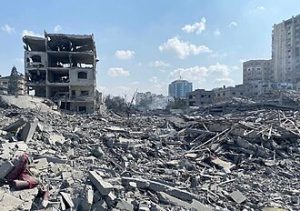 Damage following an Israeli airstrike on the El-Remal area in Gaza City on October 9, 2023. By WAFA (Q2915969) in contract with a local company (APAimages) – Correspondence with Wiki Palestine (Q117834684), Public Domain, Photo by Palestinian News & Information Agency (Wafa) in contract with APAimages, CC BY-SA 3.0, Link
Prime Minister Benjamin Netanyahu said on Sunday that Israel does not accept the 15-point roadmap proposed for the next phase of U.S. President Donald Trump’s Gaza plan and that the Israel Defense Forces will not withdraw from Gaza until Hamas has been genuinely disarmed.
His comments come as Israel resists moving to Phase 2 under the current proposal, amid concerns that doing so could restrict its military freedom of action before Hamas demonstrates it’s willing to give up its weapons.
Israel’s position follows a warning from Shin Bet Director David Zini that Hamas could use the proposed transition to prolong negotiations and limit Israel’s ability to conduct military operations without surrendering its weapons.
While Israel is discussing possible arrangements with the United States, Netanyahu made clear that Jerusalem does not accept any withdrawal of IDF troops before Hamas is disarmed.
According to The Jerusalem Post, Zini warned ministers that Hamas could use the proposed demilitarization process to prolong negotiations and limit Israel’s freedom of action, rather than giving up its military capabilities.
Zini stated he believes that Hamas is “dragging their feet” and “waiting for the elections, and then they will see what happens.” Israel is slated to hold elections on Oct. 27 this year.
A key point of contention in the 15-point plan is a proposed 14-day period to prepare for implementation of the next phase. According to Israeli officials cited by the JPost, cabinet ministers opposed steps that could signal Israel had entered that period, which would entail restrictions on Israeli military operations, including targeted strikes against Hamas operatives.
Walla News likewise reported that Israel had not signed or formally approved the Board of Peace’s (BoP) demilitarization roadmap and had raised significant objections to the proposed terms.
The BoP published a 15-point roadmap last week that calls for both sides to fulfill their remaining obligations under the previous agreement before finalizing the mechanisms for implementing Phase 2 during a 14-day period.
Speaking at the start of Sunday’s government meeting, Netanyahu sought to dispel what he described as “rumors” of Israeli weakness and withdrawals on multiple fronts, including Gaza.
“As for the Gaza Strip: First and foremost, I wish to clarify the main point: As long as I am Prime Minister, a Palestinian state will not be established, neither in Gaza nor in Judea and Samaria. Neither ‘Fatahstan’ nor ‘Hamastan’,” Netanyahu said.
Addressing the 15-point plan specifically, Netanyahu said, “Regarding specific matters surfacing in the news lately, I wish to be precise here: Israel does not accept the 15-point document.”
“I have heard people saying: ‘You didn’t say it.’ So here I am saying it again: Israel does not accept the 15-point document,” he added.
Netanyahu said Israel is continuing to discuss the issue with the United States, but that some of Washington’s ideas remain unacceptable to Jerusalem.
“Right now, we are talking with the Americans about this issue. They have ideas, some of which are acceptable to us and some of which are unacceptable, and we know how to stand firm against these things. We have proven this in the past and we are proving it today as well,” he said.
“The IDF will not carry out any withdrawal until Hamas is disarmed,” Netanyahu said. “And when I say the disarming of Hamas, it means heavy weaponry, lighter weaponry, all weaponry. And we are talking about genuine disarmament, not fictitious disarmament.”
The status of the proposed multinational force remains unresolved. While the security cabinet approved a legal framework for a roughly 200-member International Stabilization Force (ISF) in late July, each national contingent would still require separate Israeli approval, according to Reuters.
The JPost reported that a separate document governing the force’s deployment remained unsigned following Israeli objections, and that Israel had not formally authorized its entry under the new arrangements.
At the same time, the JPost learned that the government had approved the ISF entering Gaza following U.S. pressure.
The distinction is significant as Israel has approved a framework for the potential deployment of an international force while continuing to object to elements of the current roadmap governing the transition to Phase 2.
Preparations by potential troop-contributing countries are nevertheless moving forward.
Uganda’s parliament voted on Thursday to authorize the deployment of troops to Gaza if needed as part of the ISF.
Reuters reported that the broader Trump plan remained stalled, with no clear timeline for when the forces would actually deploy.
Netanyahu said, “Furthermore, the IDF will continue to thwart threats against our forces and our citizens.”


https://youtu.be/AYd1HswvFH8?is=qHwrn7bZQIqbajT5
My comment: (Note the date) “”The Jews have a natural right to the country and I favor their possession and control of it,” he went on. “Tell the Arabs to get back onto the land that was given to them by the Allies for their part in the war. If they are not satisfied with the Jewish administration, let them sell their land at a reasonable price and retire into Mesopotamia, and if they will not, then drive them out.”
ASKS US TO FIGHT FOR PALESTINE JEW; Our Duty Is to Back British Mandate, Declares Representative Chandler.”USE FORCE IF NECESSARY” Advocates Also Financial Aid to New Republic Against Arabs and Turks.”
Sept. 11, 1922
https://www.nytimes.com/1922/09/11/archives/asks-us-to-fight-for-palestine-jew-our-duty-is-to-back-british.html
—
If I could vote, I’d still vote for Smotrich because Zehut is polling at well below the electoral threshold and he would probably play the role of splitter if he did, the left wing alternative being unthinkable, but I agree with Moshe Feiglin even though, personally, I am an SBNR (spiritual but not religious – It’s a thing though its had different names, you can google it – just because it is the way I was brought up my by late Jewish mother and big sister, and it works for me, though not out of pique or rebellion like both of my parents, who nonetheless supported Israel from a secular perspective.)
I agree with this (unlike the Christian editors – this was published on many evangelical Christian sites, only comes up in Duckduckgo if you search for it), too many coincidences):
“America has been hit 10 Times with Major Disasters following attempts to divide Land of Israel”
Date: December 26, 2016
And the firsr case of the Wuhan virus in the U.S. was reported the same week Trump and Kushner announced his last proposal to divide the land of Israel.
Like his predecessors to varying extents, Presiden Trump just won’t learn.
https://thewashingtonstandard.com/america-hit-10-times-major-disasters-following-attempts-divide-land-israel/
Consider the absudity of the Allies deciding on Boards of Peace in German Sudetenland and East Prussia at Potsdam.
cont,: They learned the lesson of the WWI armistice.
My query: potsdam expulsion of germans
Google AI Overview:
“I can vouch for there being a type of Zionist who doesn’t care what kind of society our “state” will have; I’m that person. If I were to know that the only way to a state was via socialism, or even that this would hasten it by a generation, I’d welcome it. More than that: give me a religiously Orthodox state in which I would be forced to eat gefilte fish all day long (but only if there were no other way) and I’ll take it.” Jabotinsky
https://claremontreviewofbooks.com/warrior-of-zion/
cont,: They learned the lesson of the WWI armistice.
My query: potsdam expulsion of germans
Google AI Overview:
“+6 The expulsion of Germans following World War II was formalized under Article XIII of the Potsdam Agreement, reached in August 1945 by the Allied leaders (the United States, Great Britain, and the Soviet Union). The agreement sanctioned the orderly and humane transfer of German populations remaining in Poland, Czechoslovakia, and Hungary into a truncated postwar Germany, leading to the displacement of an estimated 12 to 14 million ethnic Germans and significant civilian mortality.Background and DecisionAllied Consensus: Meeting at the Potsdam Conference, the Allied leaders sought to redraw Central European borders and establish ethnically homogeneous nation-states to prevent future ethnic minority conflicts.Shift in Borders: Poland’s border was moved west to the Oder-Neisse line, and former German eastern territories were transferred to Polish and Soviet administration.Implementation and ScopeAffected Populations: Ethnic Germans were forcibly removed from regions across Czechoslovakia (the Sudetenland), Poland, Hungary, and other parts of Eastern Europe.Phases of Displacement: The process followed earlier wartime flight from the advancing Red Army and chaotic post-surrender escapes, culminating in the organized state-directed deportations sanctioned at Potsdam.Conditions: Many transferees faced severe asset confiscation, forced labor, and internment camps, resulting in an estimated death toll ranging from 500,000 to over 2 million casualties due to disease, malnutrition, and violence.If you’d like, I can provide more details on:The specific conditions in the internment and labor campsThe demographic and economic impact on postwar GermanyThe provisions of Article XIII of the Potsdam protocol”.
https://claremontreviewofbooks.com/warrior-of-zion/
My comment: Me too, though I like gefilte fish.
The 15 pts do not respect the original 20 pts!
Why did Trump bring in 3 enemies of Israel?
Trump also interfering in Lebanon, preventing the destruction of Hezbollahs.
I am an American citizen who respects, preserves, and protects my individual sovereignty and the sovereignty of the United States of America. The sovereign State of Israel cannot and should not allow others, including America, to determine what Israel will and will not accept to end the 3-year Gaza War against the State of Israel that began on October 7, 2023 when Hamas savages and other Palestinian militant groups invaded Israel and brutally attacked, captured, butchered, and murdered 1,200 Israeli civilians at a music festival!
Consider this inconvenient fact before anyone criticized Israel, Netanyahu, or calls Israel intransigent. What would America do if 6,000 Canadians breached our northern border and launched 4300 rockets on American soil and butchered and murdered 1200 Americans?? Would America allow those who fund the attackers and are in ideological agreement with them to determine her future??? Absolutely not! The whole idea is absurd!
The key countries involved in President Trump’s proposed Board of Peace 15-point plan are Egypt, Qatar, Turkey, and the United States. Seriously?? Egypt? Qatar? Turkey? It is an outrage and an insult to the sovereign State of Israel that was attacked on October 7, 2023. In a sane world, the nation that is attacked and prevails dictates the terms that end the war, not her enemies or those who fund them!!
Netanyahu is absolutely correct in rejecting this outrageous plan. It is unseemly and President Trump should never have authorized it.
While this warning from David Zini is rather obvious, it throws the effort to block the move to the next stage of the BoP plan on Netanyahu. He has to fight this step alone. Thanks a lot for making this statement public…
This is the only way to proceed and everybody knows it. However, coercing Israel to take the risk is much more fun.
Adherence to a vague 14 day period to prepare for the implementation of the next phase is only needed if one side or the other has an alternative agenda. Waiting for the elections in Israel and the USA is a good idea, but waiting for the elections in all of the other countries involved is much better. How about waiting for elections in the PA, Egypt, Saudi Arabia Pakistan, Turkiye and all the rest of the do-gooders promoting this BOP nonsense?
I have a suggestion: how about starting with the Hamas obligations. They started this war. They lost it. They should start obliging rather than demanding that others do their part. The permanent support by the members of the BOP to get Israel moving on its assumed obligations will not get peace, it will get war.
An excellent statement. Now we just need the rest of the Israeli government to support him. Get the Supreme Court and the AG to sign up immediately! The same is true after the elections. Just think if the opposition gets a new chance: they will all fall over like dominoes as soon as the USA tells them to.
We all know that no country is willing to grab the weapons from Hamas, especially since they are obviously ready to violently protest. 200 men is simply not enough to face them down. When will the BOP finally get their marbles together and get out of the way?
The very last thing we need is a promise along the lines of the UN forces in Lebanon. None of the volunteers are acceptable, not the least because they will aid and abet the terrorists rather than get them disarmed. Essentially, the only country that could achieve the plan is the USA and they will not even consider boots on the ground, so they should get out of the way too!!!