
By | August 8, 2026
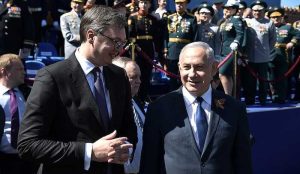 Aleksandar Vucic & Benyamin Netanyahu, The Presidential Press and Information Office, Creative Commons Attribution 4.0
Serbia has always been pro-Israel in its general attitude, but now it is demonstrating its friendship with the Jewish state in more tangible ways. It maintains close security and economic ties that are becoming ever more extensive; its officials, including President Alexander Vucic, have declared their solidarity with Israel. More on how the Serbs identify with the Jews of Israel can be found here: “As defense ties deepen, Serbia becomes one of Israel’s closest allies in Europe,” by Jonathan Spyer, Jerusalem Post, August 1, 2026:
A recent conference at the National Assembly in Belgrade, in which I participated, cast a fascinating spotlight on an under-reported but significant component of Israeli foreign relations: the Jewish state’s flourishing relations with Serbia.
The connection has accelerated steeply in the nearly three years of war in the Middle East. At a time of deep strains between Israel and several European countries, mainly related to domestic opposition to Israel’s war against Hamas in Gaza, the upward trajectory of the Jerusalem-Belgrade connection is of particular note.
The relationship is not without its complexities. Serbia’s close historic connections to Russia – and the desire of its President Alexander Vucic to maintain, at least in public, an equidistant stance in the emergent superpower contest between the US and China – place Serbia at a different point on the geostrategic map with regard to Israel.
But these details shouldn’t obscure the more general picture of growth and consolidation. The deepening ties have certainly been noticed by those opposed to them. UN special rapporteur Francesca Albanese, on her March visit to Belgrade, admonished Belgrade for cooperating “without shame” with Israel by providing it with military supplies.
If Serbia’s relations with Israel anger the world’s leading anti-Israel advocate, Francesca Albanese, the country must be doing something right.
Israeli and Serbian leaders would no doubt take issue with Albanese’s stance that these actions are shameful. Still, the UN rapporteur was not imagining things. Serbia played a vital role in the difficult first months of the Israel-Hamas War.
According to reporting by the Balkan Insight website and Haaretz, Israeli officials contacted their Serbian counterparts as early as October 8, with the Hamas assault only just contained and the military response still in early preparation. Their request was simple: ammunition. The Serbian response came without hesitation. The export order was cleared within four days, and the required munitions were on their way to the Nevatim air base outside of Beersheba.
As the Israeli ground offensive into Gaza began, the Serbian consignments kept coming. By mid-2024, Belgrade had exported a total of €16.3 million worth of munitions to Israel. In 2023, prior to October, the total of arms exported from Serbia to Israel was only €540,000.
Prime Minister Benjamin Netanyahu, in a public statement in February 2024 following a telephone conversation with Vucic, expressed gratitude for Serbia’s “unwavering support, both in word and deed,” and described the Serbian president as a “true friend of Israel.”…
Serbia and Israel are each getting what it most needs from the other. They are diversifying their sources of weapons, Serbia by buying high tech weapons from Israel, and Israel by buying low-tech weapons from Serbia. They are, militarily speaking, enantiomorphs.
Jews and Serbs both fought during World War II on the same side, against both the Nazis, and against the Ustasha, a pro-Nazi Croatian military force. Both Jews and Serbs ended up In the same concentration camp of Jasenovac.
The ties that bind are these: First, Serbs and Jews were both victims of the Nazi-collaborating Croatian Ustasha during World War II, and some of them served together in the same partisan units, and when captured, were sent to the same concentration camp at Jasenovac.
Second, Jews and Serbs have suffered at the hands of the Ottomans. Serbs were subject to the devshirme system of the Ottoman Turks. This was the Ottoman practice of taking young Christian boys between the ages of eight and eighteen, from their families in the Balkans, as a human tribute to serve the state. The process involved selection, conversion to Islam, and specialized training for military or government work.
Jews and Serbs in the Ottoman Empire were similarly oppressed as dhimmis, subject to a host of social, political, and economic disabilities. They had to wear an identifying badge (a yellow badge for Jews, a blue belt for Christians); they were forbidden to ride horses (mules were allowed), or to use saddles; they had to move to the side of the path if a Muslim was coming toward them, or get out of his way if he was coming up behind them; they could not build new, or repair existing synagogues or churches, could not possess firearms, were restricted in the professions they could engage in, and were periodically exposed to forced conversions and massacres. The most onerous of the requirements imposed on dhimmis was the capitation tax known as the jizya, a payment made to the Muslims “with humiliation,” involving a considerable sum that could prove ruinous for poorer dhimmis.
The shared historical memory of the Croatian Ustasha’s persecution of Serbs and Jews during World War II, and the memory of the shared mistreatment of Jews and Serbs at the hands of the Muslim Ottomans, help explain why, on October 8, 2023, the first country to agree to send military aid to the reeling Jewish state was Serbia. And that is why we are not surprised to learn that Serbian President Aleksandr Vucic insisted that “We will always… like the Jewish people and Israel;” or that Israeli Prime Minister Benjamin Netanyahu, in a public statement in February 2024, expressed gratitude for Serbia’s “unwavering support, both in word and deed,” and described the Serbian president as a “true friend of Israel.”And everything that has happened since confirms that verdict.


And if memory serves, in 1999, in the war between Serbia and Albanians, the Serbs were the bad guys except for one national leader knowledgable of the historic relationship between the Serbs and the Jews who defended them: Arik Sharon.