
Peloni: So Jewish youths can literally be chased across campus by a marauding Islamist anti-American crowd simply with impunity, but raise a thoughtful objection to the new tech centers of power in the US results in imprisonment within days, hours or minutes of having done so. Demonstrations of arbitrary justice has never been more blatantly employed in America.
Over the past year, dozens of people have been silenced or arrested for criticizing data centers in public forums. This is entirely un-American.
Am Thinker | August 11, 2026
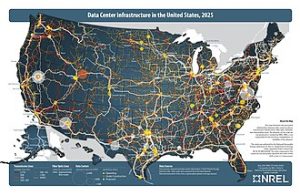 Data center infrastructure in the United States. By DOE/National Renewable Energy Laboratory (NREL), Public Domain, Wikipedia
Data centers are not popular neighbors with most Americans: a March Gallup survey found that 70% of respondents were NIMBY on the issue. Opposition is not confined to polls. There have been widespread protests, and local and state governments have imposed moratoriums. Political resistance is also growing. The backlash is now broadening to question cloud computing and AI per se, which rely on data centers as infrastructure.
What is disconcerting, however, is that over the past year, dozens of people have been silenced or arrested for criticizing data centers in public forums. American political life has been shaped by criticism, dissent, and protest, and the First Amendment guarantees all citizens the right to speak out, assemble, and petition the government. Therefore, divergence of opinion—which is not necessarily anti-government or anti-America—should be accommodated, not suppressed.
Consider a group like Humans First, which has organized 142 protests in 42 states so far. In a letter signed by 61 people, the group has urged President Donald Trump to issue an executive order requiring the vetting of AI models and curbing corporate authority to deploy unvetted new technology. At the same time, it calls for an ‘America First approach to AI’ that would give the U.S. a technological lead over China.
The group merely wants this: while promoting AI, the government must protect American jobs, preserve liberty, and address citizens’ concerns about air, water, and noise pollution; land, water, and energy use; and transparency and national security. The same could be said of most people protesting data centers. Yet they are being detained on frivolous grounds, in a manner that is both undemocratic and un-American.
In February, Darren Blanchard, a farmer opposed to Beale Infrastructure’s Project Mustang data center complex planned for 300 acres near Claremore, OK, appeared at a packed city council meeting. He refused to give his name before speaking. When he exceeded the 3-minute limit by a few seconds, he was told to stop.
Blanchard began walking toward the city officials, apparently to submit documents and his speech, but was arrested, handcuffed, and taken to Rogers County jail. All within 30 seconds of exceeding the limit. The charge: criminal trespass. When a reporter sought bodycam footage of the incident, the city quoted an exorbitant $1,750, which it reduced to $120 after the arrest was widely discussed and criticized. Notably, Blanchard had no criminal record.
In Lowell, Massachusetts, a 14-year-old girl was removed from a public hearing and detained by police after she addressed the crowd. During the hearing last fortnight, several police cruisers with flashing lights were parked in the lot, as if violence were expected. As she was led away, the girl said: “I’m not hurting anyone. We just don’t want data centers.” Some audience members rushed to her aid, and many commended her actions.
Residents were given two minutes to speak, with a police officer monitoring the time. Pablo Payan, a maintenance manager, declined to give his name before speaking and refused to leave the building after being denied permission. Police arrested him and charged him with criminal trespassing and disorderly conduct, allegations he denies. He plans to sue the city and says, “I was kicked out to prove a point that the law is on their side and if people try to express themselves and speak, they will also be intimidated and arrested.”
In July, physics teacher Lux Claridge was arrested in Emporia, KS, for clapping in support of those opposing the Flint Hills Digital Campus, a proposed 1,000-acre hyperscale data center. At the city commission meeting, officials had warned attendees that clapping and snapping were prohibited. When police approached him, Claridge refused to leave the building and was carried out. He plans to sue the city for “unjustified infringement of free expression.”
In the aftermath of the incident, the Emporia city council held its next meeting virtually and eliminated the public comment period for “public safety,” citing that city leaders had received “death threats.” A meeting scheduled for August 19th will also be held virtually. “No public comment period will be provided during either meeting.”
In December, three women were arrested and forcibly removed for “disorderly conduct” during a Port Washington, WI, city council meeting about a recently approved $15 billion data center project. Clean Wisconsin, an environmental group, has taken legal action to prevent consumers from paying higher energy rates driven by skyrocketing demand from AI data centers. It has also launched a petition to halt data center approvals until comprehensive community and environmental protections are in place. The petition will be submitted to all gubernatorial candidates once 10,000 signatures are reached.
Like Claridge, Ismael Arvizu was arrested for applauding. He clapped when someone threatened to have chairperson Peggy Price recalled at an April meeting of the Imperial County, CA, board of supervisors. The meeting was discussing a proposed 950,000-square-foot data center. Not In My Backyard Imperial, a group opposing the data center, posted a $5,000 bond for his release. The group alleges that the board violated California law by failing to submit the project for environmental review. It also demands zoning reforms and a moratorium on new data centers.
In May, Harley DeLander was arrested in Dixon, Illinois, for Facebook posts calling for a protest outside the home of former state representative Tom Demmer, who now leads an association that is pitching a 387-acre plot of farmland to attract a data center operator. This is yet another case of a protest being suppressed when locals object to data centers, which can lead to higher utility bills, environmental impacts, and increased noise.
But rather than addressing these legitimate concerns, U.S. law enforcement is warning of “anti-tech extremism.” Over 1,000 pages of unpublished reports from the FBI, the Department of Homeland Security, and fusion centers indicate a shift in policing toward dissenters at data centers, who are being viewed as an emerging threat. A New York Intelligence and Counterterrorism Bureau report, accessed by Wired, says: “The chaotic atmosphere that may result from emergent AI technology in the next five years may fuel large-scale protests that devolve into civil unrest….”
Such a view is antithetical to the principles of our constitutional republic, in which free debate empowers citizens to shape public policy, challenge authority, and hold leaders accountable.
Tennessee Representative Justin Pearson, who has been fighting against data centers and working to rein in the industry for several years, says, “What I am witnessing is a computer being given more care and concern than a human being by elected officials, corporations, leadership, and the United States federal government. That is wrong, and it should terrify people that a data center is being protected more than the people who live near it.”


Leave a Reply
You must be logged in to post a comment.