
Jonathan Feldstein
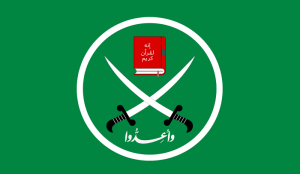 Muslim Brotherhood Flag. Photo: Public Domain, Wikimedia Commons
This is part two of a two-part series. See Part 1 HERE
If civilization jihad has a map inside the United States, Jim Hanson pointed to ground zero in local government, and the Islaist infiltration of American elections in general. Dearborn and Hamtramck, Michigan, he said, function as Moslem enclaves whose city halls are run overwhelmingly by Islamists even when the population is not uniformly Moslem. The “suburbs” of these Islamist strongholds include Paterson, New Jersey, Minnesota with Ilhan Omar, and of course New York City with an Islamist mayor.
Virginia also has an Islamist lieutenant governor. In my own New Jersey district (NJ 12), it’s personally unthinkable to think that we are on track to send to Congress a man who had defended the Blind Sheikh of the 1993 World Trade Center bombing. All eyes are on Michigan too, whose voters may send Abdul El-Sayed to become the first Moslem and Islamist US senator. Hanson called El-Sayed a gift to opponents because of El-Sayed’s orbit around Hassan Piker. But he still might win.
Are these coincidences of demography, or battles in a long-term strategy? Hanson said both. Numbers create momentum. The post-October 7 “red-green” alliance, campus keffiyehs, and invented genocide language, made it safer for previously quieter voices to run on grievance. Gaza and Iran, plus backlash against the Trump administration, gave the left a ready platform. Hanson still thinks the ticket can backfire if opponents will say out loud that a man with those associations should not hold a six-year Senate term.
He was also realistic about voter attention. The first question in this cycle, he said, is whether you like Trump or hate him. The second is the economy. Those two issues swallow about 90 percent of the electorate. That is not a reason to stay quiet. Voices in deep-blue districts still move other Democrats, Catholics in the Hispanic community, and anyone who rejects both socialism and a schoolhouse of hijabs and five-times daily prayers. He used “Islamo-leftists” for figures such as El-Sayed and Zohran Mamdani: socialists or communists who treat political Islam as benign or useful.
How did the country get here? Hanson traced the domestic story to the 1960s: a welfare state, a left capture of local government and universities, and a decision, after real civil-rights repairs, to treat Western civilization and Judeo-Christian foundations as the problem. Barack Obama’s “fundamental transformation” was, in Hanson’s hearing, the open version of that project. The melting pot became a salad bowl, then something less demanding still. Assimilation stopped being the price of entry. Borders and quotas that once favored people likely to become Americans gave way to a moral claim that everyone is entitled to come. Hanson would not bar all Moslem immigration. He would ask whether newcomers accept American civic norms. Subjugation of women, child marriage, and honor killing are not small cultural quirks. However, the Islamic value of Taqiyya- overt lying to “infidels” to achieve one’s religious goals – makes verbal promises cheap. Hanson’s answer is merit-based immigration and “extreme vetting.” No one has a right to enter. The applicant should have to prove why he belongs.
The outside pressure is not only migration. Egypt was the Brotherhood mothership until Morsi’s elected presidency ended in Sisi’s coup and the Cairo headquarters was wrecked. Saudi Arabia, Qatar, the Emirates, and Turkey all funded or hosted versions of the movement. Washington later forced the Saudis to cut much of the extremist money. The UAE stepped back toward wealth and quiet. Qatar still hosted Hamas leaders in luxury through and since October 7. Erdogan wants a neo-Ottoman Islamist role while remaining a NATO ally. Hanson said the Trump team’s warmth toward Doha and Ankara is ugly to watch and still part of a plan: peel Gulf states away from Iran, bargain over Gaza, and rearrange the region. Iran, he notes, is the larger geopolitical threat, fueled by money and a Mahdi theology of catastrophe. The Brotherhood’s fragmented civilization jihad is the larger threat inside the West. Most Iranian-Americans, he noted, want the regime gone. Yet Moslem Brotherhood-style politics wants neighborhoods, school boards, and ballots.
Hanson called the United Kingdom the canary in the coal mine: a country that has submitted to a Moslem minority, two-tier policing, and public-school arrangements that resemble madrasas. A UK resident watching the conversation live cited Sharia courts and Moslem mayors and asked if Britain can turn around. Hanson thought the analysis sound right, and the outcome uncertain unless nationalists broaden their appeal.
Pushback, as Hanson described it, is already happening where government will use power. Middle East Forum work, he said, has helped stop more than $2 billion in tax money to Islamist or terror-tied groups in the past two years. A $122 million USAID dossier of such funding sat unused under Biden for three years. On day two of the new Trump administration, it went to a State Department appointee. A week later the letters were coming off the USAID building. Funding, grant abuse, and civil-rights conflicts inside Moslem communities are the lawful pressure points. Social media and popular culture are the informal ones. The argument that works with neighbors is not “put them on a ship” and deport them. It is: many Moslems want a normal life, and some communities still have problems the public is allowed to name.
The long view, the solution or cure for the problem, is not a knockout blow. Hanson called it a clash of civilizations. The West is richer and freer and more fragmented. Islam has numbers, a coherent story, and a clear goal. He does not expect a front-porch peace. He expects a permanent case for the country people actually try to enter: the shining city, not Kabul in a burqa. Hanson called for this fight to be a priority in the upcoming presidential debates, on both party platforms, so the next occupant of the White House cannot claim surprise. The Moslem Brotherhood does not need Cairo if it has Dearborn, a school guide, and a safe district, much less a senate seat and the mayor’s residence of America’s largest city. The answer, in this conversation, is not a single law. It is funding cuts, vetting, local resistance, and the refusal to treat memory of 9/11 as a reason to go back to sleep.
Part two in a two-part series. See Part 1 HERE
Jonathan Feldstein is president of the Genesis 123 Foundation (www,genesis123.co) whose mission is to build bridges between Jews and Christians and Christians with Israel. He was born and educated in the U.S. and immigrated to Israel in 2004. He is married and the father of six, and grandfather of four (so far).
Two sons and a son in law are currently serving in the IDF and have been involved in combat in Gaza and Lebanon since the October 7, 2023 Hamas massacre in Israel.
Jonathan is a leader working with and among Christian supporters of Israel, and shares experiences of living as an Orthodox Jew in Israel through his work, writing, and as host of the Inspiration from Zion podcast. Since the war began, he has authored more than 150 articles, and participated in a similar number of interviews, briefings, prayer events, and more.
Jonathan is working with Christian leaders all over the world to realize a true peace in Gaza, details of which can be found at www.SolutionforPeaceinGaza.com.
In 2023 he published the highly acclaimed book, Israel the Miracle (www.israelthemiracle.com), which makes a great gift for Chanukah and Christmas, and year round.


Leave a Reply
You must be logged in to post a comment.