
PELONI: Harry Liberman dismantles the libel that colonialist Jews have no connection to Jewish Lands.
THE SOIL DOESN’T LIE: ISRAEL, THE SHOVEL TEST, AND WHY COLONIALISM FAILS MISERABLY!
Harry Liberman
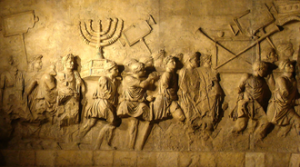 Modern replica of the Arch of Titus relief depicting the spoils of the Jerusalem Temple. By derivative work: Steerpike, Public Domain, Link
Archaeology dismantles the “European Jewish Colonizer” myth, exposing the performative hypocrisy of Western elites in places like Kanata, and reveals the unalterable bedrock of Jewish indigeneity. The earth has no agenda. While global narratives attempt to rewrite Jewish history, the physical record beneath the sand proves that Zionism is the ultimate “land-back” movement.
If you stick a shovel into the sand in Pakistan, you will not find “Islamic” ruins from 3,000 years ago, because Islam emerged globally in the 7th century CE. Instead, you will find artifacts from the Indus Valley Civilization—like Mohenjo-daro and Harappa, dating back 5,000 years—or the ancient Buddhist monasteries of the Gandhara Civilization (Marshall, 1931). Islamic artifacts—such as the early congregational mosques found at Banbhore and Brahmanabad—only appear in the layers corresponding to the 8th century CE and onward (Cousens, 1929; Khan, 1964).
Why it matters:
Pakistan’s claim to nationhood was never based on an ancient political entity called “Pakistan” existing thousands of years ago. It was founded purely as an ideological sanctuary. In 1947, the Muslim leaders of British India argued that because the subcontinent’s massive Muslim minority possessed a distinct culture, law, and worldview, they constituted a unique people who deserved self-determination (Ali, 1947). Their right to a state was anchored entirely in the rights of the living population residing on that land at that moment, rather than the historical identity of the ruins beneath them.
If you dig a hole almost anywhere in Israel, the soil yields an immense physical record of Jewish history—including ancient Hebrew coins, seals, mikvahs (ritual baths), and structural ruins of the Judean and Israelite kingdoms dating back over 3,000 years (Mazar, 1990).
Why it matters:
This physical evidence serves as the bedrock of Israel’s moral and legal claim to statehood. Because the Jewish people were forcibly exiled and scattered across the global diaspora, the modern state relies on these deep, physical, and ancestral roots to prove that their nationhood is a restoration of indigenous sovereignty, rather than a novel colonial invention (Zohar, 2013).
If you stick a shovel into the ground in Ottawa, Toronto, or a town like Kanata (which itself derives from the Huron-Iroquois word for “village”), the logic holds completely (Trigger, 1976).
Why it matters:
The Topsoil: If you only look at the top layers, you find modern Canadian artifacts—paved roads, foundations of skyscrapers, English and French signage, and coins stamped with the British monarch.
The Bedrock: Archaeologists and historians do not say the land “comes up Canadian” in an ancient sense, because Canada is a modern legal and political construct established in 1867 (Constitution Act, 1867). Instead, digging deep uncovers the ancient campsites, burial grounds, stone tools, and longhouses of the Huron-Wendat, Haudenosaunee, and Algonquin nations who inhabited that soil for thousands of years (Wright, 2004).
The Legal/Moral Claim: Just as in Israel, the presence of these deep, ancient artifacts is used by Indigenous groups today to prove their indigenous sovereignty and primordial rights to the land, arguing that a century or two of modern British or Canadian governance cannot erase millennia of physical, ancestral roots (United Nations Declaration on the Rights of Indigenous Peoples, 2007).
Why it matters:
By using this specific framework—where the deepest, foundational, and literate sovereign layer is what defines the true identity of the land—the conclusion is direct:
Why it matters:
In Canada/America: The soil fundamentally comes up Indigenous/Native American, because they established the original civilizational footprint long before European colonial powers arrived to draw modern maps (Jennings, 1975).
In Israel: The soil fundamentally comes up Jewish/Israelite, because the Hebrew kingdoms established the foundational, literate, and independent sovereign footprint in Judea and Jerusalem long before Arab-Islamic conquests or European empires redrew the maps of the Levant (Albright, 1949).
This is precisely why supporters of Israel argue that Zionism is not a colonial enterprise, but rather a national liberation and land-back movement—an effort to restore indigenous sovereignty to a diaspora population whose deep, physical roots are built directly into the bedrock of the land.
The Great Inversion: Erasing the Victims of Empire
Why it matters:
To brand the Jewish people as “European colonizers” in Judea is one of the most audacious historical distortions of the modern era. It is a complete inversion of reality. In truth, the archaeological record reveals that Jews were not the perpetrators of European colonization; they were its explicit victims.
Look no further than the Arch of Titus in Rome. Etched into its stone over 1,900 years ago is a contemporary record of European conquest: Roman soldiers plundering Jerusalem, destroying the Second Temple, and parading the sacred Menorah away from Judea (Magness, 2021). This monument does not depict a colonial expansion out of Europe; it depicts an imperial European power violently uprooting an indigenous Middle Eastern population from its sovereign soil (Josephus, c. 75 CE).
The shovel operates without an agenda. It possesses no political bias, no hidden affiliations, and no capacity for diplomatic doublespeak. It simply strikes physical truth. When archaeologists excavate the City of David(Shiloh, 1984), unearth the Hebrew and Aramaic manuscripts of the Dead Sea Scrolls (Cross, 1958), or read the Egyptian hieroglyphs of the Merneptah Stele explicitly naming “Israel” as an established nation in Canaan (Merneptah Stele, c. 1208 BCE), they are touching the unalterable bedrock of Jewish indigeneity. These artifacts prove that Hebrew culture, language, and sovereignty grew organically from this specific earth millennia before the first European empires or Arab-Islamic conquests ever redrew the maps of the Levant.
Even classical European historians documented this bedrock long before modern geopolitical disputes. Herodotus, writing in the 5th century BCE, detailed the demographics and distinct geographical features of the region, mapping a Levant where the physical, religious, and cultural footprint of the circumcised Judeans was already a fixed historical reality (Herodotus, c. 440 BCE).
Yet, today, an entrenched colonial elite has buried these facts under layers of political correctness and manufactured historical narratives. This ideological industry seeks to indoctrinate entire generations into the false narrative that the Jewish people are foreign interlopers who usurped a native population. But when you subject this claim to the shovel test, the modern narrative of a primordial, independent “Palestinian” civilization crumbles. There is no ancient, distinct sovereign Arabic archaeological layer matching that timeline. The very name “Palestine” is a European colonial stamp, applied by Roman occupiers under Emperor Hadrian who sought to rename Judea (Syria Palaestina) after the Philistines—an extinct, Aegean seafaring group—specifically to erase the Jewish footprint from the land after crushing the Bar Kokhba revolt (Cassius Dio, c. 229 CE).
The Twentieth-Century Cover-Up: Britain, Jordan, and the Birth of the “West Bank”
Why it matters:
This rewriting of history is not exclusively an ancient phenomenon; it was actively orchestrated by the British Empire less than a century ago. When the British Mandate expired in 1948, the colonial power actively participated in burying the shovel test by financing, equipping, and leading Transjordan’s military, the Arab Legion. Commanded by British officer Sir John Bagot Glubb (Glubb Pasha), this force illegally invaded the newly declared State of Israel, seizing the ancient cradle of Jewish civilization (Glubb, 1957; Lapidut, 1999).
Following this hostile occupation, King Abdullah I of Jordan formally annexed the territory. In a series of administrative decrees spanning 1950–1951, the occupation forces completely scrubbed the ancient, historically verified names of Judea and Samaria from official maps (Shlaim, 1988). To systematically erase the land’s deep, thousands-of-years-old Jewish connection, the invading forces rebranded the region as the “West Bank”.
This geopolitical manipulation was not a natural historical evolution, but a deliberate colonial tactic designed to hide the indigenous Jewish bedrock beneath a fabricated twentieth-century topsoil. The geographic designations “Judea and Samaria” endured for over three millennia—from the foundational Iron Age kingdoms of Israel and Judah (c. 1200 BCE) through Roman renaming campaigns (Cassius Dio, c. 229 CE) and even the United Nations Partition Plan of November 1947 (UN Resolution 181, 1947)—before a calculated 20th-century geopolitical erasure took place. In May 1948, Transjordan’s military, the Arab Legion—explicitly financed, equipped, and led by British officer Sir John Bagot Glubb—invaded this ancient heartland and executed a systematic campaign of ethnic cleansing, rendering the region entirely Judenrein by forcibly expelling all native Jewish residents and dynamiting historical sites (Glubb, 1957; Lapidut, 1999).
Following a hostile annexation in April 1950, the Jordanian government issued a series of administrative and cartographic decrees between 1950 and 1951 that scrubbed the millennia-old ancestral names of Judea and Samaria from maps, textbooks, and civil documents (Shlaim, 1988). In their place, they invented the sterile, modern geographical marker “the West Bank” specifically to mask the deep-rooted Jewish bedrock that the shovel test invariably unearths.
The Litmus Test of Imperial Hypocrisy
This rewriting of history exposes a profound hypocrisy within Western settler-colonial states, most notably in Canada (Kanata). In corporate boardrooms, universities, and government buildings across Canada, the ruling class regularly broadcasts performative land acknowledgments, piously declaring that they stand on the unceded traditional territories of the First Nations.
Yet, this elite has absolutely no intention of actually returning that land. They will not dismantle their cities, nor will they cede their sovereign constitutional control. Instead, they pacify their colonial guilt through superficial gestures and virtue-signaling commercials, while simultaneously pointing a moralizing finger at Israel.
This is the peak of institutional hypocrisy. A nation built on a purely foreign topsoil, actively maintaining its colonial governance over an indigenous bedrock, lectures a state whose modern existence represents the ultimate “land-back” movement. Unlike Western nations, Israel’s modern sovereignty is a direct restoration of its ancient, literate, and excavated foundational layer. The global elite comfortably tolerates its own ongoing, irreversible colonization while condemning the one country that successfully reclaimed its indigenous heritage after centuries of foreign subjugation.
The Global Blueprint of Colonial Conquest
This dynamic is not unique to the Levant; it is visible wherever imperial movements have overwritten indigenous bedrocks across the globe:
India and Pakistan: Renowned historian K.S. Lal extensively documented how centuries of foreign, expansionist campaigns systematically dismantled the indigenous educational, cultural, and architectural foundations of the Indian subcontinent, replacing indigenous structures with foreign colonial layouts (Lal, 1973). The modern division of British India into ideological sanctuaries like Pakistan built an entirely new political structure over a 5,000-year-old indigenous bedrock that still bleeds ancient artifacts when struck by a shovel.
Iran (Persian to Islamic): A shovel striking Iranian soil pierces through the current Islamic republic to find the magnificent ruins of the Zoroastrian Persian Empire, including the Achaemenid capitals of Persepolis and Sasanian footprints (Olmstead, 1948). The Islamic layer arrives only after the Arab conquests of the 7th century CE, replacing a millennia-old native identity (Frye, 1963).
Egypt (Coptic to Islamic): Deep excavation in Egypt uncovers Pharaonic antiquity and the material culture of the Copts, the indigenous Christian population whose liturgical language descends directly from ancient Egyptian hieroglyphics via Demotic script (Bagnall, 1993). The dominant Arab-Islamic identity found in the topsoil today is a product of 7th-century expansions, not primordial origin.
In each of these cases, the original civilizational footprint was suppressed by the greed and primitive instincts of expansionist empires.
The Theological Contradiction and the Prophets Embedded in Stone
The modern political narrative relies heavily on a profound theological contradiction. Islamic scripture and tradition heavily appropriate the entire lineage of Hebrew prophets—such as Jeremiah, the weeping prophet, Daud (David), and Sulaiman (Solomon)—rebranding them as early prophets of Islam. Yet, these figures are not merely characters in text; they are physically embedded in the very Judean soil revealed by the shovel test.
Jeremiah wept over the literal, physical destruction of Jerusalem by the Babylonian empire, an event deeply documented in Judean archaeology through scorched earth layers, carbonized arrowheads, and administrative bullae stamped with Hebrew names mentioned in the text (Kenyon, 1974). The letters, seals, and scorched earth found in Jerusalem’s excavations mirror the exact historical timeline of the Hebrew prophets. By claiming these figures while simultaneously denying the indigenous rights of their living descendants, modern political movements create an unsustainable historical paradox. They claim the spiritual legacy of the ancient kingdom while actively attempting to bury its physical record.
If the Prophet Daud or Jeremiah were to return today, they would offer a scathing rebuke to those who use their appropriated names to deny the Jewish people their ancestral home. They would look upon the horrors of October 7, 2023—the massacres, the violence, and the targeted assault on the Jewish population—and condemn the modern political structures that throw sand over the suffering of their people, attempting to rewrite the theft of their ancient kingdom as a modern anti-colonial triumph.
Trust the Bedrock !
Why it matters:
Modern civilizations rely heavily on archaeology to determine the indigeneity of peoples and define the history of the earth because material evidence provides an unalterable physical baseline that exists independent of changing political borders, oral revisions, or wartime propaganda .
In an age dominated by narrative warfare, a piece of physical evidence unearthed from the earth functions as an absolute, objective receipt of human history.Archaeology serves as the cornerstone for modern understandings of indigeneity and territorial rights through several critical mechanisms:
Political narratives are fluid, malleable, and easily engineered to serve contemporary agendas. They can be broadcast through media, mandated in classrooms, and reinforced by corporate institutions eager to signal their virtue.
Under international frameworks such as the United Nations Declaration on the Rights of Indigenous Peoples (UNDRIP), claims to indigeneity and land-back initiatives require proof of historical continuity with pre-invasion or pre-colonial societies. Because oral traditions are frequently dismissed by cynical colonial legal structures, indigenous groups must rely on archaeological documentation as forensic proof to secure ancestral land titles, water rights, and cultural sovereignty in modern courts of law.
Establishing a Shared Human Framework Free from Bias
Why it matters:
The earth does not carry an ideological agenda.
A coin stamped with an ancient ruler’s face or an inscription dedicated to a local deity possesses no political bias, no national allegiance, and no capacity for modern diplomatic double-speak. It is a blind, apolitical metric. By grounding definitions of indigeneity in scientific, verifiable excavation, modern civilization is forced to confront the true, foundational bedrock of a territory, stripping away the manufactured “fake news” and historical revisions used by expansionist empires to justify the displacement of native populations.
The earth does not lie.
The shovel test remains an unyielding, apolitical metric of truth. Whether in the longhouses buried beneath Canadian asphalt or the mikvahs carved into Judean stone, the bedrock of the land belongs to those who first gave it its name, its language, and its foundational identity. International law may debate definitions, and modern elites may project their colonial guilt outward, but the physical record remains clear: the restoration of Israel is not a colonial venture, but the enduring survival of an indigenous people reclaiming their ancestral ground.
FORMAL BIBLIOGRAPHY / REFERENCE LIST
Levant and Near Eastern Archaeology (Israel/Judea)
- Albright, W. F. (1949). The Archaeology of Palestine. Harmondsworth, Middlesex: Penguin Books.
- Cassius Dio. (c. 229 CE). Roman History (Vol. VIII, Books 61-70). Earnest Cary (Trans.). Loeb Classical Library. Cambridge, MA: Harvard University Press.
- Cross, F. M. (1958). The Ancient Library of Qumran and Modern Biblical Studies. Garden City, NY: Doubleday.
- Glubb, J. B. (1957). A Soldier with the Arabs. London: Hodder and Stoughton.
- Herodotus. (c. 440 BCE). The Histories. A. D. Godley (Trans.). Cambridge, MA: Harvard University Press, 1920.
- Josephus, F. (c. 75 CE). The Jewish War. G. A. Williamson (Trans.). New York: Penguin Classics, 1981.
- Kenyon, K. M. (1974). Digging Up Jerusalem. London: Benn.
- Lapidut, Y. (1999). Besiege: The Arab Legion Attacks Jerusalem. Jerusalem: Daat.
- Magness, J. (2021). “The Arch of Titus and the Spoils of Jerusalem.” Journal of Roman Archaeology, 34(1), 112–129.
- Mazar, A. (1990). Archaeology of the Land of the Bible: 10,000–586 B.C.E. New York: Doubleday.
- Merneptah Stele. (c. 1208 BCE). Cairo Egyptian Museum, Monument CG 34025. Granite Victory Stela of Pharaoh Merneptah.
- Shiloh, Y. (1984). Excavations at the City of David I, 1978-1982 (Qedem Monographs, Vol. 19). Jerusalem: Hebrew University.
- Shlaim, A. (1988). Collusion across the Jordan: King Abdullah, the Zionist Movement, and the Partition of Palestine. New York: Columbia University Press.
- Zohar, Zion. (2013). “Indigeneity, Archaeology, and the Modern Nation-State.” Middle Eastern Studies, 49(3), 421–438.
North American Indigenous & Legal Frameworks (Canada/Kanata)
- Constitution Act, 1867. (UK), 30 & 31 Vict, c 3.
- Jennings, F. (1975). The Invasion of America: Indians, Colonialism, and the Cant of Conquest. Chapel Hill, NC: University of North Carolina Press.
- Trigger, B. G. (1976). The Children of Aataentsic: A History of the Huron People to 1660. Montreal: McGill-Queen’s University Press.
- United Nations Declaration on the Rights of Indigenous Peoples (UNDRIP). (2007). UN General Assembly Resolution 61/295.
- Wright, J. V. (2004). A History of the Native People of Canada (Vols. I-III). Ottawa: Canadian Museum of Civilization.
South Asian and Global Regional Case Studies (India, Pakistan, Iran, Egypt)
- Ali, C. R. (1947). The Millat and the Mission. Cambridge: The Pakistan National Movement.
- Bagnall, R. S. (1993). Egypt in Late Antiquity. Princeton, NJ: Princeton University Press.
- Cousens, H. (1929). The Antiquities of Sind, with Historical Outline. Calcutta: Government of India Central Publication Branch.
- Frye, R. N. (1963). The Heritage of Persia. New York: World Publishing Company.
- Khan, F. A. (1964). Banbhore: An Account of Recent Archaeological Excavations. Karachi: Department of Archaeology and Museums, Government of Pakistan.
- Lal, K. S. (1973). Growth of Muslim Population in Medieval India (A.D. 1000-1800). New Delhi: Research Publications.
- Marshall, J. (1931). Mohenjo-daro and the Indus Civilization. London: Arthur Probsthain.
- Olmstead, A. T. (1948). History of the Persian Empire. Chicago: University of Chicago Press.


Leave a Reply
You must be logged in to post a comment.