
Walter E. Block & Hushang Manuchehri
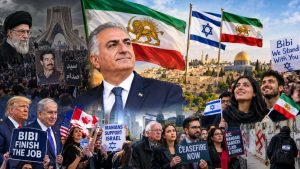 Image created via AI.
For nearly fifty years, the Islamic Republic has built its entire foreign policy identity around hostility to Israel. It severed diplomatic ties in 1979, handed the old Israeli embassy in Tehran to Yasser Arafat’s PLO, renamed the street outside it “Palestine Street,” and has spent five decades funding proxies dedicated to Israel’s destruction.
And yet in Jerusalem there is still a street named “Coresh”—Cyrus—after the ancient Persian king who freed the Jews from Babylon. Present day Tehran, meanwhile, backs the very factions that name public squares after Saddam Hussein, the man who gassed and slaughtered hundreds of thousands of Iranians. Israel still names streets after Iran’s greatest king. The irony tells you everything about which side actually speaks for the Iranian people.
Half a century of state-funded anti-Zionism simply hasn’t worked on ordinary Iranians. Walk onto a university campus in Tehran and you’ll see students pressing themselves against the walls to avoid stepping on American and Israeli flags painted on the floor by the authorities—a quiet, deliberate refusal that the regime can’t stamp out.
This defiance shows up in ways that confuse Western observers. Despite the real risk of prison or worse, large parts of the Iranian public—inside the country and across the diaspora—openly favor figures like Donald Trump, the late Senator Lindsey Graham, and Prime Minister Benjamin Netanyahu. In Persian pop culture and on social media, people affectionately call Netanyahu “Amoo Bibi” (Uncle Bibi) or “Bibi Joon” (Dear Bibi). No pollster can measure this properly—the threat of imprisonment makes standard surveys impossible—but the sentiment runs deep. Iranians see these leaders as the only ones willing to throw a genuine punch at the clerics holding their country hostage.
The clearest expression of where this energy is going is Crown Prince Reza Pahlavi. Millions of Iranians rally under his banner, and during the bloody January 2026 protests, crowds in the streets chanted for a return to the Pahlavi legacy rather than for any leftist or reformist alternative. That isn’t nostalgia so much as arithmetic: Iranians have already paid, in blood, for the “anti-imperialism” the left keeps selling them, and they aren’t buying it twice. Pahlavi understands this, and he has built an actual relationship with Israel to match it—a historic trip to Jerusalem in April 2023 to meet Netanyahu’s cabinet, followed by a September 2025 delegation of his advisors sent to map out cooperation directly with Israeli officials.
Western policymakers keep missing this. Diplomats and journalists routinely hand microphones to opportunistic leftist activists who use the Iranian cause to build their own profiles and secure grants, while repackaging the same anti-Israel, anti-American talking points the regime itself uses—just with sharper branding. Ordinary Iranians want nothing to do with either ideology. They want a clean break from both Islamist and leftist dogma, and a government capable of actually normalizing relations with its neighbors instead of arming militias against them. Investing in Pahlavi offers the West a clear Schelling point around which real opposition can converge, instead of scattering its support across factions with no credibility on the ground. (This is something that comes naturally to many people. For example if you are supposed to meet someone in New York City, but have no other information as to where, you might well choose Times Square on of the main focal points in the Big Apple).
You can see the same instinct across the diaspora, where speaking up still carries real risk to family back home. In Canada, Iranian-born Ontario MPP Goldie Ghamari has urged the Jewish community to bring Israeli flags to Iranian rallies, telling them plainly that Iranians do not hate them— only the regime does. When American and Israeli strikes hit regime targets, Iranian-Canadians didn’t protest, they celebrated, with activists describing the strikes as a rescue mission for the Iranian people rather than an attack on them. Other community leaders in Manitoba have pushed to have the Revolutionary Guard designated a terrorist organization outright.
It’s the same story in the United States. Demonstrators in Los Angeles carried signs reading “Bibi, Finish the Job” and “Support Israel, Oppose the Islamic Republic.” In Seattle, Iranian-Americans publicly backed Israel’s campaign against Hamas and Hezbollah, framing the regime itself—not Israel—as the force holding 80 million Iranians hostage.
Reza Pahlavi has said plainly that a democratic Iran would recognize Israel immediately, turning the Abraham Accords into what he calls the “Cyrus Accords.” That isn’t a fringe position. It’s the mainstream sentiment of a population that has been lied to about Israel for two generations and has simply stopped believing it. When diaspora crowds wave the Persian Lion next to the Star of David, they aren’t imagining some radical future. They are asking for their actual history back—one where Tehran and Jerusalem were once partners, not enemies, and where the only people who ever benefited from the hostility were the totalitarian men currently in charge of enforcing it.
Who stands against such an amalgamation? In England, it is politician Joshua Bonehill-Paine. In the US it is Bernie Sanders, Zohran Mamdani, AOC, and a whole host of Democratic Socialists who have recently won primaries against more established democrats who were not as quite as vitriolic about Israel as those they have unseated. This would include Donavan McKinney, Michigan, Chris Rabb, Pennsylvania, Janeese Lewis George, Washington, D.C., Brad Lander, New York, Claire Valdez, New York, Darializa Avila Chevalier, New York, Aber Kawas, New York, Melat Kiros, Colorado, Rashida Tlaib, Michigan, William Lawrence, Michigan, Abdul El-Sayed, Michigan. In Canada, those groups of people, mainly in Toronto and Montreal, who have been busily attacking Jews on the streets, shooting at synagogues, and drawing swastikas here, there and everywhere.
Why their support for the present murderous regime in Iran? Why their attacks on Donald Trump for warring against them? That is not too difficult to see. They have a visceral, passionate and all-consuming hatred for Israel. Under a democratically elected leadership, Iran would no longer launch and finance proxies such as Hamas, Hezbollah, Houthis, to plague Israel. Any enemy of Israel is a friend of theirs.


Leave a Reply
You must be logged in to post a comment.