
For now, the Badr agreement has no announced projects, budgets, or production timelines and the Mecca agreement signed a few months prior is already showing signs of strain.
By Anna Mahjar-Barducci, Middle East Forum | Nov 9, 2026
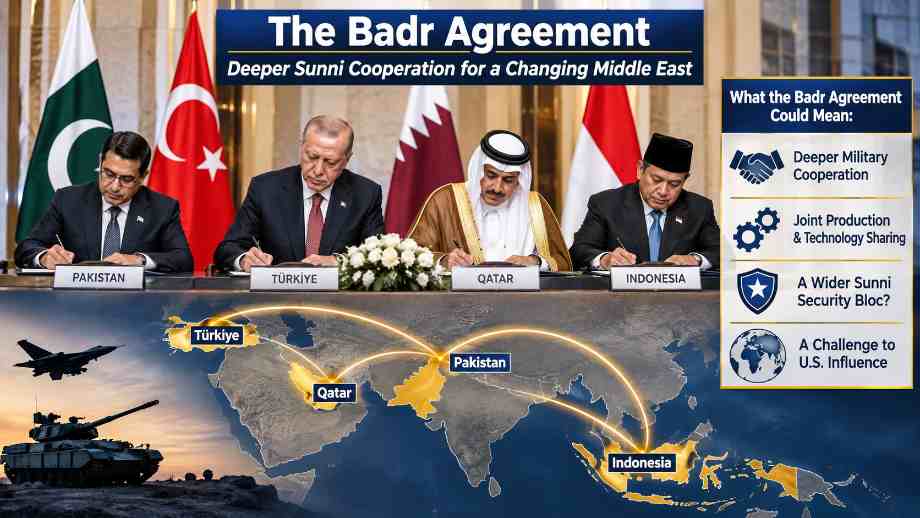 Click Image to Enlarge. Image created via AI.
Four Muslim-majority states signed a defense memorandum in Doha on October 21, 2026.
Pakistan, Turkey, Qatar, and Indonesia call it the Badr agreement. So far, it is a memorandum of understanding, not a treaty alliance.
However, the intention is plain: deeper Sunni cooperation. Ultimately, the Badr agreement might contribute to a broader Sunni security architecture.
The United States should be alert.
The Turkish Defense Ministry says the memorandum covers military production, research and development, technical training, and joint exercises.
Turkey supplies technology. Pakistan and Indonesia supply factories and skilled labor. Qatar supplies capital.
Pakistani Defense Minister Khawaja Muhammad Asif, Turkish Defense Minister Ya?ar Güler, Qatari Deputy Prime Minister Sheikh Saud bin Abdulrahman Al Thani, and Indonesian Deputy Defense Minister Yusuf Jauhari signed the text.
Other states may join under criteria the four will set.
The name carries religious resonance. “Badr” was the name of a pivotal battle in 624 CE, which marked a major shift for the early Muslim community as they became a major military force on the Arabian Peninsula.
The memorandum also follows the Mecca agreement, which ties Pakistan, Saudi Arabia and Turkey together.
Pakistan and Turkey also sit with Saudi Arabia and Egypt in the Regional Four (R4) group, which emerged in March 2026.
The goal is to build cooperation and interdependence, step by step, with a comprehensive Sunni Muslim security bloc as the end goal.
Chinese scholars interpret the Badr agreement as an attempt to reduce American influence in the region.
The China Global South Project reported that Ding Long, a professor at Shanghai International Studies University’s Middle East Studies Institute, told Jiefang Daily, a Chinese Communist Party-affiliated Shanghai newspaper, that the emergence of the Mecca and Badr agreements reflects the “decline in U.S. hegemony.”
Ding added that countries in the region are “no longer placing all their security bets on the United States,” as they instead seek to diversify their partnerships and spread risk.
At the same time, Ding warns that the proliferation of these security arrangements could fragment the regional security landscape and highlights the potential challenge to China’s arms exports to Pakistan.
This is also true for the West. Pakistan, Turkey, Qatar and Indonesia also want to reduce their reliance on Western weapons that come with strings attached.
Export licenses, sanctions threats, and training ties all lose force when a partner can buy or build elsewhere.
Washington should monitor the Badr agreement and clarify how the Countering America’s Adversaries Through Sanctions Act (CAATSA) applies.
The Badr agreement’s industrial pillar also creates a security problem. The four members buy weapons from many suppliers.
Turkey operates U.S. systems and focuses heavily on domestic NATO-standard production. Pakistan is a primary user of U.S.-origin equipment.
Qatar operates a diverse fleet of high-end Western equipment. Indonesia uses a significant amount of Western military equipment.
Joint production and technical training would bring these systems into the same workshops.
Engineers can study each other’s hardware. Reverse engineering becomes easier. So does unauthorized transfer.
A component licensed to one member could reach another member, or a third party, without its original supplier’s consent.
Washington and its allies should therefore watch Badr’s defense-technology flow closely.
They should press Turkey, a NATO member, to protect allied technology inside any joint project.
They should especially review the end-use conditions attached to U.S.-origin systems in Pakistan’s arsenal, especially given Pakistan’s close military ties to China.
The Badr agreement also raises a question about who else might benefit. Pakistan, Turkey and Qatar each have ties to Islamist groups.
Pakistan shelters Islamist militant factions. Turkey and Qatar both support the Muslim Brotherhood and host Hamas figures.
For now, the Badr agreement has no announced projects, budgets, or production timelines. The Mecca agreement already shows strain.
Turkey has yet to provide any offensive military support to Saudi Arabia against the Houthis in Yemen, and Pakistan’s contributions are more in homeland defense.
If that promise has yet to deliver, the Badr agreement’s industrial promise will need years to prove itself. Joint production demands standards, trust, and time.
Washington should act now, before the architecture hardens. The Badr agreement is open to expansion beyond its four founding members.
If its military cooperation deepens and its members begin coordinating their strategic interests, it could challenge Western influence, weaken U.S. leverage over arms transfers and sanctions, and create new channels for sensitive military technology to reach actors hostile to Western interests.
Israpundit is entirely dependent on readers support. Please help me continue educating people with the truth about what is going on in Israel and around the world.

Leave a Reply
You must be logged in to post a comment.