
PELONI: So Trump is supporting the conclusion that some agreement is being reached, which telegraphs a capitulation to the IRGC being maintained in Iran. See WIN report at bottom regarding the reported terms of the agreement by a Saudi regime news group, ie not to be taken at face value. Trump has been playing the Israelis and the Arab nations against one another since this war broke out, using the survival of the Iranian regime as the pivot by which to push each of them in turn. The Arabs require a surviving, weakened Iranian regime to offset the threat which a potential Israel-Iran block in the region might represent to them. Meanwhile, Israel requires an end to the existential threat which the Iranian regime represents in any form at all. While it should be understood that American interests would be paralleled next to that of Israel, this is not how Trump has placed himself, instead establishing a status quo, which was initially presumed to be maintained until after the midterms, but which now seems possible to be the intended end point of the war. Is this realistic? It would require an indefinite massive US military presence in the area, amid the potential for Iran to manipulate the US economy at any given moment. This seems to be a highly problematic solution for any potential of America’s pivot to Asia.
The president described the war as “ending quickly” while ruling out an immediate U.S. military withdrawal from the region.
By World Israel News Staff | World Israel News | Nov 10, 2026
President Donald Trump said Monday that the U.S.-Israel war against Iran has reached an end, changing his tone affter weeks of heightened tensions and increasingly forceful rhetoric from Washington, Tehran and Jerusalem.
“Iran militarily is effectively over,” Trump said during a press conference at the White House. “We’re just keeping it the status quo.”
The status quo Trump was referring to involves limited U.S. strikes on Iran’s Qeshm Island in recent days, targeting defense systems and technology used to threaten ships transiting the Strait of Hormuz, rather than major military installations or critical infrastructure.
Trump defended his decision to maintain an American military presence in the region after a reporter asked why he would not declare victory and withdraw U.S. troops.
The president said that doing so would effectively abandon Washington’s longstanding Middle Eastern allies, who could be left vulnerable without continued American military support.
“We have some great allies there, and we have to make sure they’re not hurt, and they would be hurt,” Trump said, referring to the potential consequences of reducing the U.S. military presence in the region.
He added that Washington was seeking a lasting agreement with Tehran rather than a temporary resolution to the conflict.
“We want to make sure [there is] a long-term solution — not just a short-term. They’ll never have a nuclear weapon, but we have to make sure that’s a long-term,” Trump said.
The president reiterated that the conflict was nearing its conclusion, stressing that the war with Iran was “ending quickly.”
Trump concluded his remarks by reaffirming his commitment to preventing Iran from developing nuclear weapons.
“I made the claim that they won’t have a nuclear weapon, and they won’t have a nuclear weapon,” he said.
The comments follow repeated assurances from Trump that the war would end shortly after the US midterm elections, which took place in early November.
His latest remarks contrast with the more aggressive rhetoric he used in recent weeks, when he warned that Iran would soon “get the hammer” if it continued delaying an agreement with Washington.
Trump reportedly agrees to allow uranium enrichment in Iran
World Israel News | Nov 9, 2026
“Iran militarily is effectively over… We’re just keeping it the status quo” seriously stepping back from his previous statements indicating threats of war.
Trump has previously denied Iran’s demand for domestic uranium enrichment.
By Vered Weiss | World Israel News | Nov 10, 2026
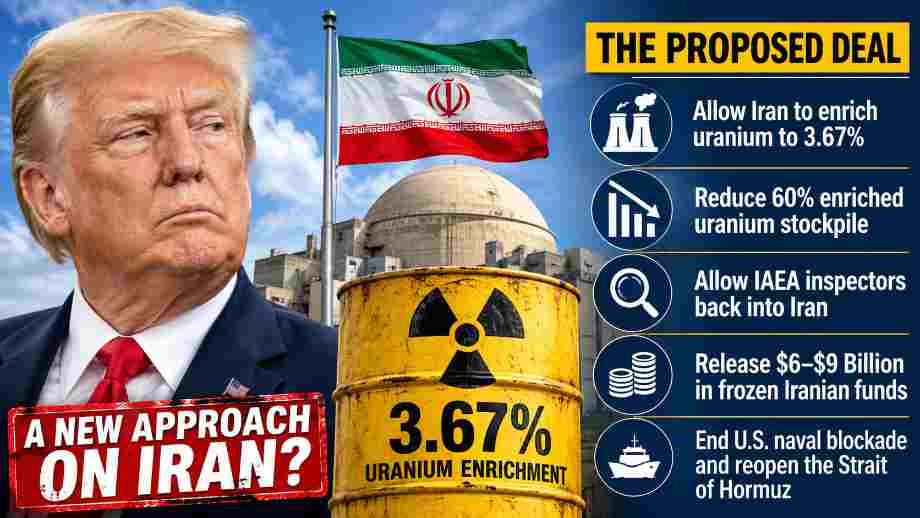 Click Image to Enlarge. Image created via AI.
The Trump administration has reportedly agreed to permit Iran to enrich uranium to 3.67% on its own territory under a new Pakistani-Qatari proposal aimed at advancing nuclear negotiations between Washington and Tehran, marking a departure from its previous opposition to Iranian enrichment.
Saudi news channel Al Arabiya, citing sources, reported that the proposal had revived serious negotiations between the United States and Iran.
In exchange for retaining limited domestic enrichment, Tehran would reduce its stockpile of uranium enriched to 60% to lower concentrations, potentially with assistance from a third country.
Under the proposed arrangement, inspectors from the International Atomic Energy Agency (IAEA) would also be permitted to return to Iran. However, the conditions governing their activities have not been specified.
The agreement would additionally provide for the release of between $6 billion and $9 billion in frozen Iranian funds once a deal is reached.
Washington would simultaneously end its naval blockade of Iran, while the Strait of Hormuz would reopen to unrestricted maritime traffic.
Trump had previously opposed allowing Tehran to maintain uranium enrichment capabilities.
In July 2025, he called Iran “stupid” for insisting on continuing enrichment and pledged to prevent the program from proceeding, according to Iran International.
That position remained unchanged in April 2026, when the White House described its opposition to domestic Iranian enrichment as a “red line” for the president, Al Jazeera reported.
During the same month, Trump claimed Iranian officials had accepted a plan allowing American and Iranian teams to recover enriched uranium and transport it to the United States. Iran’s foreign ministry disputed his account, according to CBS News.
By May 2026, Trump had indicated a willingness to consider a different arrangement.
The Times of Israel reported that he would accept a 20-year suspension of Iranian uranium enrichment rather than a permanent prohibition, provided Tehran offered a “real” guarantee.
Later that month, however, Trump told PBS News that Washington would not offer sanctions relief in return for Iran surrendering its highly enriched uranium.
Israpundit is entirely dependent on readers support. Please help me continue educating people with the truth about what is going on in Israel and around the world.


Leave a Reply
You must be logged in to post a comment.