
PELONI: More election maths exploring Bennet’s recent silence and Liberman’s recent boisterousness. It is important to note that these two are still actively positioning themselves for a potential future election. Let us hope that such an outcome materializes, even as it would seem to be more likely in the interest of the Left to cut whatever deal needed with the Haredi parties to prevent another roll at the election dice.
Yossi Baum | X | Nov 8
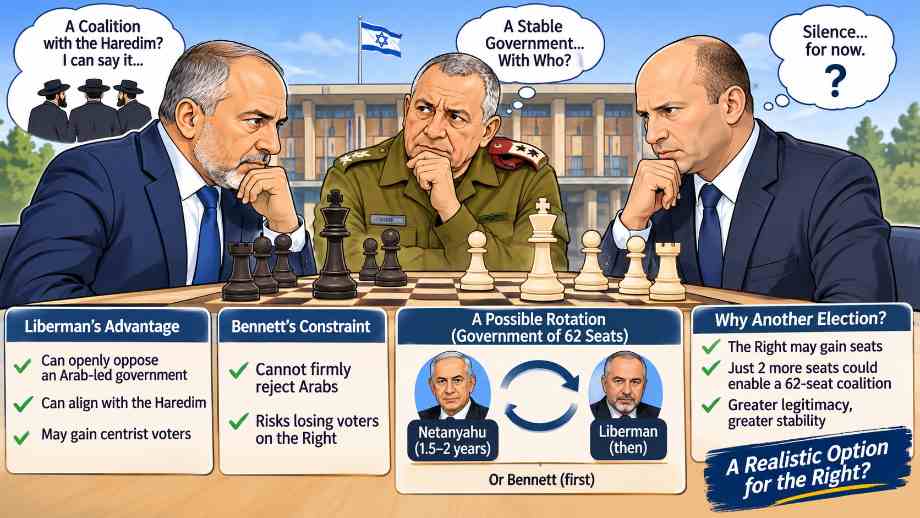 Click Image to Enlarge. Image created via AI.
For Those Who Want to Delve Deeper:
Each of the players takes into account the possibility that the Left will fail to form a government and that there will be another election. There are quite a few hurdles—mainly legal—that must be overcome in order to pass a conscription law that will entice the Haredim (ultra-Orthodox), and there are Deri [Aryeh Deri, leader of Shas, the Sephardi Haredi party] and Porush [Meir Porush, a senior figure in Agudat Yisrael, part of United Torah Judaism], who prefer elections. And here the question is what happens in a second round of elections, and this is where the difference between Bennett and Liberman lies.
Since Liberman’s voters are openly opposed to Arabs, Liberman has the ability to declare his willingness to join with the Haredim, on the assumption that most of his voters would probably prefer the Haredim over the Arabs, particularly if he receives a rotation in the premiership.
This is in contrast to Bennett’s voters, most of whom do not prefer the Haredim over the Arabs—if anything, it is the opposite: they prefer Arabs over the Haredim. Therefore, Bennett cannot declare, as Liberman can, that under no circumstances will he join a government with Arabs, because by doing so he risks his voters accusing him of sabotaging a left-wing government, and he would be crushed in the next election. Therefore, Bennett prefers to remain silent.
Liberman, by contrast, assumes that he will not be crushed in the elections, because most of his voters support his declaration. As for those who will not vote for him because he neglected the equal sharing of the burden, he will gain no fewer new voters from the Center who will prefer to vote for him because he has proven in practice that he is really unwilling to join with the Arabs (supposedly).
Since Bennett does not have the option of firmly declaring that he is opposed to a government with Arabs, Liberman is the only one from the Left bloc who can offer Eisenkot an alternative government—and that is a government with the Haredim. Such a government also has greater legitimacy (relative to a government with Arabs). Therefore, Eisenkot will be forced to compromise with Liberman on one form of rotation or another, if they indeed succeed in reaching an agreement with the Haredim.
And attention should be paid to another possible configuration, which is not currently feasible but could materialize later: The Right bloc has 53 seats, while Liberman and Bennett (excluding Lapid’s 5) each have 7. It can be assumed that each of them would be willing to join Netanyahu if he grants them a rotation in the premiership (for the sake of the example: Bennett or Liberman for the first six months, with Netanyahu receiving all the powers necessary to bring down the regime in Iran. After that, Netanyahu for a year and a half / two years, and then Liberman again).
At present, this cannot happen, because there would still be only 60 seats. At least two more defectors would be required, which is almost hopeless. But—and here comes the big but—the Right has a greater chance of gaining than losing from another election in any case (I elaborated on this in a previous post), and even if the Right gains only two additional seats in such an election, that would already allow Netanyahu to form a government in rotation with Liberman or Bennett (one seat is not enough because of Goldknopf [Yitzhak Goldknopf, influential former chairman of the Haredi Agudat Yisrael faction within United Torah Judaism] or Bitan [David Bitan, currently Likud chairman of the Knesset House Committee]) under the proposed formula.
If such a government is formed and has 62 stable seats, it can be assumed that additional defectors could be recruited who would actually support it, or who would be absent during critical votes.
Given the problematic configuration in which the national camp currently finds itself, this may be the most reasonable option one can imagine. And that is before we even discuss the fact that, in the meantime, Netanyahu continues to serve as Prime Minister of a transitional government (if a term-limit law is not passed. But let’s not get into that calculation, because we have already made ourselves dizzy enough).
Israpundit is entirely dependent on readers support. Please help me continue educating people with the truth about what is going on in Israel and around the world.


Leave a Reply
You must be logged in to post a comment.