
Struan Stevenson | Town Hall |
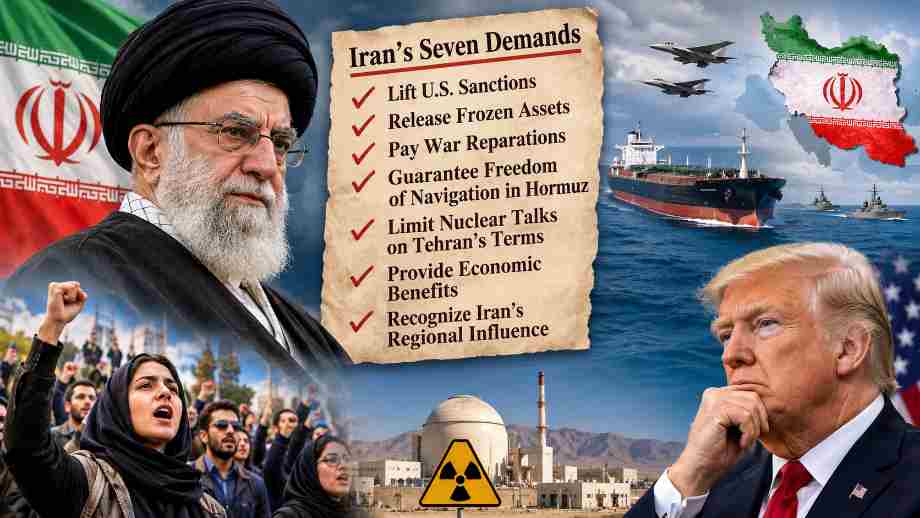 Click Image to Enlarge. Image created via AI.
There is something breathtaking about the audacity of Iran’s clerical dictatorship. Having dragged the Middle East into a devastating conflict, threatened international shipping, and attacked its neighbors, Tehran has presented Washington with seven demands that must be met before negotiations can begin. These reportedly include lifting American sanctions, releasing frozen Iranian assets, and paying war reparations. The mullahs want to be rewarded before discussing the consequences of their own behavior.
The proposal, delivered through Qatar, comes at a dangerous moment. With America’s midterm elections over, President Donald Trump has refused to rule out renewed military operations against Iran. Tehran threatens retaliation on an even greater scale. Diplomats are scrambling to prevent another explosion of violence across a region already exhausted by war.
Avoiding further bloodshed is essential. But confusing the temporary absence of fighting with durable peace would be a grave mistake. During my 15 years in the European Parliament, including five years as president of its Delegation for Relations with Iraq, I witnessed Tehran’s interference in neighboring countries. The regime cultivated militias, infiltrated political institutions, and exploited instability while presenting itself as a responsible diplomatic partner. The current negotiations bear the hallmarks of that familiar strategy.
Mohsen Rezaei, secretary of Iran’s Supreme National Security Council, has declared that the Strait of Hormuz will remain restricted until Washington fulfills Tehran’s conditions. A regime that has weaponized one of the world’s most important maritime passages is effectively demanding payment for restoring freedom of navigation.
Tehran has discovered a particularly cynical way of exploiting the crisis. It has announced exemptions for vessels from China, India, Iraq, and Qatar. Chinese and Indian ships may be charged transit fees, while Qatar receives free passage. India is expected to provide medicines, China offers political backing, and Qatar remains the principal diplomatic intermediary. This is no generous concession to international commerce. It is a calculated attempt to divide the international community, secure essential supplies, and extract political and financial advantages from a crisis of Tehran’s own making.
Israpundit is entirely dependent on readers support. Please help me continue educating people with the truth about what is going on in Israel and around the world.


Leave a Reply
You must be logged in to post a comment.