
PELONI: This is a must read article by Diana West. A long view of how to hijack a momentous opportunity of national reform, only to see it corrupted and crippled from within due to establishment personnel carveouts, both in the Reagan and Trump administrations, and how this resulting tale of chaos and limited successes bears on the personality and political positioning of VP JD Vance. Study this closely.
Diana West | Diana W | Nov 12, 2026
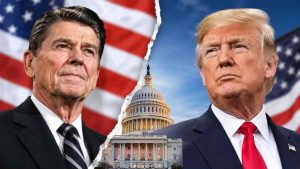 Click Image to Enlarge. Image created via AI.
Historian Richard C. Thornton called Ronald Reagan’s 1984 re-election in the largest electoral landslide in American history in many ways a “pyrrhic victory.” In the GOP-controlled Senate, Republicans lost two seats, narrowing their margin to 53-47. Despite Republicans picking up 16 seats in the House, the Democrats maintained a 71-seat-lead, 253-182.
Disappointing returns in Congress, however, were not the main problem. The thesis Thornton puts together in the final book of his tetralogy on the Reagan presidency, The Reagan Revolution IV: From Victory to the New World Order, would have it that it was the opposition forces within the administration, within the Cabinet, within the White House, that would finally and decisively in this second term triumph over the President and his Reagan Doctrine, ultimately reversing the gains, the promise of Reagan’s first term.
Reading through this American tragedy over last weekend, I had that nightmarish sense not of having been here before, but of being here right now. Right before our eyes, Donald Trump hurtled down the same precipice as Reagan before him. He has even been waylaid by some of the same traps. However different the times and players are, the reasons how and why this could be seem to be the same.
Reagan and Trump make a special pair in presidential history. Both men are not just “outsiders,” as they have often been called. Jimmy Carter was an outsider, and so what. Reagan and Trump are both “Interrupters.” This is a word Vladimir Bukovsky used to describe Trump in the early days of his first term, and it is apt. Reagan and Trump both interrupted the heavy-treaded momentum of the “establishment” agenda grinding forward through their respective eras. In Reagan’s day, that agenda carried the label of “detente,” then the current phase of accommodation, and of convergence with the Communist system centered in Moscow. In Trump’s day, the catch word was “globalism,” a more advanced stage of convergence following decades of national unraveling since the 1980s. Forty years ago, Reagan could articulate the Communist threat, the Soviet threat; and the American people, to some extent anyway, could understand it, see it. In our time, after so many years of attrition by these same forces and influences on every front including on our very own identity, Trump saw America slipping away, and wanted to build a wall to stop it. Reagan sought to win the Cold War and triumph over Communist Russia, thereby making American great again. Trump wanted to Make America Great Again. Both agendas existentially threatened the establishment agenda, which enables or advances the global communist project.
What went wrong? In spite of stunning successes, everything. The first problem was the Original Sin: Both presidents, both outsiders and Interrupters, encumbered themselves, ensnared themselves, and their administrations from the start with the very establishment their own policies and constituencies opposed. Reagan, Thornton writes, was quite open about the compromise, seeing it as the means to break impasses, and probably to win office in the first place. Having taken on George Bush as his vice president, Reagan also took on the huge establishment contingency that went with him. There were Reagan appointees, such as Edwin Meese, William Clark, Jeane Kirkpatrick; and there were GOPe appointees, such as James Baker, Alexander Haig. Treasury went to Reagan people under Don Regan; but OMB went to GOPe under Alan Greenspan’s choice, David Stockman. Often, Reaganite executives were paired with establishment associates. For example, William Casey at CIA had an establishment No. 2 in Bobby Ray Inman. Reagan choice Cap Weinberger at Defense, who took on a Kissinger man in No. 2 in Frank Carlucci. When George Shultz replaced Haig as Secretary of State, Schultz, in Thornton’s telling, became an overtly hostile rival to Reagan’s power within — which, in the Trump administration, seems to be the role Vice President Vance plays, and always has. Shultz would triumph early in 1987, shortly after the arrival of the new Congress elected in Reagan’s second term midterms (which is almost where we are now in presidential time). And therein lies Thornton’s tale, which he developed from many sources, including competing White House memoirs and a trove of largely unexploited information from the Iran Contra investigations.
Of course, Reagan at least had some people on his team who believed in what he believed in, starting with anti-Communism. The first Trump term was a personnel train wreck, start to finish. No strong MAGA contingent in sight. The first time I knew there was something really wrong with Steve Bannon was in early 2017. Bannon, then the new president’s “chief strategist,” explained the capitulation to the establishment on “60 Minutes” as a matter of necessity — but not political necessity. Bannon claimed that on winning the election, the Trump team came to the realization that there just weren’t any suitable MAGA appointees-in-waiting; in other words, we were all just a bunch of yahoos with yard signs, which I think is how Sebastian Gorka put it at the time. This was 100 percent false — and I’m thinking just off the top of my head of several excellent, credentialed candidates for senior national security positions — and Steve Bannon very well knew that. In this second term, is there any principal aside from Hegseth, Homan, who really seems to align with the Trump agenda? We can debate the Maybes, but the establishment — the “counter-state,” as Steve Coughlin would put it — still dominates. To be sure, it has blocked hiring, even input from the Islam-realist school of experts and national security professionals.
That sprinkling of anti-communists aside: No one on the Reagan team was ever able to come up to speed on the emerging Islamic threat, which, for all intents and modern purposes, began with 1979 fall of the Shah, which Jimmy Carter did so much to enable. Nearly fifty years later, how is it possible, and to our great detriment, that the same is true all the way up into the second Trump administration? The Islamic revolutionary threat has since the 1980s metastasized globally, including inside our own country, and there remains the same gaping hole in leadership, in understanding, in courage, when it comes to, first, defining the dangers that Communism and Islam both pose to our way of life, governance, survival; and, second, vanquishing them. Our predicament today is far worse because over the decades that hole has filled in with Islamic money and influence, even as our demographics now reflect the same. In recent years the payola is notoriously from Qatar; during the Bush/Murdoch years, Saudi Arabia was the public face of Islamic influence. That Qatari blandishments falling onto Trump and his family and key advisors — and all over everywhere else in Washington, DC — have grossly distorted and, in turn, interrupted any possible stirrings of a coherent counter-jihad policy can hardly be construed as accidental.
And yet. On February 28, 2026, Trump ordered the US military to attack Iran. This meant, however briefly, Trump broke away from his assorted establishment and Qatari minders. Secretary of War Hegseth put the event in its rightful context in a March 2, 2026 address:
Two days ago under the direction and direct orders of President Donald J. Trump, the Department of War launched OPERATION EPIC FURY, the most lethal, most complex and most precise aerial operation in history. For 47 long years, the expansionist and Islamist regime in Tehran has waged a savage, one-sided war against America. They didn’t always declare it openly, except for their constant chants of “Death to America.” They did it through the blood of our people. Car bombs in Beirut, rocket attacks on our ships, murders at our embassies, roadside bombs in Iraq and Afghanistan, funded and armed by Iranian Quds Force and IRGC killers.
My generation of veterans carry the names of brothers who never came home. Brothers butchered by Iranian-backed roadside bombs and well-armed militias, thousands of our own. We didn’t start this war, but under President Trump, we are finishing it. …
To the media outlets and political left screaming “endless wars” — stop. This is not Iraq. This is not endless. I was there for both. Our generation knows better and so does this president. He called the last 20 years of nation building wars dumb. And he’s right. This is the opposite. This operation is a clear, devastating, decisive mission. Destroy the missile threat. Destroy the navy. No nukes. Israel has clear missions as well for which we are grateful. Capable partners, as we’ve said since the beginning, capable partners are good partners, unlike so many of our traditional allies who wring their hands and clutch their pearls, hemming and hawing about the use of force.
If we rate the interruption of establishment agendas on a Richter scale, these words, this action, register as a 10. Victory marked by the surrender of the Ayatollahs and a free Iran would have shattered the status quo, and not only in the Middle East. It could have had all sorts of ramifications reaching right into our domestic politics, which are currently paralyzed by Jew-hatred and Jihad as political movements, which, incredible as it may seem to good, patriotic Americans, actually win elections, as we have just seen. Indeed, this is the new status quo, prized above all, above country, above freedom, by the same establishment forces who once fought Reagan to preserve the “detente” paradigm with the Soviet Union, and have been fighting Trump for a decade to preserve the global order. They were there in “Never Trump” at the beginning; and they are there now, working behind the Ballroom and all the Balayage. Their bottom line doesn’t change: The United States is never supposed to win anything. Thus, the once-in-two-generations Interrupters who improbably make it to the White House must themselves be interrupted, and by any means necessary. And, yes, in case it’s not painfully clear, this puts the establishment, whichever establishment, on or adjacent to the same page as of all of America’s enemies and adversaries, whichever enemies and adversaries. Connect the dots yourself. Sometimes you can even see a straight line.
Vice President Vance was Never Trump at the beginning; he is Never Trump now. In this adversarial relationship, the parallels to Bush and Reagan are clear. Naturally, there is night and day between Hegseth on Iran and Vance on Iran; indeed, it was Vance, whose barnyard-animal-noise “MOU” stopped the Iran War in its tracks — thus interrupting the Interrupter (who is himself always too easily interrupted — another story). Chalk one more up for the establishment eternal stabilization program.
And it is here where US history, from 1980s to the 2020s, rhymes like a mantra of doom. Thornton may well be right: It was a trap in Iran, set or used by the new world order faction that helped collapse Reagan; and, I believe, it is such a trap in Iran, set or used by its heirs, that has similarly brought Trump low. The fact is, both presidents foundered specifically due to “negotiations” with the mullahs of Iran — negotiations, which, in my opinion (born of suffering through a grueling Islamic education of sorts forced upon us by the attacks of 9/11) were doomed from the start. And obviously doomed from the start. You don’t have to be a genius or a vice president to know that.
Reagan’s covert negotiation-to-nowhere crashed and burned in what came to be known as Iran-Contra. Trump’s negotiations-to-nowhere — by contrast, conducted as public diplomacy — required more work to exploit. The “new world order faction,” or counter-state, had to throw gasoline on them to light up an opposition campaign against the whole idea of war against Iran. And it worked. Right after the election, Trump himself, aged, battered, Interrupter, actually mouthed the opposition campaign himself: The Republicans lost because of “war in Iran.” And “Israel,” too — which is at the heart of the unceasing agit prop.
What does Vance do? The Monday morning after this electoral avalanche of probable fraud and anti-American vitriol empowered a revolutionary-Islamic block on Capitol Hill, the veep meets with the Qatari PM about Iran. The two of them later meet with the president — which is not a good look. And what do you know? According to the story launched like a trial balloon in the Wall Street Journal:
Vice President JD Vance is considering face-to-face talks with a top Iranian security official as he emerges as the lead negotiator with Iran, say U.S. and Middle East officials and people familiar with the negotiations, in an effort to end a war seen as a drag on the Republican Party.
That’s the sound of the “new world order faction,” the counter-state, talking.
In recent days, President Trump has told top aides and counterparts he’s open to Vance restarting talks with Iran and has empowered him to negotiate, U.S. and Middle Eastern officials said. U.S. officials stressed that discussions about sending Vance to meet directly with Iranian officials remain preliminary.
Vance sent a letter in October to Iran’s Mohsen Rezaei, the hard-line secretary of Iran’s top security body, asking for a meeting…
Really, it’s too sickening to go on. Vance — America — sent a letter? America sent a letter asking for a meeting? To Mohsen Rezaei? Who is Mohsen Rezaei? Feel free to peruse this 2021 report here. I’ll quote one line: “Rezaei maintained a direct structural and operational relationship with Imad Mughniyeh (also known as Haj Radwan), who served as Hezbollah’s primary field commander. All of Mughniyeh’s extraterritorial operations, which included the 1983 Beirut bombings, were executed under a chain of command that ultimately ended with Rezaei.” He is also wanted by Interpol in connection with the 1994 bombing of the AMIA Jewish community center in Buenos Aires, Argentina, which killed 85 people. I’m not sure those are even the highlights of his resume of terror. Ironically, Rezaei was also involved in Reagan’s US-Iran debacle — debacle for us, that is, but not for Iran or the “new world order faction.”
Reagan’s Iran disaster was covert. It didn’t involve US military forces ever. It had nothing to do with the Iranian nuclear program, which wasn’t even a centrifuge in an ayatollah’s eye. Nonetheless, it had a lot to do with weaponry. Iran was fighting Iraq (1980-1988) and needed arms for its war against Iraq, especially as Moscow increased arms to Iraq. There was, as Thornton tells it, this notion to “open Iran,” initiate contact — excruciating to recall, they sent a cake — which might be sugarcoated as a flight of Grand Strategy fancy. However, it devolved into using US arms to ransom US hostages, who were being held by the proxies of Vance’s Penpal’s Iranian Revolutionary Guard Corps. In November 1986, the scandal broke as “Arms for hostages” — right around the time Reagan signed that disastrous Senate amnesty bill, by the way.
There are a couple of relevant points to extract from this tortuous history. It’s Thorton’s thesis that “the new world order faction” set the president up — certainly, capitalized on his exposure, which Secretary of State Schultz would finally use to wrest control of Iran policy from the White House to the State Department. (I haven’t even mentioned Nicaragua, which appears to have been re-engineered simultaneously into another killing field for the Reagan Doctrine.) As the Iranian gambit unraveled — in fact, just before its exposure in the Arab press triggered the US scandal — there came a day, October 29, 1986, in a meeting in Mainz, West Germany between North, Secord, Cave, Hakim and their Iranian contact, Bahramani, during which the light finally dawnethed and the Americans realized they have been had.
Quoting pp. 428-429:
Bahramani’s revelations meant that Reagan had not been supporting a moderate faction against hard-liners after all…The entire effort of shifting from Gorbanifar to a second channel had been a charade, cleverly managed by the Iranians to give the Americans the impression that they were moving closer to developing a political relationship.
As I search my mind for a grown-up word for “DUH,” I will note the nightmarish prospect of witnessing our current moment. This year’s on and off MOU negotiations, spearheaded by JD Vance, between the US and Iran, with Turkish and Pakistani and Qatari interlocutors, successfully derailed Trump’s boldest Interruption since closing the border — a blow which certainly played into the midterm disaster. In the eyes of the not so new world order, this counted as a victory. Under Vance, it’s possible that “negotiations” could go on indefinitely — the new “peace process.” They might even “succeed,” if, that is, success is measured by further undermining the American position. Asking for a meeting from a terrorist is a great start.
Thus, our Interrupters go down in history, flaws and all. We just go down.
Israpundit is entirely dependent on readers support. Please help me continue educating people with the truth about what is going on in Israel and around the world.


Leave a Reply
You must be logged in to post a comment.