
Michel Benchimol
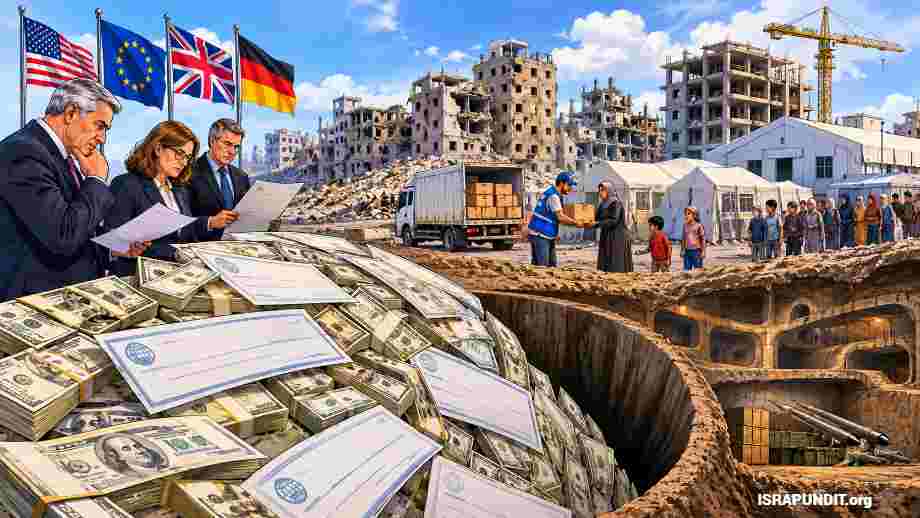 Click Image to Enlarge. Image created via AI.
Seventy-seven years of international financing, repeated wars, endless reconstruction and still no credible exit strategy. When will Western governments demand results instead of writing another cheque?
For seventy-seven years, the international community has poured billions of dollars into Palestinian refugee assistance, government operations, education, healthcare and reconstruction.
And what has this extraordinary financial commitment accomplished? No lasting peace, no end to refugee dependency, no financially self-sufficient Palestinian administration and no credible plan for ending the seemingly endless demands on Western taxpayers.
Seventy-seven years of financing, and the international community still appears to have no better solution than reaching for its chequebook. At what point does generosity become an excuse for political failure?
UNRWA: The Refugee Programme That Never Ends
Established in 1949 to assist approximately 750,000 Palestinian refugees, UNRWA now has nearly 5.9 million registered refugees, including eligible descendants—almost eight times the original number. That extraordinary historical increase is particularly striking amid repeated accusations of genocide against Israel.
According to figures compiled for this analysis, UNRWA received approximately $1.46 billion in 2023, $1.4 billion in 2024 and a reported $829 million in 2025.
While most of the world’s refugees fall under UNHCR, Palestinians have their own United Nations agency, complete with a separate mandate, bureaucracy and international financing.
What began as an emergency relief programme has become a multigenerational institution with no agreed exit date. Apparently, the answer to seventy-seven years of unresolved dependency is to finance another seventy-seven.
UNRWA’s mandate is to provide education, healthcare and humanitarian assistance. These are essential services, but maintaining them indefinitely cannot be confused with solving the refugee problem. More troubling still are the serious questions surrounding the agency’s neutrality and its exposure to Hamas.
A United Nations investigation found evidence indicating that some of UNRWA employees may have participated in the October 7 terrorist attacks. The findings exposed a deeply troubling failure of oversight and accountability within UNRWA, an organization entrusted with billions in international humanitarian assistance. That individuals implicated in terrorism could be employed under the United Nations flag raises serious questions about the agency’s screening procedures, institutional safeguards and commitment to neutrality.
How could individuals implicated in one of the deadliest terrorist attacks in Israel’s history have been employed by a United Nations humanitarian agency?
Meanwhile, Western taxpayers helped finance Gaza’s essential civilian services while Hamas invested enormous resources in tunnels, rockets, weapons and an underground military infrastructure designed to attack Israel. Weapons and tunnels have also been discovered at or near UN facilities.
Consider the contradiction: international donors helped provide the necessities of civilian life while Hamas devoted substantial resources to preparing for war. Gaza depended on foreign generosity for essential services, yet Hamas found the resources to build an extensive military network.
Donor governments should be demanding rigorous independent oversight, not simply accepting assurances that their money is being properly protected.
Hamas Starts the War. Gaza Is Destroyed. The World Gets Another Bill.
On October 7, 2023, Hamas-led terrorists attacked Israel, murdered civilians and took hostages. Israel responded militarily, and Gaza suffered catastrophic destruction.
Now comes another enormous reconstruction requirement.
The World Bank–UN–EU assessment cited in this analysis estimates $71.4 billion in recovery and reconstruction needs.
Seventy-one billion dollars. And that is a reconstruction estimate, not a guarantee that the conditions responsible for the destruction have been resolved.
Meanwhile, the U.S. Treasury has documented Hamas’s international financial networks, including an investment portfolio previously estimated at more than $500 million.
Hamas maintained substantial overseas financial resources while ordinary Palestinians remained dependent on international assistance for basic necessities.
The recurring pattern is deeply troubling. Hamas attacks Israel. Israel responds. Gaza suffers devastating destruction. International organizations appeal for assistance. Western governments face another massive reconstruction bill.
And unless the political and security conditions change, the danger of repeating the cycle remains.
What exactly are Western taxpayers being asked to finance? A lasting recovery—or another enormously expensive rebuilding programme with no credible assurance that the same infrastructure will not be destroyed in another war?
Humanitarian assistance must reach civilians, and allegations of aid diversion require evidence. But that obligation does not excuse donors from demanding enforceable safeguards, independent financial oversight and credible civilian governance.
Rebuilding Gaza without confronting the conditions that repeatedly expose it to war risks turning international reconstruction into a permanent financial obligation.
Nearly $65 Billion — And Still No End in Sight
Provisional OECD-based estimates compiled for this analysis indicate approximately $64.94 billion in inflation-adjusted international assistance to the Palestinian territories between 1993 and 2024.
|
Period |
Estimated assistance |
| 1993–1999 |
$5.38 billion |
| 2000–2009 | $18.44 billion |
| 2010–2019 | $26.16 billion |
| 2020–2024 | $14.96 billion |
| Total | $64.94 billion |
These provisional figures require verification against the underlying annual records. They do not represent all international assistance since 1949.
Nearly $65 billion over thirty-two years, before considering the full historical cost of refugee assistance or the latest reconstruction requirements.
That money has financed essential humanitarian services and helped millions of civilians. But it has not produced a lasting political settlement, sustainable financial independence or an end to recurring emergencies.
How many more billions must be committed before Western governments stop celebrating the size of their contributions and start demanding evidence that their strategy is working?
An international programme cannot be judged by how much money it distributes. It must also be judged by whether the conditions that make the assistance necessary are improving.
The objective should be to reduce dependency, not to create a system in which dependency becomes the justification for another generation of funding.
Even a Palestinian State Would Not Automatically End the Bill
Suppose a Palestinian state is established tomorrow. Does UNRWA disappear? Do nearly six million registered refugees automatically cease to be registered? Does the international financial obligation end?
No. None of those outcomes follows automatically from statehood.
Questions of citizenship, compensation, return and resettlement would still require negotiation. A Palestinian state would also need financing for infrastructure, institutions and economic development.
Without a negotiated refugee settlement and a credible institutional transition, international assistance could continue for generations.
Consider the potential cost if UNRWA registration continued growing at an illustrative annual rate of 2.75%:
| Year | Registered refugees | Illustrative annual budget |
| 2026 | 5.9 million | $880 million |
| 2030 | 6.6 million | $981 million |
| 2040 | 8.6 million | $1.29 billion |
| 2050 | 11.3 million | $1.69 billion |
These are hypothetical projections, not official forecasts. They assume constant regular programme spending per registered person in today’s dollars and exclude emergency relief and reconstruction.
Under this scenario, more than a century after UNRWA was established, the international community could still be financing a growing refugee assistance system.
A programme created in 1949 could remain a substantial international financial obligation in 2050—and beyond.
Is that a serious long-term strategy? Or have donor governments simply become accustomed to financing a problem without establishing how that financing might eventually end?
Conclusion: Stop Confusing Spending With Success
Seventy-seven years. Billions upon billions in international assistance. Repeated wars, repeated reconstruction, repeated promises of reform—and still no agreed end to the extraordinary financial dependency.
The problem is not a shortage of international generosity. It is the persistent failure to connect that generosity to a credible political, financial and security strategy.
Donor governments should be required to answer some straightforward questions. Where has the money gone? What measurable progress has been achieved? How effectively has assistance been protected from exploitation? Who will eventually assume UNRWA’s responsibilities? And what safeguards will protect the next massive reconstruction investment?
Essential humanitarian services cannot simply be abandoned. But protecting civilians must not become an excuse for avoiding institutional reform, independent scrutiny or difficult political decisions.
Compassion without accountability is not a strategy. Reconstruction without security is not a solution. And indefinite financing without a credible exit plan is not responsible government.
Western taxpayers deserve transparent accounts, enforceable safeguards, functioning civilian institutions and measurable progress toward reducing dependency.
After seventy-seven years, Western governments should stop congratulating themselves for signing cheques and start explaining why the cheques never seem to end.
Because if billions of dollars, decades of diplomacy and repeated reconstruction efforts still cannot produce a credible path out of dependency, the answer cannot simply be to demand another billion dollars and hope that this time everything will be different.
Israpundit is entirely dependent on readers support. Please help me continue educating people with the truth about what is going on in Israel and around the world.


Leave a Reply
You must be logged in to post a comment.