
Peloni: What is needed when dealing with the likes of the Mullahs of Iran is not a negotiator, but an idealogue who has the moral compass to distinguish between good and evil. This is not hyperbole, just as the images of bodies from the recent crackdown in Iran is not rhetoric. Recall too that the bodies of these protestors are but a fraction of the thousands of American dead who met their untimely fate at the hand of the regime with which Witkoff is trying to now cut a deal. From the Beirut barracks from 1982 to the barbarism of October 7, to the thousands of American soldiers butchered on the sands of Iraq, Iran has demonstrated their desire and capabilities of exacting a high price upon the American people, a price which should not be negotiated into allowing that price to continue to increase, but should in fact create a certain demand that the regime responsible for that butchers bill should be ended at the first opportunity…and the protest movement in Iran today presents Trump with just such an opportunity.
Witkoff is Negotiating with Iran’s Mullahcracy
Stephen Bryen | Weapons & Strategy | Jan 13, 2026
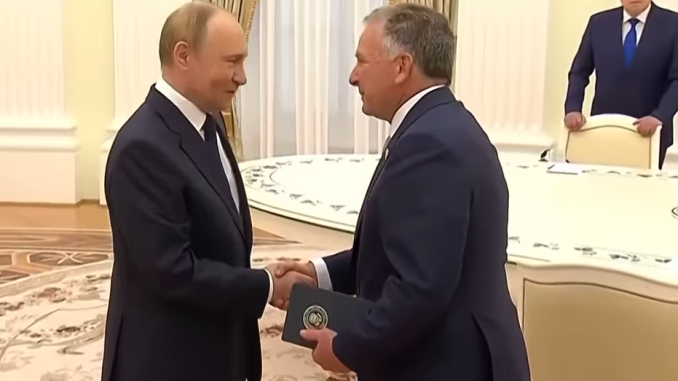 Putin-Witkoff meeting. Screengrab via Youtube
Steve Witkoff, President Trump’s fixer, has entered the Iran mess and is now talking to Iran’s leaders. This is a very bad sign for the Iranian revolution, because Witkoff’s approach is to fix “problems.” The Iranian revolution is not a problem: it is an unprecedented opportunity. By deflecting any US response to the ongoing crisis, whether intentionally or not, Witkoff could hand the Mullah’s a victory against the people of Iran.
Witkoff, as we know, has been Trump’s diplomatic fixer, starting with Gaza (which is still unsettled and in limbo), and Ukraine. Credit to him for getting the hostages, alive and dead, freed.
Witkoff’s intervention in Ukraine, most recently led to the Paris Accord, which Witkoff wanted to sign, but was told not to do so at the last minute after either President Trump, or Marco Rubio, perhaps both, saw the Accord as undermining Trump’s Alaska agreement with Vladimir Putin. Even with Washington’s pushback, Witkoff warmly endorsed the Paris deal, and pledged US support for it by supplying the most recent Coalition of the Willing (mainly the UK and France) with front-line intelligence support for their planned military deployment on Ukrainian territory.
Witkoff’s Ukraine intervention shocked the Russians. Putin regarded it as confrontational, and as a rejection of each and every Russian objective in Ukraine. It also amounted to an implicit rejection of the US-Russia strategic dialogue, one that included nuclear security agreements and various economic incentives and deals. Witkoff trashed all of that, allegedly frustrated with the Russians when actually it was the Ukrainians and Europeans who refused any serious dialog with Russia, even though some European leaders, Friedrich Merz, the German Chancellor, and Georgia Meloni, Prime Minister of Italy, openly called for meeting with Russia to try and sort out Ukraine and address other matters impacting European security. It is noteworthy that neither Merz, or Meloni, both attending the Paris meetings, refused to sign the Accord or to agree to send troops to Ukraine.
Witkoff’s turnabout on Ukraine may have reflected Trump’s frustration in not getting a deal, or there may have been other reasons unknown to us. Now he has turned his attention to Iran, most likely at Trump’s urging after the White House got pleading calls from Iran.
It seems Witkoff is engaging with Iran’s Foreign Minister, Abbas Araghchi. Araghchi, the grandson of an Iranian rug merchant, got his PhD in political thought from Kent University in the UK. He speaks fluent English.
Araghchi is offering some sort of nuclear deal if the US stays out of Iran and stops supporting the revolutionaries. Putting aside the likelihood that, no matter what the deal, Iran will cheat its way around it, the more important point is that a nuclear deal is far from the most important issue for either the US, the people of the Middle East, or for the Iranians revolting against the repressive Mullah-run regime.
Many believe that the root of the turmoil in the Middle East traces directly to Iran. Gaza would never have happened had Iran not planned the attack on Israel, not shipped weapons to Hamas or provided extensive training and military and intelligence support to Hamas.
The same is true in Yemen (Houthis), Lebanon (Hezbollah), Syria (Hezbollah, ISIS), Iraq (Kataib Hezbollah, Asa’ib Ahl al-Haq, Kataib al-Imam Ali, and Badr Organization) and many others. Iran’s goal is the destruction of Israel and forcing the US out of the Middle East and Persian Gulf. It sponsors terrorist operations, supplies weapons (including drones and rockets), military and intelligence training, provides operatives and offers intelligence to America’s adversaries.
There is no sign Witkoff is discussing any of Iran’s trouble-making in the region, or its activities beyond the Middle East, for example in Europe, North America, Africa, South America, and Asia. From what we know, the discussions are limited and follow offers from the Iranian side.
Witkoff’s bargaining could confuse President Trump, causing him, and his administration, to misunderstand what really is at stake in Iran’s revolution.
The US does not have a great track record. The US has deserted friends and allies many times, or made promises that were not kept. Afghanistan is a great example, as are Vietnam, Cambodia and Laos. The US, at Yalta, sold out Eastern Europe. Trying to set things back on a positive track, Dwight Eisenhower, as a candidate for President and later as President, said the US would support revolutions against the then-Soviet occupation of Eastern Europe and the Baltic states. Yet when Hungary revolted in 1956, the US did not help and Khrushchev sent in the Russian army to suppress the Hungarian revolution, leading to thousands killed on the streets or executed after the revolt was crushed, and hundreds of thousands fleeing Hungary.
Iran wants a free hand to kill everyone opposing the regime. Thousands have already died, and Iran announced it will start hanging the freedom fighters very soon, if they have not already started.
There is no reason to bargain with the Mullahs or with their thugs.


Witkoff is an embarrassment to the Trump Administration and all who pray for an end to the Iranian terror regime.
Witkoff is an embarrassment to Trump himself for relying on him.
Yes, I completely agree. I’ve been watching the news and hoping to hear of Trump’s intervention in Iran, with full determination to end this dreadful regime and help free the people of Iran, who deserve so much better. But what happens – a “negotiation”? On what grounds? What could possibly justify keeping these evil mullahs in power when there is this once-in-a-lifetime oppotunity to rid Iran and the world of their terror regime? Bad show, America.
Not so long ago, Persia was home to a beautiful civilization. Muslim, yes, but moderate. And a source of great poetry, painting and architecture. Look at it now, and weep.