
Peloni: Failing to appreciate and react to the threat of the Muslim Brotherhood which is insidiously invading the US will only serve to add to its great success in conquering it from within. The transnational nature of this corrupting, violent and subjugating anti-Western ideology and organization requires that it be assessed correctly as a threat to both the Western world and Western culture from every aspect of its various iterations. The ready access of the Muslim Brotherhood in the US only serves to pervert the West against itself. The influence of this anti-American ideological organization must be ripped out root, branch and leaf. The act of removing only those elements which are conveniently untethered to the corruption of the West will allow it to grow with a festering effect til it has consumed America entirely, just as it is currently consuming Europe.
Trump must also act against the organization’s patrons – Qatar and Turkey
By: Yigal Carmon | Memri | Dec 8, 2025
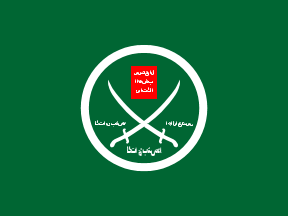 Muslim Brotherhood flag. Photo by NorthTension – Own work, Public Domain, Wikipedia
On November 24, 2025, U.S. President Donald Trump issued an executive order to consider designating chapters of the Muslim Brotherhood (MB) in Jordan, Egypt and Lebanon as terrorist organizations, due to their involvement in violence and destabilization efforts that harm the region as well as U.S. interests.[1] Against this backdrop, journalists and liberals in the Arab world published articles praising the decision, viewing it as a sign of international recognition of the threat posed by the MB. They regarded it as a positive and necessary first step, given that the organization is responsible for extensive bloodshed and is the nucleus from which many terrorist groups, including Al-Qaeda and ISIS, emerged.[2]
However, many Arab journalists argued that President Trump’s decision was insufficient to halt the spread of the MB’s extremist ideology. They called on him to take broader and more comprehensive action against the movement as a whole, as well as against the states that support and finance it, namely Qatar and Turkey. Some also called to outlaw the Doha-based International Union of Muslim Scholars (IUMS), many of whose members belong to the MB and which receives support and funding from these two countries. [3] The writers argued further that eliminating the threat posed by the MB requires deeper measures, including exposing all of the movement’s networks and members, combating its cultural legacy, and implementing reforms in education and the media.
The following are translated excerpts from some of these articles.
The MB Is A “Shadow Empire”; Confronting It Requires Broader Measures Than Just Banning Its Activity
In an article on the website of the Saudi Al-Arabiya channel, Palestinian journalist Ayman Khaled described the MB as a “shadow empire,” and argued that banning its activity is insufficient: “…The MB is an empire that exists in the shadows… For this reason, dealing with it must involve broader [measures] than only banning its activity, since it is an entity that transcends borders and can change its appearance, discourse and policy — but not its objective. It has aligned itself with forces outside the Arab region… and caused much bloodshed, and I fear Gaza will not be the last example of this.
“But the worst thing of all is that it has torn apart families, homes and communities wherever it settled by planting [ideas] in the minds of its followers, [such as] the sanctity of the party, an obsession with loyalty, and the claim that political rule is one of the pillars of Islam – [a claim] that is belied by the scriptures and by [Islamic] practice. On top of the sanctity of the party, they added the idea of loyalty to the [MB leader, the Supreme] Guide, as though he is the one with authority — an idea they invented to help create a herd [of followers].”[4]
Action Is Also Needed Against the Countries That Support And Finance The MB, And Sustain Its Influence
Hamid Zanaz, an Algerian author and researcher living in France, criticized Trump for working to classify some MB branches as terrorist while simultaneously, for reasons of interests and alliances, maintaining friendly relations with “those who finance it and ensure its continued influence” – namely Qatar and Turkey. In his column in the London-based Emirati daily Al-Arab, Zanaz argued that action against the MB must not be confined to the security level. It must also involve a long-term plan that includes reforming the education systems, in order to prevent the organization from spreading its ideas among the younger generation.
He wrote: “…The American President’s desire to designate the MB as a terrorist organization seems to be a step in the right direction, and indeed a necessary step, for it finally recognizes that the danger lies not only in direct acts of violence, but in the ideological infrastructure that produces and reproduces the violence. International recognition of the threat posed by the [MB] organization is an important first step toward curbing its ability to expand in the guise of cultural, charitable and religious associations.
“But banning the organization’s [activity] is not enough. The real danger lies in its ideological and cultural legacy. Correcting this requires a long-term plan, beginning with a fundamental reform of school curricula; modern training for teachers to prevent the reproduction of the discourse of victimhood, conspiracy and the caliphate; cleansing the media of the MB’s ideologically-charged lexicon, and fostering a new civil consciousness based on the values of citizenship, rationality, and the freedom of man.
“Confronting the MB is not merely a security effort but a battle over consciousness. Purging the cultural and everyday space of the influence of this organization’s discourse will [only] be achieved by rebuilding the Arab-Islamic consciousness and breaking the psychological cycle that creates a link between sanctity and the state, between belonging and obedience, and between religion and a political enterprise.
“Ultimately, the main question is this: How can the American President designate the MB as a terrorist organization when he maintains friendly relations with those who finance it and ensure its ongoing influence? The answer, as Bob Dylan says in his famous song, is ‘blowing in the wind,’ and is lost between interests, alliances and conflicting stances.”[5]
The Decision Will Be Futile Without Action Against the Countries That Support the MB
Saudi journalist Mashari Al-Dhaidi, a columnist for the London-based Saudi daily Asharq Al-Awsat, likewise called for action against the countries that fund and support the MB, writing: “The decision of the Trump administration in the U.S. to ban and pursue some of the MB ‘chapters’ in certain countries is an important one, but it is neither firm, decisive or essentially sustainable… Why? Because some Western countries did this before the U.S., and others, such as France and Austria, did it at the same time — yet without any practical result…
“[This is because implementing] the decision runs into multiple difficulties. For example: How do we define the MB? What about those who are influenced by the MB culture? What about the countries that support the MB? What about the parties, organizations and individuals in the West that are allied with it?
“Under U.S. President Barack Obama, there were members in the [U.S.] administration who belonged to the MB or were influenced by it. Furthermore, there was a political-cultural ‘climate’ that matched the narrative of the MB media and politically accommodated this narrative.
“Has all of this disappeared with the wave of a hand?! Has anyone examined the content on social media and on podcast platforms in Arabic, French, English and other languages, to see how close or distant it is from the political-media discourse and messaging of the MB?!… The MB is not only a party and a security, economic, media, political, religious and social organization. It is certainly all of these, but it is also a network of global collaborations and connections. More than that, it is an idea that attracts believers…
“Indeed, it is possible to ban a party affiliated with the MB, to shut down one of its financial institutions, or to imprison or restrict a specific activist. But for the effort to be genuine and successful, certain conditions must be met, among them [taking] a comprehensive approach that is not restricted to the security or media levels, but also includes the ideological and educational dimensions…
“In order to effectively confront the MB, its worldview and its dangerous, divisive activity, a unified policy must be employed in dealing with the political incubators of this organization. In other words, does the decision to confront the organization’s chapters also imply confronting its sources, namely, the countries that support it?…”[6]
The International Union Of Muslim Scholars, The Spearhead Of The MB’s Global Influence, Must Be Outlawed As Well
Mauritanian writer Cheikh Ould Saleck called to expand Trump’s ban and take action against the entire MB movement, including its “spearhead”: the International Union of Muslim Scholars (IUMS), which is based in Doha and supported by Qatar and Turkey. He wrote on his X account: “The MB has sowed destruction and ruin across the Arab world, from east to west, and has established itself in Western capitals, using their democratic systems to consolidate and spread its destructive enterprise. [The MB] is the nucleus from which most terrorist organizations emerged: Al?Qaeda, ISIS, Jabhat Al?Nusra [in Syria], Ansar Al?Shari’a [in Tunisia], Boko Haram [in Africa], and many other organizations that have filled the world with violence and chaos.
“In recent years [sic], the organization has adopted a strategy of establishing political parties, which are recognized in some countries and which serve as a civilian façade that conceals its ideological and cross-border organizational activity. Today, the West has become convinced that the MB is the source of the ideological and organizational malaise that has nourished terrorism in its various forms. It is necessary to seize this historic moment and support the international trend toward restricting this organization.
“The U.S. President’s decision to designate the MB’s chapters in Jordan, Egypt and Lebanon as terrorist organizations is a positive first step, but its success depends on continuing to expose the organization’s true [face] and on demanding that it be outlawed on the international level. This will be possible only through a broad effort to uncover the organization’s networks and members — especially given that this is a clandestine organization skilled in underground activity, whose members are highly trained in the art of concealment.
“The most important first step is to outlaw the spearhead: the International Union of Muslim Scholars. This organization is the primary façade behind which the [MB] has concealed its activity and its ideological and organizational expansion throughout the world.”[7]
[1] The order reads: “Certain chapters or other subdivisions of the Muslim Brotherhood shall be considered for designation as Foreign Terrorist Organizations… The Muslim Brotherhood, founded in Egypt in 1928, has developed into a transnational network with chapters across the Middle East and beyond. Relevant here, its chapters in Lebanon, Jordan, and Egypt engage in or facilitate and support violence and destabilization campaigns that harm their own regions, United States citizens, and United States interests…” (Whitehouse.gov, November 24, 2025).
[4] Al-Arabiya.net, November 28, 2025.
[5] Al-Arab (London), November 28, 2025.
[6] Al-Sharq Al-Awsat (London), November 28, 2025.
[7] X.com/shabay35, November 25, 2025.


Leave a Reply
You must be logged in to post a comment.