
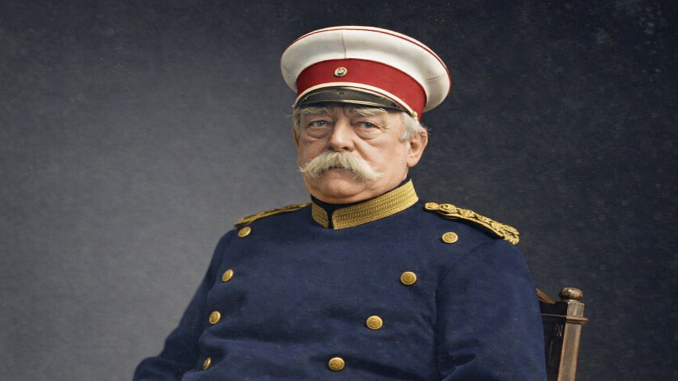
 Otto Von Bismark. By Braun et Compagnie – Kabinett-Photo, Public Domain, Wikipedia. [Cropped] [Colorized via AI]
Otto von Bismarck is often credited with the insight: “The aggressor is not the one who attacked; the aggressor is the one who provoked the attack.” This notion aligns with the Caroline Doctrine, which justifies preemptive self-defense as legitimate under certain conditions, as well as with principles of American self-defense law, which recognize that initiating physical violence isn’t the sole measure of aggression.
Nevertheless, labeling someone as an aggressor remains sharply contested, both legally and morally. Indeed, few phrases carry more weight in international diplomacy than unprovoked aggression. It has become a rhetorical weapon—used to condemn adversaries, justify military interventions, and shape public sentiment. Consider two contemporary cases: the American-Israeli strike against Iran and Russia’s invasion of Ukraine.
Since the 1979 Islamic Revolution, Iran has viewed Israel as a Western outpost and an illegitimate state. For over the last thirty years, Iran’s nuclear ambitions stirred global concern—underscored by repeated declarations from Iranian leaders calling for the eradication of Israel.
Over the past three decades, successive American presidents Bill Clinton, George W. Bush, Barack Obama, and Donald Trump have attempted to rein in Iran’s nuclear ambitions through a combination of diplomacy, economic sanctions, and international isolation.
The obstacle, however, lay not in flawed diplomatic style but in substance. The conflict was not caused by clashing national interests, which could be negotiated, but by Iran’s ideological absolutism, which Iran would not subordinate to its political and economic needs. Its theological rejection of Israel as a legitimate state, coupled with its nuclear ambitions, created a strategic environment in which deterrence was no longer sufficient. For Israel, the calculus was existential. The prospect of a nuclear-armed adversary committed to its annihilation rendered the preemptive military action a matter of national survival.
President Trump understood the predicament, aligned himself with this logic, and went along with Israel using American military power in effort to resolve the conflict once and for all.
Coincidentally, over the same thirty years, Russia’s strategic posture vis-à-vis NATO followed a nearly identical trajectory. Russia, which considers NATO irrevocably hostile, has sought to rein in NATO’s expansionist ambitions.
Moscow has consistently warned that it would not tolerate NATO’s eastward advance, which it referred to as yet another “Drang nach Osten,” a term originally associated with Hitler’s ambition to conquer Eastern Europe, especially Ukraine’s NATO membership, which Moscow defined as a red line.
Despite repeated warnings, NATO has continued to test Russia’s psychological endurance, repeatedly poking the proverbial Russian bear with promises of Ukrainian membership. At the 2008 Bucharest Summit, the alliance proclaimed that Ukraine “will become a member” in the future. Even in 2024, in the middle of the conflict, NATO stoked the flames by reinforcing this message, declaring that Ukraine was on an “irreversible path” to joining and applauding its deepening integration. As events have unfolded, it has become increasingly evident that Ukrainian membership has never been NATO’s true intent and appeared more like a deliberate provocation.
To sustain tensions, NATO has held annual naval exercises in the Black Sea near Crimea since 1997, under the codename Sea Breeze. These drills have included a few Ukrainian vessels – Ukraine did not even have a navy to participate in the drills. The largest iteration, held in 2021, involved 32 ships, 40 aircraft and helicopters, and 5,000 personnel from 24 nations. The impact was akin to the Russian navy performing drills in the Gulf of America near Florida.
Furthermore, as reported by the New York Times on February 25, 2024, the United States set up twelve intelligence?gathering centers in Ukraine to intercept Russian military communications, well before Russia launched its invasion on February 24, 2022.
In the autumn of 2021, President Putin made a final attempt to prevent conflict by sending a draft treaty to NATO, which included a promise not to invade Ukraine if NATO agreed to halt its eastward expansion, including Ukraine’s NATO membership. He received no response.
As NATO Secretary General Jens Stoltenberg told a European Parliament joint committee meeting: “So he (Putin) went to war to prevent NATO, more NATO, close to his borders….”
Stoltenberg inadvertently unveiled the truth. The conflict did not begin because Putin sought to resurrect the Soviet Union, or out of fear of the so-called Ukrainian democracy. Stoltenberg and the leadership of NATO were fully aware that Russia would eventually be compelled to act according to its security imperatives and invade Ukraine to alleviate the NATO threat at its borders.
Ironically, this conflict was not caused by clashing national interests either. NATO’s eastward expansion could hardly have been driven by Europeans’ security concerns, after all, in 1999, when NATO initiated its expansion Russia was at its lowest ebb economically, politically, and militarily. The move was undertaken for an objective whose purpose remains unclear, but the outcome of which was predetermined. In any event, the strategy of escalating Moscow’s anxiety about Ukraine’s impending NATO membership had been successful.
Despite the striking geopolitical similarities that led to the Russian invasion of Ukraine and the American-Israeli attack on Iran, the former was labeled by the global community as an unprovoked assault, whereas the latter was deemed preemptive and justified.
It tells us that in the realm of foreign relations, particularly, the interpretation of events can be highly intricate; it all depends on who shapes geopolitical narratives, who’s telling the story, and whose interests are at stake. Fatefully, the true aggressor is not always the one who fires the first shot, but often the one who is the last to pursue peace.
Alexander G. Markovsky is a senior fellow at the London Center for Policy Research, a conservative think tank that examines national security, energy, risk analysis, and other public policy issues. He is the author of “Anatomy of a Bolshevik” and “Liberal Bolshevism: America Did Not Defeat Communism, She Adopted It.” Mr. Markovsky is the owner and CEO of Litwin Management Services, LLC. He can be reached at alex.g.markovsky@gmail.com


For me, the most important element of this excellent analysis is this:
It is Islam’s religious, doctrinal imperative to rid the world of infidels and establish a worldwide Islamic caliphate. It is Islam’s megalomaniacal “convert or kill” religious commitment that transcends economics and politics. First comes Saturday, then comes Sunday. First the Jews/Israel, then the Christians/America. Islamic doctrine has remained unchanged for 1400 years and any “peace deals” with Islamic countries (Sunni or Shia) are taqiyya lies and hudna pauses all in service of establishing the Islamic caliphate. That is what President Trump needs to understand, everything else is details.
Very interesting and quite true that the provoker is to blame for the following aggression. Any beaten wife will confess… However, these platitudes won’t and don’t solve the problem.
Taking the Russia/Ukraine issue or the Iran/Israel/rest of the world issue as examplss, the threat offered by either side, if believable enough is certainly a provocation intended to cause a reaction. Often, the reaction is itself is a provocation that, if believed, will either cause one side or the other to call the bluff or back down.
I like the argument, seldom used, that if you play poker and lose, you can’t expect/demand to get your money back. Life doesn’t provide this opt-out. You played and lost. Cut your losses and quit the game. This is a particularly useful view of the “Palestinian”/Israel ongoing strife. The “Palis” play and lose but they want their money back. The problem here is that irrelevant of the sum involved or the stakes, if the so-called international community accepts this plea to get the “Pali” losses reimbursed, it is actually they who are being called upon to reimburse the loss.
In this case, it becomes much too easy to convert the victim into the aggressor, especially when it’s your wallet that is at stake. No wonder the claims that antisemitism is on the rise. The “Palis” lose, but the Israelis do too. Then we get to the story that the clever guy backs down, every time, till he us no longer clever.