
Peloni: The US preference of Jolani over the Kurds is a recognition of Trump’s preference to promote and strengthen Turkey in the region, something which will only lead to further Turkish expansion and greater recognition of Turkey’s growing dominance in the region. The only way this can lead to peace if all others in the region are forced into the subjugating role which the Kurds were forced to accept when abandoned by the US.
Syrian Democratic Forces’ collapse will intensify Turkish-Israeli rivalry while providing possible entry point for an Islamic NATO
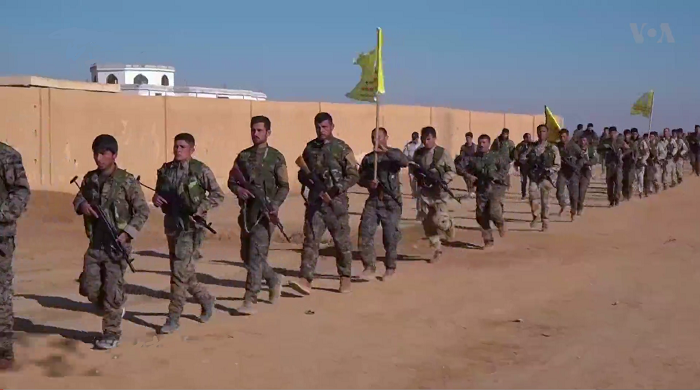 SDF fighters during the Northern Raqqa offensive (November 2016–present). Photo by VOA, Public Domain, Wikipedia
The Syrian Democratic Forces (SDF), a US-backed umbrella group dominated by armed Syrian Kurds from the YPG and linked to the PKK which Turkey designates a terrorist organization, rapidly collapsed over the weekend due to the coordinated defection of their Arab tribal junior partners.
Their geopolitical project of building an autonomous region organized according to PKK founder Abdullah Ocalan’s socialist-liberal “democratic confederalist” ideology, which the United States had exploited as a regional wedge, is now over.
The SDF’s dramatic reversal of fortune, from controlling Syria’s agricultural, energy and water resources for years to being forced by fast-moving events into a lopsided ceasefire that restores the central state’s authority over these assets and territory is largely attributable to three reasons.
The first is that this control was always fragile given tensions caused by the imposition of the group’s socialist-liberal “democratic confederalist” model on the authoritarian-Islamist tribal society of local Arab communities.
The second factor explains why mass defections had not occurred earlier: US military patronage of the SDF, which ended only under Trump 2.0. His new National Security Strategy deprioritizes West Asia and seeks broadly to avoid foreign entanglements.
As a result, the SDF’s role as a regional wedge against Iran’s local allies, Syria and Turkey became outdated. This helps to explain why the US did not block the dismantling of the group’s geopolitical project and instead stepped aside.
The final factor was a miscalculation by the SDF’s armed Syrian Kurdish core, which believed the US was a more reliable ally than ex-President Bashar Assad. Had they broken with the US before it abandoned them, they might have secured a deal for preserving part of their autonomous region.
New Syrian President Ahmed Sharaa decreed language rights and citizenship for Kurds shortly before this weekend’s events, but those measures fall short of the political and territorial autonomy for which many fought and died.
With the causes of Syria’s rapid dismantling of Kurdish autonomy established, attention now turns to the consequences. Chief among them is a major geostrategic victory for Turkey, which has eliminated the military and territorial threat posed by PKK-allied and Israeli-aligned armed Syrian Kurds, advanced its goal of subordinating Syria and can now focus more fully on expanding its influence eastward into Central Asia.
The first two outcomes challenge Israeli interests, while the third challenges Russia’s.
An intensification of Israeli-Turkish rivalry in Syria is already a concern for Israel, especially if Turkey leverages potential membership in a Pakistani-Saudi alliance to encourage those states, and possibly prospective member Egypt, to increase pressure on it.
This emerging “Islamic NATO”, emboldened by victories in South Yemen and Syria, could expand military cooperation in the Levant, including Syria and perhaps Jordan, and eventually into Central Asia, including Kazakhstan, in ways that threaten both Israel and Russia.
The consolidation of Turkish influence over Syria strengthens a nascent military bloc within the Ummah and supports the emergence of a new pole at the crossroads of Afro-Eurasia if its prospective members formalize their ties.
The US appears to tacitly approve of this, likely viewing an “Islamic NATO” of Arab, Pakistani and Turkic states as the ultimate wedge to keep the Eastern Hemisphere divided, given its geostrategic location and inherent frictions with Russia, India, Israel, the EU and Sub–Saharan Africa.
This article first appeared in Asia Times


Leave a Reply
You must be logged in to post a comment.