
by Uzay Bulut • Gatestone Institute • December 10, 2025 at 5:00 am
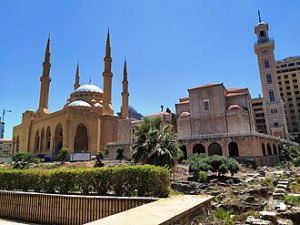 Today, Lebanon, like formerly Christian Turkey and Egypt, is majority-Muslim. The once-thriving Christian community has plummeted to roughly one-third of the population. Increasingly, Shia Hezbollah families, with financial backing from Iran, have been purchasing properties in Christian areas, threatening Christians with weapons, and gaining wider control while many Christians flee the country. Pictured: Mohammad Al-Amin Mosque and St. George Maronite Cathedral, Beirut, Lebanon. Photo by Rados?aw Botev, CC BY 3.0 pl, Wikipedia
- Christianity — Maronite, Orthodox, Catholic, as well as other denominations — was the dominant religion in the entire Levant before the Islamic military invasions and conquests in the seventh century. Constantinople (renamed Istanbul in 1930) was the capital of the great Christian Byzantine Empire.
- After defeating the Byzantine Empire in 636… the Islamic Arab Caliphate conquered Lebanon…. Today, Lebanon, like formerly Christian Turkey and Egypt, is majority-Muslim.
- Shia Muslims in southern Lebanon have been moving to Christian areas, increasingly displacing the Christians there. Increasingly, Shia Hezbollah families, with financial backing from Iran, have been purchasing properties in Christian areas, threatening Christians with weapons, and gaining wider control while many Christians flee the country.
- “Christians also have lower birth rates than Muslims. Muslims can marry more than one wife and create many more children than in monogamous marriages.” — Habib C. Malik, Lebanese retired associate professor of history and cultural studies at the Lebanese American University, to Gatestone, November 2025.
- “The new Lebanese government and President have pledged to ‘disarm’ Hezbollah and concentrate all weapons in the hands of the state-run Lebanese armed forces, but so far very little of this has actually happened; the pro-Iran group has been openly defiant in handing over its arms.” — Habib C. Malik, to Gatestone, November 2025.
- “Hezbollah remains an armed force capable of paralyzing the Lebanese state and defying its policy of concentrating all weapons in the hands of the Lebanese authorities. Hezbollah, which still has several MPs in the Lebanese parliament and at least two ministers in the Lebanese cabinet, act as a state-within-a-state inside Lebanon and are the main obstacle thus far preventing a Lebanese-Israeli peace treaty from materializing.” — Habib C. Malik, to Gatestone, November 2025.
- “Whatever the preferred political outcome, it would help if the West could shepherd any such process to protect the Christians and their freedom.” — Habib C. Malik, to Gatestone, November 2025.
Although Lebanon is in the news today largely due to the actions of the terror group Hezbollah and the economic hardships in the country, Lebanon in the mid-20th century was one of the wealthiest, most prosperous and stable countries in the Middle East. It was also, until a few decades ago, the only majority-Christian country in the Middle East. Thanks to its being a center of commerce and a thriving mixture of Muslims, Christians and Jews, Lebanon was known as the “Switzerland of the Middle East” and its capital, Beirut, as the “Paris of the Middle East.”
Lebanon, historically, was a Christian-majority land. The religion was introduced to the area in the first century by St. Peter and St. Paul, and the faith spread early throughout the region.


Leave a Reply
You must be logged in to post a comment.