
Like Versailles, it is a Disaster for all the Players
Stephen Bryen | Weapons & Strategy | Jan 08, 2026
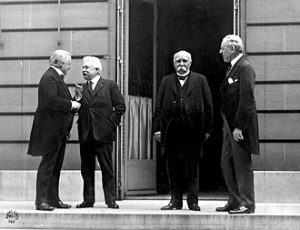 Paris Peace Conference, 1919. The heads of the “Big Four“ nations at the Paris Peace Conference, 27 May 1919. From left to right: David Lloyd George, Vittorio Orlando, Georges Clemenceau, and Woodrow Wilson, By Edward N. Jackson (US Army Signal Corps) – U.S. Signal Corps photo, Public Domain, Wikipedia
The Paris Accord aimed at providing security and economic guarantees for Ukraine is a strange agreement. If it is taken seriously, it will convince the Russians to change their strategy in Ukraine, meaning the Russians may well decide to try and take over all of Ukraine. The Accord gives nothing at all to Russia, which was probably its intent. It has the same bad smell as the Versailles Treaty, which the US Senate rejected.
Officially Russia’s strategy is to secure the goals it has set for the Special Military Operation. While NATO does not accept the terminology, the Russians have operated in a framework defined below:
1. Territory: Russia aimed to secure the five areas which Russia has already annexed, using the traditional boundary lines for each area. Russia fully controls one of the five, namely Crimea. For the other territories Russia controls: Luhansk, 99.6%; Donetsk, 78.1%; Zaphorize, 74.8%; Kherson, 72%.
2. NATO: Russia insists on keeping NATO out of Ukraine. This means no NATO bases or operations in Ukraine.
3. Government: Russia wants a Ukrainian government friendly to Moscow.
4. Military: Russia demands a reduction in the size of Ukraine’s army.
5. Remove Ukrainian Nazis: Russia wants to rid Ukraine of the ultranationalists in the army and in the government, which the Russians usually define as Nazis.
6. Protect Russian-speaking Ukrainians. Russia wants equal treatment for Russian language speakers in Ukraine and restoration of the Russian Orthodox Church and other Russian institutions, educational and cultural.
The Paris Accord is based on a cease fire being reached in Ukraine. Assuming that one was reached today, Russia would fall short of its territorial goal.
On all the other points, Russia would not only get nothing, but it would suffer a massive setback powerful enough to topple any Russian government.
Below are some of the negative consequences for Russia or the Paris Accord, if it actually was implemented.
(1) NATO’s main members will organize and operate in Ukraine with no agreed or fixed deadline. This is a little like the Versailles Agreement which put the Rhineland under Allied Forces occupation; put Allied garrisons at key crossings in Cologne, Koblenz and Mainz, created a 10 km demilitarized zone east of the Rhine (on German territory), returned Alsace-Lorraine to France, ceded Eupen-Malmedy to Belgium, placed the Saarland under League of Nations control, with France controlling Saarland coal and awarded eastern territories to Poland including the “Polish Corridor (Eastern Pomerania) for sea access, plus the province of Posen (Poznan) and parts of West Prussia and Upper Silesia. The Allies were supposed to withdraw from the Rhineland in a phased manner in 15 years. The Germans also got slapped with a massive debt payable to the Allies.
As I have pointed out before, those who support the accord are a coalition of NATO-willing, meaning that states in NATO that would oppose a NATO operation in Ukraine, have been put in the freezer. The decision to isolate states that won’t go along with an expanding NATO utterly changes the NATO Alliance and may eventually lead to its dissolution. (This is the same game the EU is playing.)
The size of the troop commitment under the accord (so far) is said to be between 7,500 and 15,000. The British, who speak loudly but have a de minimis army, are steadily reducing the size of their armed forces troop commitment for the Accord because they hardly have any to spare. UK Prime Minister Starmer says he will submit the Accord to Parliament for approval. Where he will get funds for the endeavor is another matter, as Britain has almost no credible expeditionary capability. If fighting actually re-started after a ceasefire, the UK and France would need to rapidly expand their troops in Ukraine and would have to send tons of armaments, which both lack.
Had the US signed the Accord, it almost certainly would need US Senate approval under the Advise and Consent Clause (Article 2, Section 2) of the Constitution, requiring a two-thirds vote in the US Senate. There is a better to even chance it would be rejected.
According to news reports, Turkey agreed to manage the ceasefire in the Black Sea. While Turkey does control the Turkish Straits (Bosporus, Sea of Marmara, Dardanelles) under the 1936 Montreux Convention, exactly how the Turkish navy, perhaps including the Turkish air force, can control the Black Sea, and what the parameters for control means, is anyone’s guess. For sure the Russians, whose oil, agricultural and mineral exports go through the Black Sea and the Straits, will want to know what Turkey has pledged and whether they would accept the Turks expanding their role.
(2) Under the Paris Accord there is no change in the Ukrainian government, leaving the Russians with a hostile neighbor keen on getting back its territories and punishing Russia. The Accord is entirely silent on whether or not Ukrainian drones and missiles can be fired at Russian territory, including Moscow.
(3) There is no reduction in Ukraine’s army. In fact, the Accord anticipates rebuilding Ukraine’s army to either 700,000 or 800,000 troops, and sets up heavily fortified arms manufacturing installations throughout Ukraine. In short, the agreement anticipates a much stronger Ukrainian army that could try and take back lost territories. Because the framework is launched after a ceasefire, there is no provision for recognition of any of Russia’s territorial gains. Nor is there anything in the accord that would prohibit Ukraine from using its modernized and western-backed army from restarting the war to reclaim lost lands. In short, Ukraine gets security guarantees but Russia gets nothing.
(4) There are no provisions of any kind about Ukrainian internal politics. The Russian idea of cleaning Ukraine of “Nazis” is not included in the accord and in any case is pie in the sky unless Russia took over all of Ukraine.
The Paris meeting was attended by France, the UK, Germany, Italy, Canada, Turkey, Poland, the United States, the EU and NATO officials. However, only France and the UK actually signed the accord. The US, speaking through the US representative, verbally endorsed the deal, offering both military intelligence help and economic support, but, at the last minute according to news reports, the President’s special envoy Steve Witkoff, did not sign. Neither did the Poles, Canadians, Italians, or Germans. Of these, the German Chancellor said Germany would provide troops to a NATO country near Ukraine. Most likely, if we are speaking of NATO countries bordering Ukraine, these are Poland, Slovakia and Romania.
The Paris Accord, which is meant to reassure Ukraine and pressure Russia into a deal, in fact does the reverse. If the Russians agreed to a ceasefire, they would acknowledge they have failed in virtually all of their objectives in Ukraine. In short, the Paris accord makes the continuation of the war a certainty with Russia thinking about modifying its claims on Ukraine for the worse.


This war was completely unnecessary. It began because the West acted provocatively in Ukraine and Putin was, understandably, alarmed. Ukraine was intended to be a neutral buffer between Nato countries and Russia. I believe the war was a result of an unholy alliance between greedy Western companies hungry for new markets for their shoddy products and the arms manufacturers, who always make a profit regardless of who wins. This “accord” will do nothing to encourage peace but will make the situation even more tense than it is now.