
Peloni: It is time to see if America remains the world’s superpower or if it is in fact too constrained by commitments and regional dependencies to pursue policies which are in fact in its own interest rather than to support those of its waffling allies and opportunistic adversaries. While it is said that no man is an island, the world’s superpower must be capable of being exactly this, or accept the reality that we truly have come to stand in a multi-polar moment with American strength and geopolitical dominance only a remnant of its former capabilities. While some believe America has the strength and will to succeed in deciding this struggle in her own favor, others will certainly disagree. Yet the only opinion which is truly relevant in this moment is that of Pres. Trump, whose legacy will in no small part be decided in how he reacts to the Iranian menace, be it in the coming hours, days or weeks.
Report on the Iran Negotiations, 2/27/2026
Stephen Bryen | Weapons & Strategy | Feb 27, 2026
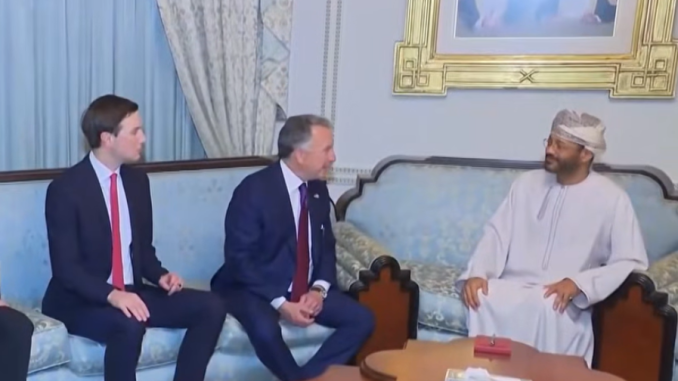 Special Envoy Steve Witkoff and Jared Kushner met with Iran’s Foreign Minister in Oman on Feb. 6, 2026. Screengrab via Youtube
The indirect negotiations in Geneva between the US and Iran, mediated by Oman concluded their latest meeting. Oman said there was “significant progress” made by the two sides.
The US position is significantly weaker that it was earlier because the terms of any deal have been significantly narrowed and watered down. Trump also is in a tough spot since the Iranians have managed to give him a take it or leave it challenge, where it would be difficult for Trump to have support from US allies.
Britain Won’t Support the US if it Attacks Iran
The British, America’s closest ally that involves a special relationship, already have stepped away from any support role for US forces and closed their bases to US operations if there is an Iran war. The closure could include British strategic bases in the UK that support US long range bombers and fighter aircraft or even Diego Garcia in the Indian Ocean.
Technical Talks in Vienna
Reports say that discussions will now move to “technical talks” that will take place early next week and that a fourth US-Iran bargaining session could follow. The technical talks will happen in Vienna, Austria, where the headquarters of the IAEA (International Atomic Energy Agency) is located. During the talks in Geneva, IAEA and its Director General, Rafael Grossi participated as technical advisors to both Iran and the United States.
The US has not officially commented on the outcome of the talks. In the meantime, the the US ambassador to Israel, Mike Huckabee, said that non-essential personnel and the family members of diplomats at the US Embassy in Israel should leave the country as fears grow that war with Iran is imminent. Parallel with the Huckabee announcement, the top U.S. military commander in the Middle East, Central Command Admiral Brad Cooper briefed President Trump on Thursday about the options for military action against Iran. The Chairman of the Joint Chiefs of Staff, General Dan Caine, also attended the briefing. Caine had earlier reportedly warned about significant risks of US military action on Iran.
Role of IAEA
According to reports, the IAEA and Grossi were consulted in drafting the “technical requirements” for “curbing” Iran’s nuclear activities, such as calculating enrichment levels (e.g., reducing stockpiles to 1.5% or 5%) and determining the fate of sensitive facilities like Fordow and Natanz. The IAEA was also asked what a “robust inspection regime” would look like in 2026, especially after Iran had previously severely limited inspector access, including some “military” locations, by blocking any inspections.
According to some reports, Grossi tried to bridge the gap between the US position of “zero enrichment” and Iran’s claim of its “peaceful nuclear rights.” Apparently Grossi offered some sort of compromise where Iran would be allowed to enrich uranium for some specific purposes, for example the use of enriched uranium for medical treatment.
Medical Use of Uranium
However, for medical uses highly enriched uranium (bomb grade at 90%) is no longer used. Over the last decade, almost all major medical isotope producers (in countries like Belgium, Australia, and South Africa) have successfully switched to Low-Enriched Uranium (LEU), which is enriched to less than 20%. Uranium is used to produce Molybdenum 99 which decays into Technetium-99m. This is the workhorse of nuclear medicine. It isn’t clear what Grossi had in mind.
Immediately after the latest negotiating round Iran claimed it would not under any circumstances give up its right to enrich uranium.
The IAEA meanwhile said it could not verify current levels of Iran’s enrichment program.
Assuming that the current negotiating process is consistent with President Trump’s expectations, there are some conclusions that can be reached.
US Abandons Most Iran Demands
Firstly, the US has abandoned most of its other claims on Iran other than Iranian enrichment. For example, the US has given up on insisting on restrictions on Iranian ballistic missiles, abandoned any ideas that Iran stop its support of proxies such as Hezbollah or the Houthis, and dropped its insistence that Iran agree not to punish or kill regime protestors. None of these topics are any longer part of the negotiations.
Some in the administration don’t agree with this shift by Trump’s negotiators or by Trump himself, particularly Marco Rubio. Rubio, so far at least, has been sidelined even though he nominally controls the US foreign policy process and heads, ad interim, the National Security Council. Instead the negotiation seems to be in the hands of Witkoff and Kushner, who report directly to Trump.
Son of the JCPOA
Second, any final package would appear to resemble some slightly enhanced version of the Obama administration deal called the Joint Comprehensive Plan of Action (JCPOA), that was adopted in 2015. That deal was between Iran and the P5+1 (the five permanent members of the United Nations Security Council (UNSC)—China, France, Russia, the U.K., U.S.—plus Germany) together with the European Union. Whether other nations will ratify a new deal, let’s call it the “Son of the JCPOA” remains to be determined, but seems unlikely.
Trump called the JCPOA deal unacceptable and withdrew US support for the arrangement.
Term of the Proposed Deal
One of the issues surrounding such a deal is its term. The US negotiators want it to be a forever deal, which Iran does not accept. Iran is probably looking for a deal that will run between two and five years at most. The Iranian timeline probably corresponds to Iran’s internal estimate on how quickly it can design a deliverable nuclear weapon mounted on its long range ballistic missiles, especially hypersonic speed missiles.
Likely Result
As noted above, judging from the negotiations and next steps, it seems the Trump administration has backed off most of its demands and is likely to accept a “Son of JCPOA” solution. This will leave the Mullahs and the IRGC in charge in Iran and potentially bring an end to the attempt to replace the regime.


Leave a Reply
You must be logged in to post a comment.