
Peloni: The foul sickness of Jew Hatred which has taken hold in the psyches of many in our current age is a frightening and growing event. Where it might lead and how it might end is clearly uncertain at this point, but if past proves prophetic as is too often true, we are facing an ever greater calamity which will forever cast a shade of shame for those inheriting the mantle of the Greatest Generation which recognized this soiling scourge as a clear death knell of morality and decency. As the chants for the annihilation of the Jews of Israel are followed by Jew Hunts in Amsterdam, Jew Shaming in Harvard, Jew Ransoming in Gaza and Jew Slaughter in Australia, the grand old generation which made an easy transition from defeating the Nazis to defying the Communists could only look down in shame at the rogues which are filling the streets of the modern world which were paved with the cost and privilege of facing down the very evil which is today made more and more commonplace among people we know and whom we once considered to be honest and good folks, only to find that they have morphed into the fountains of Jew Hating propaganda which would have made them the pride of Goebbles.
The charge was as ugly as it was predictable, reaching reflexively for conspiracy when accountability proved inconvenient.
Stephen M. Flatow
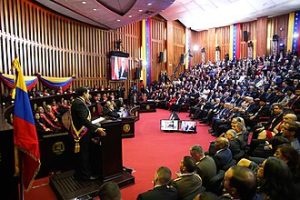 Proceedings inside the Supreme Court during Maduro’s second inauguration in January 2019. Photo by Presidencia El Salvador – Flickr, CC0, Wikipedia
The first reaction from Nicolás Maduro’s allies was not denial, reflection or even outrage over the mechanics of his reported rendition. It was an accusation. Almost immediately, regime figures and sympathetic outlets claimed the operation bore “Zionist fingerprints”—that it was inspired, guided or orchestrated by Israel. The charge was as ugly as it was predictable, reaching reflexively for conspiracy when accountability proved inconvenient.
This tactic is familiar. When authoritarian regimes are exposed, they externalize blame. When legitimacy collapses, they invoke shadowy forces. “Zionism” becomes a convenient all-purpose villain, capable of explaining away corruption, repression and failure without requiring introspection. The accusation says nothing about Israel, and everything about the moral and political bankruptcy of those making it.
Stripped of propaganda, the event itself was stark and unprecedented. Maduro, president of Venezuela since 2013 and long indicted by the United States on narco-terrorism and corruption charges, was removed from power through force-backed legal action rather than a popular uprising or conventional military intervention. Whether one applauds or questions the tactic, it reflects a conclusion Washington had delayed making for years: Venezuela under Maduro no longer functioned as a legitimate sovereign state.
That conclusion did not arise in a vacuum. Maduro’s most recent presidential election was widely viewed, inside and outside Venezuela, as stolen. Opposition candidates were barred or sidelined, electoral institutions were firmly controlled by the ruling party, and independent verification was denied. Opposition tallies indicated that Maduro suffered a decisive defeat despite the official declaration of victory. The aftermath—mass protests, arrests and renewed repression—only deepened the legitimacy crisis. Sovereignty rests on consent. When consent is replaced by fraud and coercion, claims of inviolability weaken accordingly.
This context is conspicuously absent from much of the international criticism. The United Nations, along with progressive advocacy groups, rushed to condemn the U.S. action as a violation of international law and a “dangerous precedent.” The language was familiar and immediate, delivered with little apparent interest in how Venezuela reached this point.
Such reactions have a distinctly knee-jerk quality.
Invocations of sovereignty and non-interference are offered as absolutes, untethered from legitimacy, accountability or reality. Yet the same institutions issuing grave warnings have shown limited success, if not outright failure, when it comes to protecting stability, democracy or civilian life in their own regions. Their sudden reverence for international norms rings hollow when measured against years of selective enforcement and selective outrage.
International law was never intended to function as a perpetual shield for regimes that steal elections, dismantle institutions and transform the state into a criminal enterprise. Sovereignty is not a magic cloak that converts narco-authoritarianism into legitimacy. It is a responsibility owed to citizens and neighbors alike. When that responsibility is abandoned, appeals to legal formalism lose their moral force.
From a strategic standpoint, the U.S. action reflects a long-overdue acknowledgment that Venezuela had become more than a domestic tragedy. Under Maduro, it evolved into a hemispheric problem: exporting narcotics, laundering money, destabilizing neighbors and welcoming hostile foreign actors. Millions fled the country. Regional stability suffered. What was once framed as internal dysfunction became a clear external threat.
This is where history matters. Nearly two centuries ago, the Monroe Doctrine articulated a basic principle: The Western Hemisphere should not become a staging ground for destabilizing forces hostile to regional security. Over time, that doctrine was abused, diluted and often caricatured, but its core premise endured. America has legitimate interests in preventing threats from taking root in its own neighborhood.
Today’s threat is not European colonialism but the normalization of fraudulent regimes that cloak criminality in sovereignty while inviting America’s adversaries into the hemisphere. By that measure, drawing a firm line is not recklessness; it is overdue clarity.
The claim of a “Zionist operation” will persist in hostile media because it serves a purpose. It shifts blame outward, activates familiar antisemitic tropes and reframes regime collapse as victimhood rather than failure. But slogans cannot erase reality. Maduro did not fall because of Israel. He fell because his regime exhausted every claim to legitimacy.
For the United States, this moment signals a recalibration—away from performative restraint and toward enforceable red lines when stolen elections, criminal governance and regional instability converge. Critics may object on principle. But principles that cannot distinguish between sovereignty and impunity deserve scrutiny, not deference.
If this episode marks a modernized return to Monroe Doctrine thinking—grounded in accountability rather than ideology—it will be because the old guardians of the so-called “rules-based order” proved unwilling or unable to enforce that order themselves.


https://www.snopes.com/fact-check/trump-machado-nobel-peace-prize/