
PELONI: Our past is etched into the very land we walk upon and by the hands of nonother than our own forefathers, and the record of this revelation lies entrusted by time to the ground on which footfall drop with each step we take. Reflecting upon this fact, I am often reminded of the passage by Yeats which states : “Tread softly because you tread on my dreams,” but in Israel such dreams are fashioned around our very connection to the land, held safe in perpetuity by the debris of millennia, surviving disasters, wars and cataclysms. Hence, the majority threat which they face is not that someone might tread not too harshly, but that the land should be cast into the hands of our enemies who have seen fit to destroy the record of our history rather than to treat it with the care and consideration which such artifacts demand upon their discovery.
Israeli archaeologists uncover a 300-meter section of an ancient water system dating to the Hasmonean period, revealing how engineers transported spring water over 21 kilometers using gravity alone.
TheJ.ca Staff | TheJ.ca| October 15, 2026
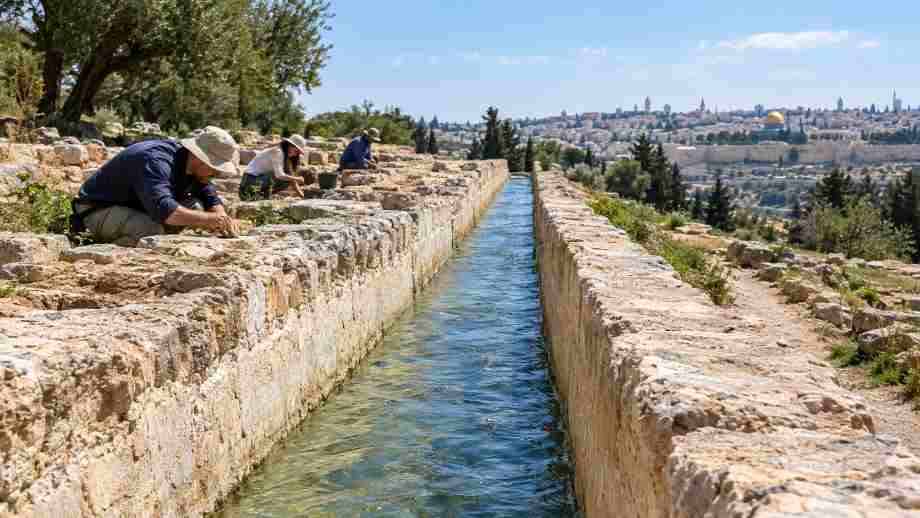 Click Image to Enlarge. Image created via AI.
Israeli archaeologists have uncovered a remarkable 300-meter section of an ancient aqueduct that supplied water to Jerusalem and the Temple Mount about 2,000 years ago, revealing an extraordinary feat of Jewish engineering from the Hasmonean period.
The Israel Antiquities Authority (IAA) made the discovery during excavations south of Kibbutz Ramat Rachel, where the Israel Land Authority plans to develop a new residential neighborhood.
Known as Jerusalem’s Lower Aqueduct, the ancient water system transported spring water from the Gush Etzion region through Solomon’s Pools, south of Bethlehem, to Jerusalem.
The newly exposed section offers a rare opportunity to examine the engineering expertise that allowed ancient Jerusalem to maintain a reliable water supply without pumps, motors, or modern technology.
Remarkably, the system remained in intermittent use until approximately a century ago.
An Engineering Marvel From the Hasmonean Kingdom
During the Hasmonean period, Jewish rulers governed Judea after the Maccabean revolt against Seleucid rule and built the Lower Aqueduct.
The Hasmonean dynasty, which emerged in the second century BCE, oversaw a period of Jewish political independence and significant development in Jerusalem.
As the city’s population and religious activities grew, supplying enough water became an increasingly pressing challenge.
The aqueduct provided an ingenious solution.
Stretching about 21 kilometers from Solomon’s Pools to Jerusalem, the system carried water along a carefully calculated route that followed the landscape’s natural contours.
Its most impressive feature was its remarkably gentle gradient.
Water descended about one meter per kilometer, allowing gravity to maintain a continuous flow toward Jerusalem.
Dr. Benyamin Storchan and Gil Freid, excavation directors for the Israel Antiquities Authority, described the ancient construction’s sophistication.
“The Lower Aqueduct was an impressive engineering project, probably built in the time of the Hasmonean kings to supply water to Jerusalem,” they explained.
“The system was so well planned that it remained in intermittent use until about 100 years ago.”
The archaeologists emphasized the precision required to construct the waterway.
“The aqueduct runs about 21 km from Solomon’s Pools, south of Bethlehem, to Jerusalem. Along most of the route, the water flowed along a very gentle gradient, dropping just one meter in elevation per kilometer.”
Delivering Water to the Temple Mount
The aqueduct formed part of an extensive water infrastructure system that supported Jerusalem during the Second Temple period.
Water was essential not only for the city’s growing population but also for the religious and ceremonial activities associated with the Temple Mount.
The Temple complex required significant quantities of water for ritual purification, cleaning, and other daily operations.
Supplying that water from distant springs required planning and technical precision that still impress modern archaeologists.
Unlike contemporary water systems that rely on mechanical pumps and electrical infrastructure, the Lower Aqueduct operated entirely through gravity.
Ancient engineers carefully surveyed the terrain, adapting the waterway to hillsides, rock formations, and changes in elevation.
Even a small miscalculation could have disrupted water flow along the 21-kilometer route.
To keep the system operational, its builders built maintenance access points that let workers remove accumulated sediment and clear blockages.
These features demonstrate that the aqueduct was designed not merely to function, but to remain serviceable over extended periods.
Centuries of Repairs Reveal Jerusalem’s Changing History
The newly discovered section also provides important evidence of how successive generations maintained and modified the ancient water system.
Originally, water flowed through a constructed, plaster-coated channel to prevent leakage.
About 500 years ago, during the Ottoman period, workers installed ceramic pipes inside the original channel.
Workers also applied plaster to the aqueduct’s exterior wall, pressing small stones into the surface while the material remained wet.
This created a distinctive finish that archaeologists have identified along the aqueduct’s route.
These modifications show the water system’s continued importance long after its original construction.
Rather than abandoning the ancient infrastructure, later authorities adapted it to meet changing needs.
The result was a waterway that remained useful for roughly two millennia.
Preserving an Ancient Jewish Engineering Achievement
Dr. Amit Re’em, Jerusalem District Archaeologist for the Israel Antiquities Authority, described the discovery as an extraordinary testament to ancient engineering.
“The aqueduct is an engineering marvel,” Re’em said.
“Even today, with all our modern technology, building such a system would require extensive planning and effort.”
He emphasized the original builders’ remarkable achievements.
“The thought that about 2,000 years ago they managed to bring water to Jerusalem this way is astonishing, and we want the public to be able to appreciate this achievement up close.”
Plans call for preserving the newly exposed section and incorporating it into the residential neighborhood being developed at the site.
Rather than concealing the archaeological remains beneath modern construction, the project will integrate the aqueduct into the surrounding urban environment.
The preservation initiative will allow residents and visitors to examine the ancient waterway and appreciate the engineering methods used by Jerusalem’s builders.
New Research to Be Presented at Archaeological Conference
Researchers will present the discovery publicly at the 19th “New Studies in the Archaeology of Jerusalem and Its Region” conference.
The event, taking place in Jerusalem and Tel Aviv, is organized through an initiative involving the Israel Antiquities Authority, Tel Aviv University, the Hebrew University of Jerusalem, and Taglit, the Israel Institute of Archaeology.
Researchers will present their findings concerning the aqueduct’s construction, maintenance, and historical development.
The newly uncovered section adds to archaeological evidence documenting the infrastructure that supported Jerusalem during the Second Temple era and subsequent centuries.
A Living Connection to Jerusalem’s Ancient Past
For archaeologists, the Lower Aqueduct represents far more than an ancient water channel.
It demonstrates the technological capabilities of Jerusalem’s inhabitants during a period when the city was a central focus of Jewish religious and national life.
Its construction required detailed knowledge of topography, water management, masonry, and long-distance infrastructure planning.
The discovery also highlights the continuity of Jerusalem’s urban development, with infrastructure originally constructed during the Hasmonean period remaining useful under successive administrations.
Now, more than 2,000 years after its original construction, a substantial portion of the aqueduct will become accessible to the public.
Visitors can stand beside the same waterway that once carried spring water toward the Temple Mount, offering a tangible connection to the engineers, builders, and communities of ancient Jerusalem.
The discovery is another reminder that beneath modern Jerusalem and its surrounding neighborhoods lies an extraordinary archaeological record of the city’s history, innovation, and enduring significance to the Jewish people.
Israpundit is entirely dependent on readers support. Please help me continue educating people with the truth about what is going on in Israel and around the world.


Leave a Reply
You must be logged in to post a comment.