
“Erdogan is in a way the current caliph of Muslims, and Istanbul is undoubtedly the capital of the Islamic caliphate.” — Yusuf al-Qaradawi, late Muslim Brotherhood spiritual leader, 20141
Sinan Ciddi & William Doran | April 1, 2026
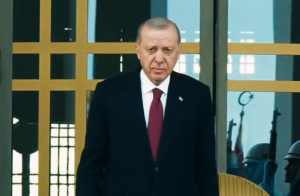 Turkish President Recep Tayyip Erdogan. Screengrab via Youtube
Mustafa Kemal Ataturk founded the Republic of Turkey in 1923 on the principles of republicanism and secularism, setting it on a path apart from much of the Middle East. For decades, Ankara pursued an earnest, though imperfect, experiment in secular-liberal, pro-Western government. Since coming to power in 2003, Recep Tayyip Erdogan has moved to replace this experiment with a sultanistic version of Islamism. Inextricable from this is his ideological affinity for the Muslim Brotherhood and his extensive political and financial support for the international Islamist movement’s most unsavory members.
Western governments hoped Erdogan wanted nothing more than to build a mild kind of Islamist-inspired democratic system. Yet as Turkey’s prime minister-turned-president, Erdogan has thrown support behind the Brotherhood as a transnational force, hosting leaders expelled by other states, backing Brotherhood governments and parties, and even funding terror networks.
The Muslim Brotherhood has no formal chapter in Turkey, but its ideological counterpart, the Milli Gorus (National View) movement, played an integral role in shaping Erdogan’s ruling Justice and Development Party (Adalet ve Kalkinma Partisi, or AKP).2 Since its founding in the late 1960s, Milli Gorus has endorsed the Brotherhood’s vision and later set the stage for the AKP’s political and material support to affiliated groups, including Hamas. Additionally, Ankara has supported various violent jihadist organizations, notably al-Qaeda in Syria.3 Throughout his time in power, Erdogan has promoted a gradual Islamization of Turkish society by eroding the separation of mosque and state (Ataturk’s principle of laiklik, or laicism) domestically and championed the rise of the Muslim Brotherhood in the Middle East during the Arab Spring.
Origins of Political Islam in Turkey
Milli Gorus — the progenitor of modern Turkish Islamism — emerged as a significant political force in the late 1960s, founded by physicist-turned-politician Erbakan.4 At its core, it has always been a pan-Islamist movement whose end goal is the unification of the Muslim world under Ankara’s leadership. Erbakan’s movement was saturated from the start with strong distrust and disdain for the United States, the West at large, and all other obstacles to Turkish Islamist government and supremacism.5 The manifesto of the Milli Gorus movement speaks to this, arguing that “Muslims of different sects must unite against the encroachment of the West” and painting Zionism as “the power that controls the world by turning it into a prison.”6
Erbakan’s ideology also explicitly rejects the notion of empire by Islamic rule and Ataturk’s conception of state patriotism, claiming an alternative “nationalism” derived in large part from “the Seljuk-Ottoman heritage.”7 So too does Erbakan’s movement decry moderate Islam for producing “a type of Muslim who is enslaved, without the concept of jihad.” Thus, it is unsurprising that Erbakan extolled the 1979 Islamic Revolution and regarded the Islamic Republic warmly for decades. He even visited Iran in April 2009 to reaffirm his solidarity with the Tehran regime and its struggle against “Western imperialism and Zionism.”8
Under Erbakan’s leadership, Milli Gorus launched successive Islamist parties — including the National Order Party, the National Salvation Party, and the Welfare Party. Between 1961 and 1998, Turkish courts dissolved each of them, citing their anti-secular stance and threat to democratic governance. Nevertheless, the movement’s agenda remained constant: opposing NATO, EU membership, and secularism while advocating for Sharia law and Ottoman revivalism.9 It toned down its anti-American and anti-Western vitriol only in the mid-1990s, finding a more subtle approach to gain political traction in a post-Cold War Turkey.
Erbakan maintained a close and enduring relationship with the Muslim Brotherhood throughout his political career. In July 1996, during his brief premiership, Erbakan met and traded grievances with Egyptian President Hosni Mubarak, an avowed nemesis of the Brotherhood. He chided Mubarak on his crackdown amid a rash of terrorist attacks perpetrated by radicalized Brotherhood members in Egypt. “They [the Brothers10] are our friends, treat them better,” Erbakan said. His choice of a particular Turkish word for friends — dostlar — signaled a close and special relationship with the Brotherhood, not simply ideological kinship. The sincerity and timing of Erbakan’s statements boded ill for the Islamist leader, resurfacing as evidence in a trial that resulted in his Welfare Party’s dissolution.
Like major Brotherhood leaders and ideologues, Erbakan too became an inspiration to the worst in jihadi terrorism. Notes recovered from Osama bin Laden’s journal after the 2011 Abbottabad raid described a trip to Turkey the future al-Qaeda founder made in 1976, seemingly on the Brotherhood’s dime.11 According to the journal, bin Laden’s goal was to meet with Erbakan, whom he deemed a source of inspiration.12
Erbakan also mentored Erdogan, who rose to prominence as Istanbul’s mayor (1994-1998) under the Welfare Party. The young Erdogan was a true believer in Milli Gorus, enthusiastic about its zealous calls for Islamist mobilization. In 1998, the up-and-coming mayor published a poem that landed him in prison for inflammatory rhetoric, writing: “the mosques are our barracks, the domes our helmets, the minarets our bayonets, and the faithful our soldiers.”13
Following a brief prison term, Erdogan broke from Erbakan and launched the AKP in 2000, claiming to embrace secular democracy. After winning the 2002 election, Erdogan — as prime minister from 2003 to 2014 — promoted EU accession and democratic reforms. However, the start of the new decade — culminating in the AKP’s sweeping 2011 electoral win — marked a turning point. With a secure grip on political power, Erdogan began pushing an Islamist agenda.14 At home, this marked the beginning of a lengthy campaign to erode secular education and civil society in favor of an Islamist social ecosystem. Abroad, it meant more aggressive backing for Islamist governments, militias, and even terrorist groups, asserting his government as a vehicle to promote the international Brotherhood.
The AKP: Turkish Islamism in Power
The AKP has ruled Turkey since 2002. From the start of his first premiership in 2003, Erdogan has radically altered Turkey’s governance. The AKP mirrors aspects of the Brotherhood’s core ideology, rejecting institutional secularism and promoting democratic norms only as far as they advance Islamic norms. The AKP’s ideology sees no obligation to democratic ideals — they are expendable once they outlive their use in cementing power or begin to conflict with Islamist aims. Erdogan famously quipped in 1996 that “democracy is like a tram. You ride it until you arrive at your destination, then you step off.”
Erdogan and his government have garnered much approval and pride from the Muslim Brotherhood, particularly since 2013 — the year when his government pushed further toward Islamist authoritarianism and began championing the Brotherhood abroad. During protests in Cairo against the ouster of Egypt’s first Brotherhood president, Mohamed Morsi, in 2013, pro-Brotherhood masses marched with posters of Erdogan and thanked the Turkish president for his solidarity.15 Years later, in 2017, when Erdogan defended the Brotherhood once again during a visit to Saudi Arabia, Egyptian Brotherhood deputy leader Ibrahim Munir extolled the Turkish president. Munir’s remarks echoed with a seeming pledge of loyalty: “the Brotherhood will never disappoint Erdogan — or any other of the movement’s defenders — no matter what the pressures are.”16
Erdogan has long understood the position secular republicanism has held in the Turkish government, and over the course of his 23-year rule, he has sought to gradually supplant it. In particular, he prioritized the development of a devout and pious youth to replace Turkey’s historically secular ruling elite, so this rising generation could become the vanguard of what he refers to as the “New Turkey.”17 This zero-sum view of Turkish society is well-summarized in a tirade Erdogan delivered while mayor of Istanbul, declaring that either Islamism or secularism must go:
You cannot be both secular and a Muslim! You will either be a Muslim, or secular! When both are together, they create reverse magnetism [repel one another]. For them to exist together is not a possibility! Therefore, it is not possible for a person who says ‘I am a Muslim’ to go on and say ‘I am secular, too.’ And why is that? Because Allah, the creator of the Muslim, has absolute power and rule!18
Much of Erdogan’s progress in dismantling secularism came with the help of a separate Islamist movement under Turkish cleric Fethullah Gulen. While Gulen was no agent of the Muslim Brotherhood, his powerful network propelled Erdogan’s Islamist, Brotherhood-aligned agenda into power and cemented his control over Turkish society.19
Gulen sought to destroy Ataturk’s secular order and create a new Islamist one, albeit one more loyal to him than to the Muslim Brotherhood. Erdogan and his loyalists helped Gulenists secure coveted and powerful posts across law enforcement, the military, the judiciary, and the foreign ministry, all while persecuting and imprisoning secular leaders and bureaucrats in sham trials.20 The Erdogan-Gulen partnership frayed when Gulen began to take his power for granted — most notably after trying to have Erdogan’s then intelligence chief and avowed “secret-keeper” Fidan arrested in 2012.21 This brought on years of infighting that accelerated the erosion of Turkish democracy and enabled Erdogan’s consolidation of power, expanding his authority in pursuit of eradicating the “Gulenist terror organization,” referred to in Turkey by the acronym FETO.22 After a July 2016 coup attempt failed, Erdogan devoted vast resources to purging the government and military of opposition — Gulenists and secular liberals alike — and amending the Turkish constitution to guarantee his continued rule.23
Re-Islamization of Education and Society
Erdogan aggressively sought to reshape Turkey’s secular educational system, central to the Islamist worldview of making faith and state — referred to by the Brotherhood as the tenet of din wa dawla — inextricable. This process began in 2010 when Ankara passed provisions allowing secular public high schools to convert to Imam Hatip religious schools — state-run vocational institutions for training clerics and preachers.24 By 2015, enrollment in Imam Hatip schools surpassed 1 million students, which Erdogan later cast as a fulfillment of his pledge to raise a “pious generation.”25 Tens of thousands of these students came from families that had no choice but to enroll their children in Imam Hatip schools, unable to afford secular private education in their school districts.26 When Erdogan’s school conversion act came into force in 2010, observers worldwide hailed the Imam Hatip model as a healthy education model for countering Islamic extremism.27 Yet over the years, this rose-colored view turned more skeptical both in Turkey and abroad. In 2017, state-issued textbooks introduced lessons on jihad (in Turkish, cihat) to Imam Hatip schools, with their universal implementation in public high schools by 2019.28 While the term jihad has various interpretations in Islam, many of which are explicitly spiritual and nonviolent, the state Turkish Language Association defines it as religious war.
Complementing this were thousands of students attending madrasas (religious schools) affiliated with Naqshbandi Sufi (Islamic mystic) religious orders adhering to sharia law and the Iran-backed Turkish Hezbollah, a Sunni militant group.29 Court records reveal that some graduates later joined the Islamic State (ISIS).30
In tandem with eroding secular public education, Erdogan also introduced numerous changes that rolled back Turkish society’s secular-liberal character. The most controversial of these was his successful push to reconvert the Hagia Sophia — the renowned sixth-century Byzantine church — to a mosque in the summer of 2020. Ataturk made the Hagia Sophia a public museum in 1934 as a gesture of secularism and religious equality. Erdogan’s courts discarded the 1934 decree, ruling that a nearly 600-year-old Ottoman mosque deed for the site was more legally binding than modern Turkish law.
Erdogan’s move to re-Islamize the Hagia Sophia drew outrage from secular and moderate Muslim Turks at home and from peoples of many faiths worldwide.31 Against the grain of international condemnation, the Muslim Brotherhood praised Erdogan for his decision. Egyptian Brotherhood spokesman Talaat Fahmi called it an “historic step” and celebrated what he deemed a vindication of past wrongs to Muslims.32
International Support for the Muslim Brotherhood
Between 2009 and 2014, Erdogan and then Foreign Minister Ahmet Davutoglu positioned Turkey as a leading patron of Muslim Brotherhood-linked regimes in the wake of the Arab Spring. Erdogan and his cadre believed these political upheavals presented an opportunity to supplant brittle secular Arab nationalist military regimes with Islamist ones. When nascent Brotherhood governments failed, Erdogan let many of their leaders take shelter in Turkey, which became a new base for their financing and ideological missions. For Islamists who remained on the ground in their home countries, Erdogan acted as a sponsor, befitting his desire for Ankara to take charge of the international Islamist movement.
After Mubarak’s fall from power, Turkish President Abdullah Gul — a close ally of Erdogan and an AKP co-founder — became the first foreign leader to visit Egypt’s President Morsi and backed his rise with $2 billion in aid.33 Morsi’s Brotherhood government did not last long, however. Ankara subsequently became a destination for Islamists fleeing the anti-Ikhwan crackdown by Cairo under General Abdel Fattah el-Sisi. In 2020, a Turkish opposition politician claimed that Egyptian Muslim Brotherhood members and their relatives living in Turkey numbered between 15,000 and 30,000.34 Erdogan rallied the AKP in solidarity with the ousted Morsi, organizing demonstrations in Turkey to support the Muslim Brotherhood in Egypt. Members of the most extreme Brotherhood contingents took refuge under his auspices.35 Among these were al-Qaeda affiliates and senior leaders of Gamaa Islamiya, an Egyptian terrorist network descended from the worldview of the Egyptian Brotherhood and al-Qaeda.36
In March 2023, the Egyptian Muslim Brotherhood announced that it had elected Salah Abdulhaq as its new acting leader, following the death in London of his predecessor, Ibrahim Mounir, the previous November.37 Abdulhaq resided in Istanbul at the time of his appointment, but his current whereabouts are not known.
Erdogan also opened Turkey up as a haven for the organization’s Yemeni leadership and elites in the mid-2010s, allowing them to manage financing schemes and escape prosecution. Among the Brotherhood factions in Turkey, Yemen’s al-Islah Party has established deep roots in Istanbul, comprising a substantial proportion of the 25,000 Yemenis living in Turkey today. These Brotherhood members have gained the enmity of Turkish citizens who resent their state-funded privileges (including generous student scholarships) and wealthy enclaves in Istanbul’s suburbs.38
Until his death in 2024, Islah leader al-Zindani — a U.S. Treasury-listed Specially Designated Global Terrorist — resided in Turkey with state security protection.39 Zindani, who ran the Sanaa-based al-Iman University as a pipeline for Taliban and al-Qaeda recruitment, was a trusted ideologue for bin Laden. Zindani’s sons still manage his business interests and finances in Turkey.40 Other Yemeni brothers in Turkey include tribal militant leader Hammoud al-Mekhlafi and U.S.-sanctioned al-Qaeda front charity organizer al-Hasan Ali Abkar.41
In Libya, following Muammar Qaddafi’s demise in 2011, Turkey offered a $300 million credit line to the Transitional National Council and supported the Brotherhood-aligned Justice and Construction Party.42 Even after Libya descended into civil war, Turkey’s support for Islamist factions enabled their eventual control of the capital, Tripoli. Following the start of Libya’s second civil war in 2014, Turkey emerged as the primary sponsor and suzerain of Libya’s Tripoli faction, with which it concluded a “maritime agreement” in 2019 that violated Greek, Cypriot, and Egyptian exclusive economic rights.43 Through the end of 2025, Ankara had exerted significant influence on the Tripoli government, extending Turkey’s mandate for military deployment in Libya to allow Turkish operations there until early 2028.44 While Tripoli’s Islamist tilt has become diluted amid attempts to form a unified government, it was the Libyan government’s early involvement with the Brotherhood model that made Erdogan a key power broker in Libya. Even now, Islamist undertones characterize Turkey’s soft-power strategy in Libya. A 2025 initiative to open a satellite branch of the Yunus Emre Institute, a Turkish government nonprofit that proselytizes pro-Erdogan ideology, provides one such example.45
Turkey’s ideological influence extended beyond countries in which it played a direct role. In Tunisia, the birthplace of the Arab Spring, Ennahda Party leader Rachid Ghannouchi explicitly modeled his movement after Erdogan’s AKP.46 At that time, Ennahda — which claimed early inspiration from the Muslim Brotherhood upon its founding in 1981 — had not yet distanced itself from violent jihadi groups.47 The AKP-inspired government sat by as a pro-terror mob attacked the U.S. Embassy in Tunis on September 14, 2012, just days after Ansar al-Sharia murdered U.S. Ambassador to Libya Christopher Stevens in Benghazi.48 Across the region, Erdogan’s support for populist Islamists is now well known.
Support for Violent Movements
Turkey’s support for Hamas — a U.S.-designated terrorist group and the Muslim Brotherhood’s primary Palestinian offshoot — is long-standing. Even before Erdogan’s hard turn to open Islamism in 2011, the ruling AKP government was quietly supportive of the terror group and welcomed its leaders to Ankara. Erdogan took sharp criticism from Israel and the United States after letting in a Hamas delegation led by then political chief Khaled Mashal in February 2006. Gul, then Erdogan’s foreign minister, rationalized the decision by pointing to Hamas’s victory in the 2006 Palestinian elections and declaring his expectation for Hamas to “act in a democratic way.”49
Erdogan’s decision to stand by Hamas’s corrupt humanitarian aid network is also instructive. Senior members of the Turkish Cooperation and Coordination Agency (TIKA), Ankara’s primary foreign aid bureau, have long aligned with Hamas. Israeli intelligence found that TIKA’s Gaza chief, Muhammad Murtaja, began working for Hamas in the fall of 2008 and spent nearly a decade funneling cash directly to its coffers until Israel arrested him nearly a decade later.50 TIKA still operates in the West Bank and Jerusalem, and its projects across the Palestinian territories have functioned as logistical bases and tactical cover for Hamas militants.51
After the 2010 Mavi Marmara incident — in which Israeli forces boarded an unauthorized flotilla that was attempting to breach the Israeli naval blockade of Gaza to distribute undisclosed materials — Erdogan shifted from an erratic critic of Israel to a supporter of Hamas. The flotilla was organized by IHH Humanitarian Relief Foundation (IHH), a Turkish “government-organized” nongovernmental organization (NGO) with a history of funneling cash to Hamas and trafficking arms and recruits to violent jihadi networks in Europe and the Middle East.52 IHH is institutionally rooted in the Muslim Brotherhood through its founding leadership. Co-founder and chairman Fehmi Bulent Yildirim, who organized the Mavi Marmara flotilla, led Milli Gorus’s National Youth Foundation (MGV) university network before founding IHH during the Bosnian War in 1992.53 To aid jihadists in Europe and the Caucasus, Yildirim coordinated arms trafficking and foreign fighter recruitment through IHH offices in Europe and the Caucasus in the late 1990s.54 During the flotilla controversy, Erdogan took the side of Hamas sympathizers, claiming the Israeli operation — which resulted in violent clashes and the deaths of 10 flotilla members — was “an act of war” and vowed that Israel “will not go unpunished.”55
Dispelling all doubt about Ankara’s tacit support for Hamas and its Turkish facilitators is the fact that Erdogan, too, has provided the group with political and financial support, including an alleged $300 million pledge in 2011.56 After the Gilad Shalit prisoner swap (Shalit was an Israeli soldier held hostage by Hamas and returned to Israel in exchange for Israel releasing Hamas prisoners), numerous Hamas operatives, including high-ranking leader Saleh al-Arouri, resettled in Turkey.57 Erdogan publicly endorsed Hamas, declaring: “I don’t see Hamas as a terror organization. Hamas is a political party.”58
The relocation of Hamas operatives and Muslim Brotherhood allies to Turkey has provided the terror group with a base for raising funds beyond the reach of the world’s counterterrorism forces. A 2023 New York Times investigation explored the depth and breadth of Turkish cover Hamas enjoyed in preserving its financial network, from leveraging outwardly clean Turkish fronts to exploiting Ankara’s tax loopholes.59 Yemeni Brotherhood member Hamid Abdullah al-Ahmar stood up Trend GYO, a $500 million Turkish construction firm, after arriving in Turkey in 2014 and continues to operate the al-Ahmar Group conglomerate.60 From his residence in Turkey, al-Ahmar also chairs a Hamas front, the U.S.-designated Al-Quds International Foundation.61 The U.S. Treasury sanctioned Trend GYO in 2022 for funneling proceeds to Hamas.62 In 2024, Treasury designated Turkish firm Al Aman Cargo and several exchange houses for moving funds and arms on behalf of Iran’s Islamic Revolutionary Guard Corps-Quds Force and the Houthis.63
Erdogan’s support for Hamas deepened even after its massacre in Israel on October 7, 2023. Instead of condemning the murder of 1,200 Israelis — most of them civilians — Erdogan hosted Hamas political chief Ismail Haniyeh in Istanbul just months before Haniyeh’s death in a 2024 Israeli strike.64 Reports suggest the two discussed relocating Hamas’s political bureau from Qatar to Turkey.65 On the first anniversary of the October 7 attacks in 2024, Erdogan offered no denunciation of Hamas’s crimes, instead declaring that Turkey “will continue to stand against the Israeli government no matter what the cost.”66
Jihadist Persons and Entities Inside Turkey With Ties to Hamas and Beyond
Following Hamas’s October 7 attack, U.S. Treasury officials made clear that Washington is increasingly alarmed by the group’s continued financial activity on Turkish soil. Undersecretary for Terrorism and Financial Intelligence Brian Nelson warned in November 2023 that Hamas retains the capacity to raise funds and prepare for future attacks from within Turkey.67 In response, the United States has issued successive rounds of sanctions targeting individuals, nonprofits, and companies that enable Hamas’s presence and financing pipeline in the country.
U.S. Treasury sanctions have shed new light on Hamas’s financial and political footprint in Turkey. One figure is Jihad Yaghmour, a Jerusalem native arrested by Israel in 1994 for his role in the kidnapping and murder of an Israeli soldier.68 Released and deported to Turkey in the 2011 Shalit prisoner swap, Yaghmour has since become instrumental in Hamas’s operations in the West Bank. He has used an Istanbul- and Ankara-based NGO called KUTAD (Association of Jerusalem and Our History) to host senior Hamas figures, such as Ismail Haniyeh and Nesim Yassin, and to serve as a conduit to Turkish intelligence services.69 Zaher Albaik, who runs KUTAD’s Ankara office, has helped facilitate meetings with Turkish officials.70 In December 2023, the United States and the United Kingdom jointly sanctioned Yaghmour and seven others for advancing Hamas interests internationally and managing its finances.71
Also among Hamas’s leadership in Turkey is Haroun Nasser al-Din, the head of Hamas’s Jerusalem office and a close associate of Hamas finance chief Zaher Jabarin and now deceased deputy political chief Saleh al-Arouri. A primary facilitator of Hamas’s terrorism in the West Bank, Nasser al-Din launders funds in Turkey for the terror group’s use in Hebron, a Hamas hub in the West Bank. The U.S. Treasury sanctioned Nasser al-Din in December 2023.72
Another key operative is Kuwaiti-born Amer al-Shawa, who sits on the boards of multiple Turkey-based firms providing financial support to Hamas. Treasury designated him in October 2023, and months later, the State Department placed a bounty of up to $10 million on several Hamas financial facilitators, including al-Shawa.73
Additional sanctions have targeted figures such as Musa Daud Muhammad Akari, a Hamas financier in Turkey since at least 2011.74 Akari was convicted for the 1992 kidnapping and murder of Israeli Border Police officer Nissim Toledano but later freed in the Shalit exchange and deported to Turkey.75 Akari has been photographed with Hamas political chief Khaled Meshal and deceased military leader Ahmed Jabari. He is a key mover of funds from Turkey to Hamas in Gaza and the West Bank.76 His close associate, Mahmoud Muhammad Ahmad Attoun, also deported from Israel in 2011 for Toledano’s killing, remains active in Turkey but has yet to be designated by the United States, unlike his brother Ahmad, who was sanctioned in 2023.77
The network also extends into Turkish political circles. Hasan Turan, a senior AKP figure who leads the Turkey-Palestine Parliamentary Friendship Group, has hosted multiple high-level Hamas delegations both before and after October 7.78 On October 12, 2023, Turan hosted Bassem Naim at the Turkish National Assembly.79 Naim headed the Hamas-run Gaza Health Ministry that allowed Hamas to run military operations out of hospitals across the Gaza Strip. Turan also plays a leadership role in the League of Parliamentarians for al-Quds and Palestine, an organization that has included sanctioned Hamas financiers in its ranks, including now deceased senior political officer Ahmed Bahr, who in 2012 publicly called on Gazans to kill all Jews and Americans in God’s name and maintained close ties to Erdogan allies.80 Although Treasury sanctioned the league’s leader in October 2024, Washington has not yet targeted the organization itself.
Several Turkish-based NGOs function as additional access points to Hamas. FIDDER, the “Turkish Society for Solidarity with Palestine,” has a mission of expanding Turkish-Palestinian ties but is known to host high-level Hamas visitors.81 Israeli authorities have recognized another NGO, the Istanbul-based Khir Ummah — licensed in Turkey and active in Syria and Gaza — as a front charity with Hamas operatives, including financiers Ibrahim al-Naji and Abdel Jaber Shalabi, among its ranks.82 Khir Ummah has partnered with internationally sanctioned entities, such as Hamas’s Union of Good financing network and the IHH, the Turkish organization implicated in material support to Hamas.
In 2021, Khir Ummah received $110,000 from Igatha 48 Association (AID 48), the fundraising arm of the Brotherhood-offshoot Islamic Movement in Israel.83 Israeli authorities highlighted Khir Ummah’s alleged ties to terror by filing an indictment against Rami Habiballah, an Arab from northern Israel who sent money to the group. The association also received the money via Shalabi, who manages Khir Ummah in Turkey.
Turkey as a Forward Base for Brotherhood-Aligned Jihadism
Turkish state support for Syrian jihadist groups affiliated with the Muslim Brotherhood is also a concern. In 2016, a U.S. drone strike killed senior Egyptian Brotherhood member Rifai Ahmed Taha, hosted in Turkey since 2013, during a cross-border trip into Syrian jihadist territory.84 Taha was a senior leader in Gamaa Islamiya and masterminded the 1996 Luxor massacre that killed 58 tourists. At the time of his death, Taha was in Syria to provide counsel to Turkey-backed Jabhat al-Nusra, which was then al-Qaeda’s branch in Syria.
Among the living, Taha’s counterpart, al-Islambouli, a longtime associate of bin Laden and Gamaa Islamiya co-leader, has remained in Turkey since Morsi’s ouster.85 Islambouli, whose brother Khalid assassinated Egyptian President Anwar al-Sadat in 1981, handled operations for al-Qaeda’s Syria-based Khorasan Group — a terror outlet established for attacks on Western targets — from his Istanbul haven.86 Turkish authorities placed Islambouli under house arrest in 2016. This prevented the internationally wanted terrorist from facing extradition and trial, allowing him to live comfortably in Istanbul.87
Distinct from its support for the Muslim Brotherhood and Hamas, Turkey has also backed jihadist groups in Syria, notably Hayat Tahrir al-Sham (HTS), which absorbed al-Qaeda affiliate Jabhat al-Nusra.88 Treasury concluded HTS was simply a rebranded version of Nusra, with its leader Ahmad al-Sharaa (then known as Abu Muhammad al-Jolani, and now the president of Syria) remaining at the helm. Thus, Treasury’s designation of Nusra as a terrorist organization applied to HTS, as well. In December 2024, HTS overthrew the Bashar al-Assad regime, ending Syria’s civil war on terms favorable to Ankara. Sharaa then began pursuing warm ties with the Trump administration, which has lifted sanctions on him, on HTS, and on Syria.
How we arrived here is important. In 2012, Ankara, with Qatar and Saudi Arabia, helped establish a covert operations center to coordinate jihadist attacks on Assad.89 Turkish border policies were notoriously lax — militants, weapons, and supplies flowed freely. In 2017, Turkey created the so-called Syrian National Army (SNA) — a proxy rebel force distinct from HTS, bringing together armed secular and jihadist opposition groups.90 While benefiting from Ankara’s support, SNA fighters committed serious human rights abuses against Kurdish communities in Turkish-occupied northern Syria.91 In August 2024, the U.S. Treasury Department imposed sanctions on two prominent SNA militias, the Suleiman Shah Brigade and the Hamza Brigade, for abduction, extortion, torture, and sexual violence.92
The SNA and HTS were formally dissolved following Sharaa’s assumption of power, but in March 2025, their members massacred some 1,500 members of Syria’s Alawite minority group.93 HTS and SNA fighters now form the backbone of the new Syrian army, which Ankara supports by providing training, assistance, and military equipment.
Conclusion and Policy Recommendations
Erdogan’s embrace of the Muslim Brotherhood has damaged Turkey’s secular-liberal democratic character and its willingness to address terrorism and related security concerns. In shedding the AKP’s early moderation for hardline Islamist domination, Ankara now extols anti-Western and anti-NATO policy just as its Milli Gorus predecessors hoped for decades. So too has it made Turkey an international hub for terrorist financing and shelter. From Turkey, violent Brotherhood elements can export violence and sponsor terror across the Middle East and sub-Saharan Africa. However, the United States can still compel Turkey’s government to rein in the international Muslim Brotherhood and its most violent contingents.
First, Washington should pursue Global Magnitsky sanctions against targets in Turkey involved in grand corruption and election interference. In recent months, Erdogan and his ruling party have pursued criminal charges against political activists and opposition figures, jailing hundreds of them. To date, very little has been done by the international community to respond to these anti-democratic measures. The Global Magnitsky Act allows for sanctions on individuals who engage in significant corruption, bribery, asset expropriation, or facilitation of corrupt proceeds. The United States should actively pursue asset freezes and visa restrictions against targets in Turkey engaged in these behaviors.
Second, the United States should utilize Global Magnitsky authorities to target Turkish individuals responsible for human rights violations in Syria. Turkey has taken an active role in supporting Syrian groups such as the SNA’s Suleiman Shah Brigade and Hamza Brigade — and even HTS in the several years leading up to its takeover. These groups engaged in terrorism and human rights violations, particularly while receiving sponsorship and assistance from Turkey. They often targeted civilians and attacked the critical infrastructure of vulnerable populations, leading to food and water shortages, electricity lapses, and physical harm to Kurds and other minority groups.94 While the United States supports the new central authority in Syria, it should continue to monitor extremist elements in Syria that Turkey has supported and directed. These groups are also closely aligned with Muslim Brotherhood ideology and should be subject to designation if sufficient evidence is gathered.
Third, the White House should fully apply the November 2025 executive order aimed at designating branches of the Muslim Brotherhood as terrorist organizations. The White House subsequently designated four branches — in Lebanon, Jordan, Egypt, and Sudan — for acts of terrorism or providing support to Hamas.95 State and Treasury should similarly evaluate persons in Turkey — including government officials — and agencies that may meet this criterion for designation.
Fourth, Treasury officials should consider the Turkish financial sector a jurisdiction of money laundering concern. Turkey is actively hosting and supporting Hamas. Hamas senior leadership is routinely welcomed in Istanbul and Ankara and meets publicly with senior AKP party officials and the foreign minister. Regional intelligence reports indicate funds have traversed the Turkish banking sector en route to terror groups in Lebanon, Syria, the West Bank, and Iraq. The United States should protect the international financial sector by recommending added scrutiny and screening to transactions involving Turkish financial institutions.
Finally, Washington should coordinate with the G7 to return Turkey to the Financial Action Task Force (FATF) “grey list” until further improvements are seen in combating terrorism financing. In 2021, Turkey was added to the list of countries with insufficient controls and weak monitoring of its banking sector with regard to money laundering and terrorist financing. Turkey continues to lack control over large swaths of its financial sector, which is opaque and lacks transparency. Until Turkey implements sufficient laws and regulations, it should be returned to the FATF grey list so that financial institutions are warned about improper anti-money laundering and counter-terrorist financing monitoring.
Turkish support for the Muslim Brotherhood is no longer confined to statements of kinship and shared Islamist ideology. Under Erdogan, Turkey’s Brotherhood sponsorship is now a heavily institutionalized network radiating out from Ankara. As this network threatens to wreak further havoc in Syria, the Palestinian territories, Libya, and elsewhere, Washington should not exempt Erdogan from the consequences of harboring, funding, and defending terrorists.

Leave a Reply
You must be logged in to post a comment.