
Peloni: Had this regime been removed from power, their influence extending to Lebanon, Yemen, Gaza and the region could have been ended by now. The determination to keep Israel from seeking victory in battle will be seen to have a very unfortunate consequence, and for more than just Israel. This regime must be ended.
Janatan Sayeh | August 8, 2025
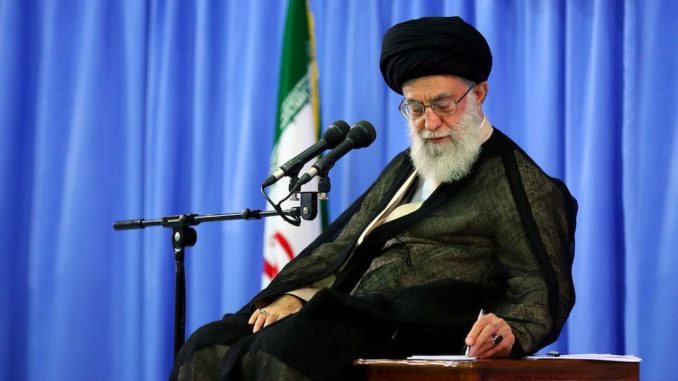 Photo by Khamenei.ir, CC BY 4.0, Wikipedia
In Iran, espionage trials have become a form of theater in which political prisoners face very real executions. It’s an attempt by the regime to mask its failure to stop Israel’s spy agency, the Mossad, from operating within its borders during June’s 12-day war. It is also an attempt to cow a population primed for unrest.
On August 5, Iran Human Rights reported that 67 political prisoners are currently on death row, including nine accused of spying for Israel and the United States. In June, six of the 17 security-related executions were carried out against individuals charged with espionage for Israel, with prosecutors offering no credible evidence to support the allegations. The Islamic Republic has turned arrests into instruments of intimidation rather than acts of credible counterintelligence.
Regime Moves to Further Codify Executions for Fabricated Espionage Charges
Security forces detained roughly 700 individuals following the 12-day war, and media affiliated with the Islamic Revolutionary Guard Corps (IRGC) called for their mass execution in a July 8 article. On July 14, Islamic Republic Judiciary Chief Gholam Hossein Mohseni Ejei urged expedited rulings in espionage cases involving defendants with alleged ties to Israel, an offense punishable by death.
The Islamic Republic has long imposed capital punishment for espionage, under Articles 279 and 286 of the Islamic Penal Code, but new legislation that the parliament and the Guardian Council are currently seeking to finalize marks a significant escalation. Under the “Intensifying Punishment for Espionage” bill, cases once left to judicial discretion would carry mandatory sentences of execution and asset seizure. Citing the 12-day war as a justification, the bill also expands the scope of what counts as espionage and empowers the Supreme National Security Council to designate which countries are “hostile.”
Religious Minorities Routinely Targeted by Espionage Allegations
Since the June 24 ceasefire, Iranian authorities have intensified their crackdown on members of religious minorities under the pretext that they have collaborated with hostile intelligence services. At least 53 Christians were arrested over alleged Mossad links, while security forces raided more than a dozen homes of Baha’i citizens and detained four. More than two dozen Jews were interrogated, with five still in custody, including one American accused of ties to Israel. Despite claiming to differentiate between anti-Zionism and antisemitism, the Islamic Republic routinely folds its Jewish community into its anti-Israel campaigns.
Islamic Republic Fears Iranians Most During War Time
Israel’s strikes on military sites weakened the regime’s military capabilities, but it is the targeting of its repression apparatus that Tehran viewed as an existential threat. Demonstrating the fear the Islamic Republic has of its own people, nationwide security checkpoints were deployed during the 12-day war to limit movement. The same fear is reflected in the arrests of dozens of people accused of posting pro-Israel content online as the war began.
Complemented by a messaging campaign aimed at Iranians, Israel’s first wave of strikes, from June 13 to June 18, targeted senior IRGC commanders, Tehran’s Law Enforcement Command, and the regime’s main propaganda outlet. Attacks on June 23 struck sites central to the regime’s campaign of repression, including Evin Prison, known for the torture and executions of political prisoners. Israel also struck the headquarters of the IRGC and its auxiliary forces, as well as police bases used to suppress civic dissent. The ceasefire took effect the very next day, before people on the ground could mobilize against the regime.
Preserving People’s Hope Amid Threats of Execution
Israel’s strikes on the regime’s tools of repression generated a sense of hope among Iranians, as it marked a rare reckoning for those who had suppressed them for decades. More executions are looming, but Washington has remained silent on human rights in Iran despite being vocal about the nuclear threat. This inaction only reinforces the regime’s sense of impunity. A targeted diplomatic messaging campaign from the United States could help revive anti-regime sentiment at a moment when the regime sees energized dissent as a greater threat than military setbacks.
Janatan Sayeh is a research analyst at the Foundation for Defense of Democracies (FDD), where he focuses on Iranian domestic affairs and the Islamic Republic’s regional malign influence. For more analysis from FDD, please subscribe HERE. Follow Janatan on X @JanatanSayeh. Follow FDD on X @FDD and @FDD_Iran. FDD is a Washington, DC-based, nonpartisan research institute focusing on national security and foreign policy.
Israpundit is entirely dependent on readers support. Please help me continue educating people with the truth about what is going on in Israel and around the world.


Leave a Reply
You must be logged in to post a comment.