
Peloni: While the nuclear program drew most of the attention regarding the threat from Iran, its ballistic missile program represents an existential threat of its own. Given this fact, it is important to recognize that this, in addition to Iran’s nuclear program, which must be addressed in dealing with the threat from Iran. Despite this fact, the US negotiations with Iran, ever destined for failure, have inexplicably never included any discussion regarding the missile development program, leaving it to Israel to deal with, as Fitzgerald explains below. Notably, the continued pursuit of developing missiles with an ever greater range, is not a threat targeting Israel, as its main target for this is actually America…
By | Aug 23, 2025
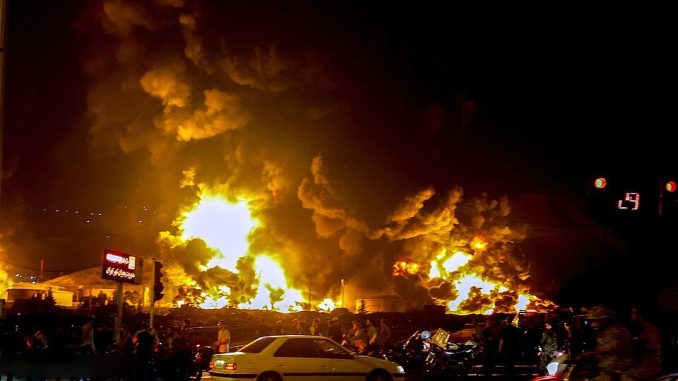 Israel’s bombing on IRGC facilities in Tehran. (By Avash Media, CC BY 4.0, Wikipedia)
Most of the coverage of both the Israeli and the American attacks on Iranian military targets last June focused on the Islamic Republic’s nuclear program, which was the most worrisome part of Iran’s preparations for a future assault on Israel. But in an interview with The Times, Israel’s Foreign Ministry spokesman, Oren Marmorstein, noted at that time that there was almost equal worry about Iran’s ballistic missile program, which even without nuclear warheads was presented a great threat to Israel, and to Western Europe as well, for the intercontinental missiles Iran was building could reach London. More on Iran’s ballistic missile threat to Israel can be found in this article from shortly after the attacks: “Iran was stockpiling missile arsenal that could reach Europe, FM spox. says,” Jerusalem Post, June 29, 2025:
Iran was moving ballistic missile production into an industrial scale, and was about to become the top missile producer in the world, with intercontinental missiles able to reach European cities, including London, Israel Foreign Ministry spokesperson Oren Marmorstein said during an interview with The Times on Sunday.
Iran “was about to become the top missile producer in the world’? That will come as news to many of us, so focused have we been on Fordow and Natanz and Isfahan, on enriched uranium purified to a near-weapons-grade level of 60%, and on 900 pounds of missing uranium. But an equally grave threat, according to the Israelis, was posed by those 3,000 ballistic missiles Iran had built, including those long-range missiles that could threaten Europe. Not enough attention has been given to that ballistic missile program that before the war had nearly made Iran the largest producer of missiles in the world.
Describing Israel’s reasoning for conducting airstrikes on Iran, Marmorstein told The Times that “We actually acted because of two existential threats. One was nuclear, and we acted when we did because Iran was at the 11th hour of being able to build a bomb. But the other was the ballistic threat.”
The US estimated Iran possessed approximately 3,000 ballistic missiles before Operation Rising Lion began, but was undergoing attempts to increase production to 20,000, Marmorstein stated, with missiles capable of carrying two-ton payloads, The Times noted.
The Israelis now estimate that of those 3,000 ballistic missiles Iran possessed at the beginning of the war, at least 1000 were either destroyed on the ground in Iran, or were intercepted and destroyed in Israeli airspace. Had Israel not agreed to the ceasefire that Trump imposed, it could have destroyed many hundreds more. Israel also destroyed at least 120 rocket launchers, about one-third of the number Iran possessed at the beginning of the war. In addition, the IDF destroyed all of the plants where ballistic missiles were produced. The Iranians had big plans; they had been hoping to produce 20,000 ballistic missiles; now they can produce none. It doesn’t mean they won’t begin again to build such plants, but of course, the IDF will attack at will to destroy any of those new plants. Rinse, repeat — what can the poor Iranians do against such a relentless enemy?
At the first sign of attempts by Iran to resume either its uranium enrichment program, or to rebuild its ballistic missile plants, the IDF will be in the skies over Iran wreaking as much damage as it can. And President Trump has also pledged that Iran will not be allowed — will in fact be attacked again by the American military — if it tries to restart its nuclear program. The ballistic missile program is apparently being left for the Israelis to deal with.
Even in Europe, scales fell, at least briefly, from the eyes of its leaders, as they fully take in the threat that Iran posed to them, with its intercontinental ballistic missiles, which are not needed to attack Israel, but exactly what are needed to hit targets in Europe. That is what German Chancellor Friedrich Merz had in mind when, at the NATO summit, he praised Israel’s actions in Iran: “This is the dirty work that Israel is doing for all of us. I can only say that I have the utmost respect for the Israeli army and the Israeli leadership for having had the courage to do this.”
How long — how many years — given the widespread discontent in Iran, will it take for the regime to fall?


Leave a Reply
You must be logged in to post a comment.