
Peloni: The very reason for Hamas attacking Israel alone was to prevent Saudi normalization, and given the renewed support of Palestinians in the Arab street, it appears that this ship has sailed with the return of the regional primacy of resolving the Palestinian issue, thus imploding the Abraham Accords which did the opposite. Notably, if MBS were to accept the fact that a Muslim Palestinian state has existed since the creation of the Emirate of TransJordan more than a century ago, stabilizing the region might move forward, something which will be missed if this is ignored. Importantly, for Israel to accept Saudi normalization, it must come with no requirement that Israel should suffer the need of fostering an existential threat against it, and the creation of a second Muslim Palestinian state would do exactly that. Such a creation, however, would simultaneously represent a threat against the Saudis as well, whose future interests align with a stabilized region, something which the TSS has no possibility of achieving. With saying goodbye to the Abraham Accords, recognizing Jordan as the Muslim Palestinian state remains the only focus which could significantly achieve what the Abraham Accords were intended to achieve, namely peace in the region with the expansion of trade, commerce, travel and modernization as the potential windfalls which would support more than just Saudi interests.
MSB cites ‘widespread anti-Israel sentiment’ as reason preventing peace
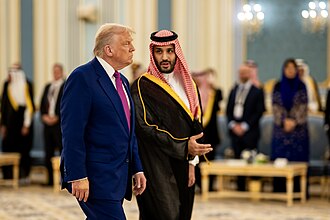 President Donald Trump participates in a coffee ceremony with Saudi Crown Prince Mohammed Bin Salman Al Saud at the Royal Court Palace in Riyadh, Saudi Arabia, Tuesday, May 13, 2025. Photo by The White House – https://www.flickr.com/photos/202101414@N05/54521889084/, Public Domain, Wikipedia
U.S. President Donald Trump was taken aback after Saudi Crown Prince Mohammed bin Salman rejected normalizing relations with Israel in a “tense” meeting at the White House last week, Israel’s Channel 12 News and Axios reported.
Both outlets cited two U.S. officials and another informed source, who said Trump was left “disappointed and angry” after raising the issue of Saudi Arabia joining the Abraham Accords.
Mohammed bin Salman (MBS) had been informed by a U.S. official ahead of the discussion that Trump expects progress on normalization, which has been in the works since the Abraham Accords were signed in 2020, during the U.S. president’s first term.
However, MBS reportedly argued that he isn’t opposed to making peace with Israel but that the widespread anti-Israel sentiment among the Saudi public would not allow such a significant step at this time.
Despite the “tense” meeting, the conversation stayed polite and the two leaders gave no indication of differences of opinion after the meeting.
U.S. officials told Axios that Trump “pressed hard” for MBS to join the accords but that the Saudi leader pushed back, insisting that it wasn’t a good time for him to advance an ostensibly unpopular peace deal at this time.
“The best way to say it is disappointment and irritation. The president really wants them to join the Abraham Accord. He tried very hard to talk him. It was an honest discussion. But MBS is a strong man. He stood his ground,” the source said.
MBS reportedly reiterated his insistence on an “irreversible, credible and time-bound path” for a Palestinian state as a condition for peace, which he stated in public after the meeting.
Israeli Prime Minister Benjamin Netanyahu has ruled out this possibility for now but agreed to a U.S.-backed UN resolution stating that once the PA completes reforms and Gaza’s reconstruction progresses, “conditions may finally be in place for a credible pathway to Palestinian self-determination and statehood.”
“MBS never said no to normalization. The door is open for doing it later. But the two-state solution is an issue,” a White House official told Axios.
“Now that Iran’s nuclear program has been totally obliterated and the war in Gaza has ended, it is very important to President Trump that all Middle Eastern countries join the Abraham Accords, which will advance peace in the region,” the source added.
However, some experts have argued that the Iranian nuclear threat was the main motivating factor for Saudi Arabia to seek a security alliance with Israel and the U.S., making peace less likely now that the regime’s nuclear program has been set back by years.
According to a poll by the Jerusalem Center for Security and Foreign Affairs published last week, 70% of Israelis oppose the establishment of a Palestinian state in the 1967 borders, meaning in Judea and Samaria.
Sixty-two percent of respondents said they oppose establishing a Palestinian state in exchange for normalization with Saudi Arabia.
In addition, 40% of Israelis said they support normalization if the Saudi Kingdom receives F-35 aircraft in exchange for dropping the demand for a Palestinian state. However, 34% of all respondents said such a deal should be contingent on a U.S. commitment to maintaining Israel’s qualitative military edge.


Holding the creation of an Arab Palestine state as a condition – price – for peace side steps the question of whether such a state will create peace or just disturb everybody by pursuing irredenta? Given Arafat tried to bag Jordan in “Black September”1970-71 as well as “River to the Sea” Israel it is reasonable to think that Saudi is avoiding a treaty with Israel because it also has imperial ambitions in the region where all the frontiers and state identities are in woolly focus and all rulers re absolute and NOT constitutiional institutions.
For ages the two state lobbyists reply to security questions was that the peace itself would provide security by pulling the rug under the casus belli of the Arabs wanting a Palestine State BUT the Arabs real aim is they want to bury Israel. This argument of the peace itself being security needs turning on those Arabs who reject a peace without their demands for the formalities of state of Arab Palestine West of the River Jordan.
As things are – and after 7th Oct 23 – it is quite likely we shall see a re-run of 1948 as soon as Arabs think they can, BUT this time the Moslems West of the river get tipped over it as refugee Jews from the West settle the hill country.