
Peloni: Excellent article!
by Sha’i ben-Tekoa
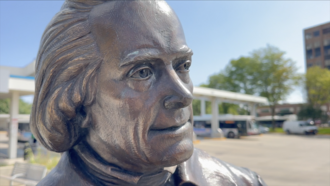 Close up of the Thomas Jefferson statue, created bt Edward Hlavka, located in the Jefferson Park neighborhood of Chicago, outside of the Chicago Transit Authority, from the documentary, Holy Ground. By Maxjolls – Own work, CC0, Wikipedia
The first Muslim aggression against Americans came in the late summer of 1784 when the U.S. had been legally independent a mere five months; when it had no navy, no army, let alone air force to deal with the attack.
The thirteen former colonies had become legally independent in May, which was the last, legal formality of the American Revolution, when the only branch of government in those days, still under the Articles of Confederation, convened in Annapolis and approved the peace treaty with England negotiated in Paris the previous September.
Five months later, the first American passenger and cargo vessel was hijacked by cruisers from Morocco, the Betsey out of Philadelphia, Capt. Isaac Stephens in command, with a crew of six, and it took nine months to free them after Congress promised to send the Sultan $40,000.
These merchant seamen were liberated in the spring of 1785, but two weeks later two more American merchant ships carrying another twenty Americans into Muslim captivity were boarded by cruisers from Algiers and enslaved in that port city, with the U.S. diplomatic corps in Europe almost non-existent.
They were the first U.S. diplomats to handle a hostage crisis in the Middle East, and how they responded is instructive; men who couldn’t have been more American and individualistic in their attitudes, considering who they were. On duty were three trade commissioners commissioned by Congress to launch American commerce into European markets: Benjamin Franklin, John Adams and Thomas Jefferson, and what they had to say about these first attacks has lessons for today.
Franklin, the war-averse Quaker, argued that since trade in the Mediterranean was marginal, American merchant ships should just avoid that dangerous sea.
Adams, lawyer to maritime interests in Boston, advised the U.S. to join the European countries that paid “tribute” to the four North African powers, a.k.a. the “Barbary Pirate” states, which was basically “protection money.” The Muslims believed the Mediterranean was their territory and non-Muslims wanting to trade there must pay “tribute.” Failure to do that meant having your merchant vessel and cargo confiscated and the crews and innocent travellers aboard enslaved until ransomed.
They were called the “Barbary Pirates” (Morocco, Algiers, Tunis, Tripoli) but that was only a nickname. In truth they were not “pirates” if we think of freebooting, seagoing armed robbers whose cruisers flew the Skull & Bones, and when on ashore hung out in taverns swigging rum and pawing at wenches.
No, these were religious pirates whose flag was green, Islam’s color, who justified hijacking and enslaving with the Jihad, the eternal war between Muslims and infidels until Judgment Day. These seagoing predators were Muslims who when ashore prayed five times daily like everybody else, but at sea, with a leniency, only three times daily. Whoever heard of religious pirates?
Thomas Jefferson was told this truth to his face by an Arab emissary from the pasha in Tripoli who had his hand out and was asking for roughly one-sixth of the U.S. budget that year not to begin preying on U.S. commercial ships. And when Jefferson asked for an explanation for this behavior, when the U.S. was only a few months old and had never aggressed against Tripoli, this prompted the sheik to teach him that Americans are Christians and the Jihad is eternal.
At the moment, he and John Adams were now American ambassadors to France and Britain, respectively, meeting in London, probably in Mayfair, with the sheik demanding payment from the United States for the right to sail and do business unmolested in the Mediterranean, when at that very moment a dozen or so Americans were still slaving in Algiers.
One can only imagine what ran through Jefferson’s mind in this face-to-face encounter with a Muslim who told him the Jihad was forever and America had to pay the usanza (the tribute) or else.
This was the same post-Christian Deist Jefferson whose Bill for Religious Freedom in Virginia had passed that very year, which would become the inspiration, three years on, for the famous 1st Amendment to the Constitution sealing off religion from government interference. This idea of Jihad was so contrary to Jefferson’s idea of liberal democracy, in which religion is outside of politics.
This was Jefferson the political philosopher of revolution and progress, and one can only guess how he reacted upon discovering these were not conventional “pirates” just out for loot but justified with their religion hijacking and enslaving innocent passengers and crews who were Christians. In the age of the Enlightenment, the idea of preying on innocent people like this just because they believed differently about religion was the antithesis of progress. And unlike his friends John Adams and Ben Franklin, Jefferson wanted to fight to suppress these Muslims for whom enslaving infidels was a religious way of life. Jefferson was a rebel, a reformer, a revolutionary bent on improving society.
Jefferson spent five years in Paris, and his principal work was trying to free the scores of American captives in Algiers. His opinion was that America had no choice but to build a navy to blockade North African ports for a Biblical generation of forty years, if necessary, to create a new generation of Muslims in these ports who did not know how to sail and be forced to become, as in America, self-supporting yeoman farmers.
In 1790, Jefferson returned to the States to become the first Secretary of State under the new Constitution, and his first task was draughting a report to Congress on the perilous state of U.S. commerce in the Mediterranean posed by the Muslims, which contained an update on the plight of the almost two dozen American hostages still alive and slaving in Algiers.
His report also included his call for — as he had for years — a navy to squelch these religion-motivated kidnappers and enslavers. American colonists had come to hate the British navy and many believed the U.S. could do without a navy, but Jefferson saw no alternative to having a fleet to defend U.S. commercial vessels from these Muslim predators.
Spiritual godfather of American Liberalism, Jefferson was persuaded that the only way to deal with such enemies of civilization was military force — versus today’s American Democrats who side with Muslim terrorists.
In the fall of 1793, Jefferson was planning to retire when news reached the country that the Algerines (sic) had struck again, this time hijacking eleven U.S. merchant ships, enslaving one hundred and forty more merchant seamen and innocent passengers. His last effort as Secretary of State was a report on this latest outrage.
When news reached New York of the mass hijacking, the New York stock market crashed. In the few days it took for the news to travel up and down the Atlantic seaboard, voyages were cancelled in every major port, seamen were thrown out of work, ship suppliers went out of business. What 9/11 did to the U.S. economy in 2001, the mass hijacking of late 1793 did too.
So, thanks to Islam, on March 27th, 1794, the U.S. Congress finally passed, after debating the topic fitfully over a decade since the first hijacking to Morocco, the Naval Establishment Act. The government would build a fleet of six extra-large frigates, including the first Constellation, today a tourist attraction in Baltimore’s Harbor Place. Yes, predatory Islam was responsible for the birth of the U.S. Navy.
Also among the six was the Constitution (the future “Old Ironsides”), to this day on display in Boston Harbor. Congress’s compromise idea was to build the ships in the hope that the construction itself might scare the Algerines, while at the same time they would send negotiators to appease them by imitating Europe and offering to join the tribute system.
The Naval Establishment Act tried to please both hawks and doves in Congress by ordering the building of a fleet, while simultaneously sending negotiators to deal, with the legislation specifying that if they succeeded, the ship-building, immensely expensive in every generation, would stop. And that is exactly what happened.
But in the end, the U.S. wound up paying close to $1,000,000 in ransom and also, to atone for the tardy delivery of gold coins, to throw in, for free, a brand-new warship as a gift to the Dey of Algiers. It was christened “The Crescent,” in honor of the Islamic flag.
In 1796, some 85 surviving American hostages, crippled and emaciated by the ordeal, were freed from slavery. Eventually, the ship-building resumed, but the menace of Barbary piracy continued to plague the U.S. and led to a four-year war against Tripoli conducted by President Thomas Jefferson, a war he had been in favor of for 17 years. Imagine: the godfather of today’s Democratic Party was the number one hawk for war with Islam. How politically incorrect can you get?
Not until France finally occupied Algiers in 1830, and later Tunisia and Morocco, did Barbary criminality disappear. Only under imperial occupation could the “piracy” be suppressed.
France was driven out in 1962 after eight years of grisly and gory FLN terrorist atrocities, and liberated Algeria emerged as a major base for so-called international terrorism, meaning, largely, Arab terrorists terrorizing the world.
The terrorist FLN Stalinists who drove out the French that year became the model for Fatah and other murder cults in the PLO, purveyors of Palestinian nationalism.
Jefferson, the “patron saint” of American Liberalism would today be horrified that his ideological grandchildren smile on Hamas and its sex crazed rapists, torturers and mutilators, who justify their sick behavior with their evil religion.
Sha’i ben-Tekoa’s PHANTOM NATION: Inventing the “Palestinians” as the Obstacle to Peace is available at Amazon.com in hard cover or a Kindle ebook. His podcasts can be heard on www.phantom-nation.com.
Israpundit is entirely dependent on readers support. Please help me continue educating people with the truth about what is going on in Israel and around the world.


AI Overview
If I had more space, I would have referenced this Koran that Ellison abused by suggesting it was TJ’s respect for Islam. Horse fathers. TJ bought it to find out about the enemy. Respect for Islam was the last thing on his mind.
@Shalbit Yes, obviously.
Bravo !!!!