
Natasha Hausdorff discusses proposed special tribunal for 7/10/23 crimes on i24

Peloni:  The butchers of October 7, like all terrorists, should be understood to be a threat to society, and this is actually the very basis of their calling.  Providing them with the means to pursue their goals thru manipulation of legal nuances which always have an international influence is far too great a gift to offer them.  I recall the term “Victor’s Justice” which has gained an unpopular and illicit connotation, but the reality is that this is what the butchers of October 7 earned, it was what the Nazi’s at Nuremberg earned, and it is what Adolf Eichmann earned.  As we grant terrorists and war criminals the garbs of criminal redress, we offer them a platform to which they are unwarranted and which only empowers those who should instead be shown to have no power at all.  The use of civilian niceties in dealing with war criminals disguises the fact that the war criminals have no right to claim civilian defenses, no right to juris prudence, and no basis upon which to appeal to the sensitivities of those they would massacre.  Pretenses of the civilized world needing to extend legal protections to mass murderers whose aim is the overthrow of society only permits these aims to be further advanced.
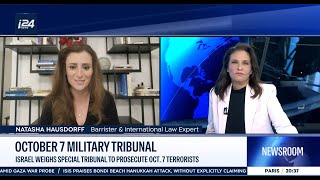
Video Loads Below


December 19, 2025 | 2 Comments »

Leave a Reply

2 Comments / 2 Comments

  1. “Captured enemy commandos (saboteurs) out of uniform on U.S. soil during World War II were tried by a military tribunal, found guilty of violating the laws of war, and executed. The legal precedent for this was the Supreme Court case Ex parte Quirin (1942).
    The Operation Pastorius Case
    The specific event that established this precedent was “Operation Pastorius,” a failed German sabotage mission in June 1942.
    Infiltration: Two teams of four German saboteurs each landed from U-boats on the coasts of Long Island, New York, and Ponte Vedra Beach, Florida. They landed in partial German uniforms to ensure prisoner-of-war status if captured immediately, but quickly changed into civilian clothes and buried their uniforms and sabotage materials.
    Capture: One of the saboteurs, George John Dasch, had a change of heart and turned himself in to the FBI, leading to the rapid arrest of all eight men before they could carry out any sabotage.
    Legal Proceedings:
    President Franklin D. Roosevelt, fearing a civilian court might be too lenient, ordered a special, secret military tribunal to try the saboteurs.
    The defense challenged the tribunal’s constitutionality, but the Supreme Court, in Ex parte Quirin, unanimously upheld the military commission’s jurisdiction.
    The Court ruled that the saboteurs were “unlawful combatants” because they had shed their uniforms and operated in civilian clothing behind enemy lines with hostile intent, a violation of the laws of war. This status meant they were not entitled to the same rights as uniformed prisoners of war, such as a jury trial in civilian court.
    Sentence and Outcome:
    All eight were found guilty and sentenced to death.
    Due to their cooperation with the FBI, President Roosevelt commuted the sentences of George Dasch (to 30 years imprisonment) and Ernest Peter Burger (to life imprisonment).
    The other six saboteurs were executed by electric chair at the District of Columbia Jail on August 8, 1942, just over a month after their capture.
    Dasch and Burger were eventually granted executive clemency and deported to Germany in 1948 by President Harry Truman.
    This case established the precedent that enemy belligerents who violate the laws of war can be tried and punished by military tribunals. ”

    AI Overview