
Peloni: The US-Israeli partnership has been an important asset to both nations over the years, culminating in the seamless joint attack on Iran this year. Importantly, however, there are reasons why this relationship has taken on a nature which distinguishes a lack of equal respect by the US for Israel, upon whom it has used Israel’s partnership and dependency with the US to manipulate the Jewish state against its own interests. The below proposal makes mention of the potential of including Israel in a similar arrangement with Riyadh. There is a problem here, and that problem is that the more integrated or integral Israel becomes to the US, the less freedom of action she can have in determining and pursuing her own national interests. The complications would be even more difficult in such a marshal relationship with a nation such as Saudi Arabia whose national interest rides on Israel agreeing to the creation of an existential threat in the form of a second Palestinian state. As I have noted before, many things with SA become easier if Riyadh would accept that the second Palestinian state would be understood to in fact be the original Muslim Palestinian state of Jordan. This however would not erase the dilemma of Israel’s dependency on either the US or SA, something which recent and past events have demonstrated a need for Israel to extricate herself from being manipulated against her own interests.
Bradley Bowman | Dec 19, 2025
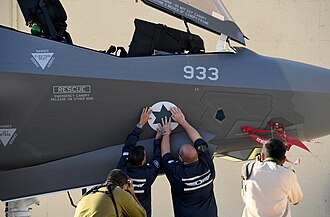 27th Adir F35 arrival at Nevatim, August 2020. Photo by U.S. Embassy Jerusalem – DSC_0863SM, CC BY 2.0, Wikipedia
In one’s personal life and in the life of a nation, it is good to have friends. It is even better to have capable and motivated friends, especially when one confronts increasingly formidable enemies who cooperate with one another. The Trump administration may publish its new National Defense Strategy soon, and its lines of effort will include “increasing burden-sharing with U.S. allies” and “supercharging the U.S. defense industrial base,” according to a December 6 speech by Secretary Pete Hegseth previewing the strategy.
To support those priorities and better secure American interests in the Middle East and elsewhere, President Trump should work with Israel to negotiate what would be known as the United States-Israel Strategic Partnership Agreement (SPA). The SPA would be the successor to the current U.S.-Israel Memorandum of Understanding (MOU), which sets important conditions for bilateral security assistance but will expire in 2028.
The SPA would include both Israeli and American commitments. Israel, for its part, would commit to 1) spending at least 4.5 or 5 percent of its gross domestic product (GDP) each year on defense for the duration of the agreement; 2) spending at least $1 billion each year of its own resources procuring American-made military hardware and boosting the American defense industrial base (DIB); and 3) investing at least $150 million each year on combined U.S.-Israel military research and development efforts to advance shared combat readiness priorities.
In return for these commitments, the United States would provide Israel $5 billion each year through what would be known as a Partnership Investment Incentive – or PII. This PII would provide funding via existing foreign military financing (FMF) mechanisms that Israel would use to procure American military hardware, but there would be two differences compared to the current MOU. First, Israel would be required to spend all PII in the United States. Israel would also be required to spend PII in areas designated by both militaries as combat preparedness priorities and by the Pentagon as DIB priorities. PII could also be used to support efforts to deepen security cooperation with Saudi Arabia and encourage normalization between Riyadh and Jerusalem, while maintaining Israel’s qualitative military edge (QME).
President Trump “likes helping countries that help themselves, and we feel the same way. That’s the nature of partnerships rather than dependencies. It’s what we owe our friends and, most importantly, what we owe the American people,” Secretary Hegseth said at the Reagan National Defense Forum on December 6, after citing Israel as one of America’s “model allies.”
To understand why Israel is a “model” partner, how Americans benefit from U.S.-Israel security cooperation, and how both countries can best advance shared interests in the future, it is helpful to explore the strategic context and the potential components of the SPA.
Israel’s Record of Advancing American Interests
The current MOU, signed in September 2016, covers fiscal years (FY) 2019 to 2028. It provides Israel $3.3 billion per year in foreign military financing (FMF) and $500 million per year for cooperative missile defense programs for a total of $3.8 billion per year or $38 billion altogether over the 10-year period. This funding has played an instrumental role in helping Israel become the preeminent military power in the Middle East, one that can and does take the fight to America’s adversaries in the region, including Iran and its terror proxies. The assistance America provides is an investment that has paid significant dividends.
That military capability was on full display during the 12-Day War in June, in which Israel damaged Iran’s nuclear facilities and severely degraded its air and missile defenses and ballistic missile production capacity. In Operation Midnight Hammer, when President Trump decided to send American B-2 bombers to hit hardened and deeply buried targets associated with Iran’s nuclear program, the job for the American pilots was less difficult because of the impressive work the Israeli Air Force had already done, relying heavily on its American-made F-15, F-16, and F-35 fighter jets flown by capable Israeli pilots launching, in some cases, American-made munitions.
That same military prowess, empowered by American support, was on display against Hezbollah, the U.S.-designated terrorist organization in Lebanon. Hezbollah started attacking Israel on October 8, 2023, one day after Hamas’s barbaric terrorist assault. The group’s top commanders included Fuad Shukr, who the U.S. government says played a key role in the 1983 Beirut Marine barracks bombing that resulted in the deaths of 241 U.S. military personnel. As part of the Rewards for Justice Program, the United States had offered a $5 million reward for information that would bring him to justice. That effort did not yield any results.
But on July 30, 2024, as part of its military operations against Hezbollah, Israel killed Shukr using American-made aircraft and likely an American air-launched munition. He will never again harm American troops — thanks to the Israelis. That is more than burden sharing. That is Israel accomplishing objectives that make Americans safer without putting a single U.S. service member in harm’s way. America needs partners like that.
Israeli military prowess also empowers American diplomacy. When President Trump or future presidents warn that there will be consequences for aggression, Iran and its terror proxies must worry that Israeli forces, and not just the U.S. military, is prepared to back up Washington’s words with decisive action. In short, Israel’s hammer makes pronouncements from Washington even more powerful. That’s why American efforts to build Israeli military capability are a wise investment — and not charity.
To be sure, Israel may not have one of the largest economies in the world and is certainly not an industrial superpower. Israel does, however, consistently create world-class military technologies from which Americans regularly benefit. This includes technology developed years ago to detect, map, and destroy Hezbollah and Hamas terror tunnels that Israel shared with the United States. The United States used these Israeli technologies to find and neutralize drug-smuggling tunnels under our southern border that could also be used by terrorists to infiltrate the United States. These same technologies developed in Israel also helped U.S. troops deployed to the Middle East expose tunnels that Islamic State terrorists used to approach, surveil, and attack U.S. military bases.
Due to necessity, culture, and size, Israel, a country of around 10 million people, is unusually effective at quickly fielding cutting-edge military technologies. The United States, for its part, has consistently struggled to go quickly from military concept to fielded combat capability, and many troops did not return home as a result, or returned with permanent wounds, both seen and unseen. “On average, the Department of Defense takes almost 12 years to deliver the first version of a weapon system,” according to a June 11, 2025, Government Accountability Office report. “That’s not nearly fast enough to keep up with emerging threats or deliver innovative technology,” the GAO concluded.
The United States has periodically purchased weapons systems from Israel to fill significant military capability gaps more quickly. The U.S. Army, for example, purchased the Trophy Active Protection System (APS) from Israel in 2018 to protect American M1 Abrams main battle tanks from rockets and missiles. But the Army could have closed this gap far sooner — the Trophy system has been operational in the Israeli military since at least 2011. Meanwhile, U.S. Army testimony in May 2018 made clear that American programs that might have provided a similar kind of protection were still “not ready yet for full rate production.” With new conflicts potentially looming, America’s warfighters may pay a steep price in the future if the Pentagon cannot move more quickly from identified requirements to fielded combat capability.
Echoing bipartisan concerns for years, Secretary Hegseth has rightly bemoaned the fact that Pentagon processes have “moved at the speed of paperwork, not war.” In a speech on acquisition reform on November 7, he emphasized the need to ensure “speed replaces process, money follows need, joint problems drive action, experimentation accelerates delivery and the services move faster and smarter.” Israel can support this vital effort.
At a time when China, Russia, Iran and North Korea are pursuing “unprecedented levels of cooperation,” according to Chairman of the Joint Chiefs of Staff Gen. Dan Caine, an American partner such as Israel is a national security asset that should be nurtured. By helping to secure American interests in the Middle East, Israel lightens the U.S. burden there and enables Washington to focus more on priorities elsewhere, including the Western Hemisphere and the Pacific, consistent with Trump’s new National Security Strategy.
Essential Components of a U.S.-Israel Strategic Partnership Agreement
A U.S.-Israel SPA could pick up where the MOU will leave off when it expires in 2028, enabling Israel to continue advancing U.S. interests. The SPA could begin in fiscal year 2029 and be negotiated to last for 10 years or longer. To maximize the value of the SPA for the United States, U.S. negotiators should suggest that Israel formally agree to three major commitments related, respectively, to its defense spending, procurement of American weapons, and investment in cooperative U.S.-Israel military research and development.
Defense Spending Commitment
First, as part of the SPA, Israel could agree to spend no less than 4.5 or even 5 percent of its GDP on defense each year. That is an extraordinary amount for a democracy to spend on defense — more than any NATO member state, including the United States, was estimated to spend this year. Yet Israel reached that level in 2023, before the war begun by Hamas pushed spending even higher.
For a decade, the United States has been spending around 3 percent of its GDP on defense. According to a NATO report with data current as of June 2025, only two members — Poland and Lithuania — were estimated to spend 4 percent or more of GDP on defense this year.
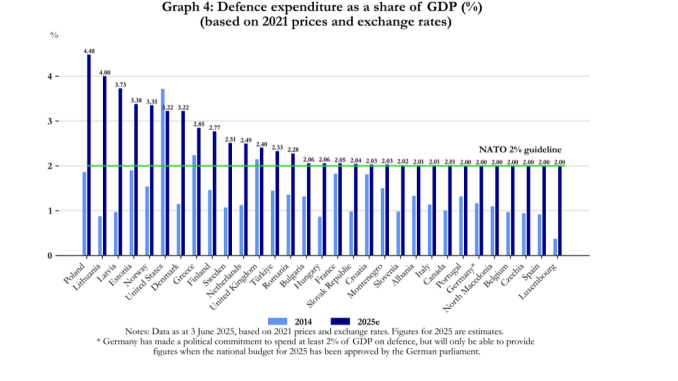 Source NATO
Notably, in the June 25, 2025, NATO Hague Summit Declaration, President Trump elicited commitments from America’s NATO allies to spend 3.5 percent of GDP on defense by 2035. In other words, if Israel were to commit to spending 4.5 or 5 percent of its GDP on defense each year of the SPA, it would be spending around 30 to 40 percent more by that measure on defense than NATO members are expected to spend in 2035 – six years earlier than the NATO requirement.
For those concerned about the burden on Israel, it is worth noting that Israel spent roughly 4 percent of GDP on defense in 2022 and 5 percent in 2023. In 2024, the first full year after the October 7 terror attack, Israel spent roughly 8 percent of GDP on defense and then 7 percent in 2025. While the 2026 number is not finalized, the expected figure is roughly 6 percent. Some in Israel might be reluctant to commit to spending at least 4.5 or 5 percent of GDP on defense for 10 years or more, but the shock of the October 7 assault and the multi-front war that followed show there is a clear need. Israel must replenish, expand, and modernize its military capabilities – and that will not be cheap.
Requirement for Israeli Purchase of U.S. Military Hardware
The second key component of the SPA would be an Israeli commitment to spend a certain amount each year in the United States procuring American-made military hardware. This commitment would be in addition to any Israeli spending related to foreign military financing or PII funding (see below). U.S. negotiators could suggest a floor of $1 billion per year as a starting point. This injection of Israeli resources would create American jobs, spur the economy, and bolster the U.S. DIB, by increasing production capacity and keeping assembly lines and supply networks active and healthy.
In addition to benefiting U.S. interests and the American worker, this commitment would serve Israel’s interests, as it needs to procure large quantities of American military hardware. Turning this plan into a firm commitment would explicitly, tangibly, and publicly demonstrate Israel’s commitment to the partnership and investment in the American DIB.
Requirement To Invest in Cooperative Research and Development
Finally, the third key commitment in the SPA would be for Israel to spend millions each year to help fund combined military research and development efforts identified by the U.S.-Israel Operations-Technology Working Group (OTWG) to meet common requirements identified by the Pentagon’s Office of the Under Secretary of Defense for Research and Engineering and Israel’s Directorate of Defense Research and Development. A starting point for negotiations could be $150 million per year. This minimum investment figure could increase each year in proportion to the growth of Israel’s GDP the previous year.
There are ample additional opportunities for collaboration. The OTWG includes sub-working groups focused on artificial intelligence/autonomy, directed energy, counter-unmanned aerial systems, biotechnology, integrated network systems-of-systems, and hypersonic capabilities. These are among America’s top military modernization priorities and Israel is already helping. If new priorities emerge, the OTWG could establish new sub-working groups. The United States could match Israeli funding using mechanisms like those employed by the Capability Development and Innovation Divisions in the Pentagon (formerly known as the Irregular Warfare Technical Support Directorate).
U.S. Partnership Investment Incentive Funding
In return for these significant Israeli commitments, the United States, as part of the SPA, could commit to providing Israel with PII funding via the existing FMF mechanism. Israel would use this funding to procure American-made military hardware. Pursuant to negotiations, the amount of PII could be $5 billion or so per year, which would represent roughly the inflation adjusted value of the $3.8 billion figure negotiated in 2016. Regardless of the amount, there would be important differences between the old FMF and the new PII, even though PII could be delivered using existing mechanisms.
Israel would be required to spend all the PII funding solely in the United States, which would benefit American workers, a major administration priority. There would be no so-called “off-shore procurement” (OSP) funding that has permitted Israel to spend a portion of FMF outside the United States. Under the current MOU, Israel was permitted to spend $815 million in fiscal year 2019 outside the United States. Over the 10 years covered by the current MOU, that amount gradually declines to zero in FY 2028. Under the SPA, all PII would be spent in the United States starting in the first year (FY 2029) and would stay that way throughout the entire SPA term. Eliminating OSP would also incentivize Israeli companies to partner even more with American defense companies, further strengthening the American DIB and providing both partners additional opportunities to benefit from each other’s innovation. That would, in turn, help Israel build redundant production capacity in the United States to complement production capacity in Israel. That is important in case Israeli factories are damaged in a major war or the mobilization of reservists deprives those factories of workers when they are needed most. It is worth remembering that thousands of Israelis left their factories to fight after October 7.
Any Israelis concerned about the lack of OSP authority can take comfort in the fact that it is not necessary, as Israel needs to spend well more than $5 billion per year in the United States to procure needed weapons. The Department of State, for example, announced on February 7, 2025, a foreign military sale to Israel for almost $7 billion in American military equipment.
A second difference between existing FMF and a PII would be that Israel would, under the SPA, also agree to spend all PII not just in the United States, but on areas designated by the Pentagon as top American combat preparedness priorities — a condition that would further bolster the U.S. DIB. The negotiation process for the SPA could formally identify these areas to ensure they are mutually agreeable. They could include air superiority, air and missile defense, and precision strike, for example.
A benefit of PII is that it would help Washington ensure Israel maintains its QME relative to other states in the region. The administration is eager to expand security cooperation with Saudi Arabia, including the potential provision of F-35s. This plan should not move forward unless concerns about Saudi Arabia’s military cooperation with China are resolved. If those concerns are conclusively addressed and Riyadh agrees to normalize relations with Israel before the delivery of the first aircraft, the F-35 deal could perhaps proceed. However, in that scenario, U.S. interests and U.S. law require Washington to take additional steps to help Israel maintain its relative QME. PII could help Israel acquire the additional capability and capacity necessary to maintain its QME.
Finally, the SPA could include agreements related to non-military cooperation in areas such as agriculture and dual-use areas such as artificial intelligence. It could also include agreements codifying and expanding already impressive levels of mutually beneficial intelligence cooperation.
Conclusion
If the president were able to negotiate a Strategic Partnership Agreement like the one laid out above, it would represent a historic accomplishment, supporting the administration’s goals to strengthen America’s defense industrial base and increase partner capacity so that those nations can carry more of the security burden.
As the United States seeks to do more here at home in the Western Hemisphere while deterring aggression in the Pacific, Washington needs capable and motivated partners to defend enduring U.S. interests in the Middle East, such as countering Islamist terrorism and the threat of a nuclear-armed Iran. Thankfully, that kind of partner is exactly what Americans have in Israel. A U.S.-Israel Strategic Partnership Agreement can help ensure that remains the case for many years to come.
Bradley Bowman is senior director of the Center on Military and Political Power (CMPP) at the Foundation for Defense of Democracies (FDD). For more analysis from Brad and CMPP, please subscribe HERE. Follow Brad on X @Brad_L_Bowman. Follow FDD on X @FDD and @FDD_CMPP. FDD is a Washington, DC-based, nonpartisan research institute focusing on national security and foreign policy.


The US wants to have its cake and eat it too. They are happy getting Israeli know-how to advance their military machine but they require Israel to share everything they have achieved and be sure not to even try to circumvent US policies by selling their own achieved capabilities elsewhere. That sounds to me like a great deal placed very close to coercion.