MenuThere is no diplomatic solutionIsrael should declare three nos; no to nuclear Iran, no to two-state solution, no to bi-national state
Deterrence or illusion? The Egypt gas deal is Netanyahu’s test
Will Netanyahu leverage this deal to force Egypt to honor its peace commitments, or will he allow the deal to shield Egypt from accountability?
By AVI ABELOW |
Netanyahu speaks before UN General Assembly. Image via Youtube
Israel’s newly announced $35 billion natural gas deal with Egypt is being hailed as a diplomatic and economic triumph, proof, we are told, that Israel has secured its place as a regional energy superpower. Once an energy-dependent country, now an exporter of energy. A huge shift for the small Jewish state of Israel, which had no natural resources.But this deal is not primarily an economic story. It is a test of leadership.
The real question facing Prime Minister Benjamin Netanyahu is not whether the gas deal strengthens Israel’s balance sheet, but whether it will be used to strengthen Israel’s deterrence, or whether it will become yet another excuse for Israel to ignore blatant violations of the Camp David Accords and Egypt’s direct role in empowering Hamas.
Egypt has openly and massively breached the Camp David Accords, deploying tens of thousands of troops, tanks, and heavy military equipment into the Sinai, far beyond what the treaty allows. This is not speculation. It is documented reality. And Israel has chosen, for years, to look the other way in the name of “stability.”That tolerance has come at a catastrophic price.For years, Egypt enabled Hamas’s military buildup by allowing, at best, massive smuggling operations through Sinai, and at worst, active cooperation with the terror tunnel network feeding Gaza with weapons, explosives, and materials. Those weapons were later used to butcher Israeli civilians on October 7.And now, after all this, Israel signs a multibillion-dollar gas deal with Egypt and projects optimism regarding foreign relations with Egypt.This is not realism.It is self-deception.
The core illusion: Economics overcomes ideology
At the heart of this deal lies a familiar and dangerous Israeli fantasy: economic incentives can tame an enemy whose hostility is ideological. But there is no placating a 1,400-year-old Islamic worldview that sees Jewish sovereignty in the Middle East as a historical mistake, and gas revenue will not neutralize jihadist theology. Israel has already paid dearly for this illusion in Gaza: Just days before Oct. 7, 2023, IDF and Shin Bet leadership actually advised the government that Hamas preferred jobs and economic development over jihad.
Like sand in the wind
Even if one generously assumes that President el-Sisi currently seeks stability, that argument collapses under the most basic understanding of the Middle East: regimes in the region do not last. Had Israel surrendered the Golan Heights to Assad as so many demanded for decades, for example, ISIS-linked forces under Jolani would today be overlooking the Kinneret with weapons aimed at Tiberias.
“Every deal with the Arab Muslim Middle East is like sand in the wind,” Dr. Mordechai Kedar once told me, words that should be engraved in the halls of Israel’s Foreign Ministry. “Everything can change in an instant.” This is Middle Eastern literacy.
Deterrence is built on consequences, not contracts
The gas deal itself is not the problem. How Israel uses it is. The agreement should have been conditioned on Egypt paying for violating its treaty with Israel, specifically:
Full withdrawal of unauthorized military forces from Sinai
Accountability for enabling Hamas’s military buildup
Clear consequences for future breaches of the peace treaty
Instead, Israel has sent a dangerous message: that massive violations, strategic threats, and even indirect responsibility for Israeli deaths can be washed away with economic cooperation. This will not be lost on Egypt, or on other regional actors who are watching.
The Middle East does not respect paper agreements. It respects power, land, sovereignty, and irreversible consequences.Every Israeli withdrawal has been interpreted as weakness. Every concession has been banked as an opportunity for future attack. And every attempt to replace deterrence with economics has cost us dearly with Jewish blood.If Egypt, or any regional actor, harbors long-term ambitions against Israel, this gas deal will not stop them. It will merely help finance their patience.
This is Netanyahu’s moment
Israel doesn’t need applause from international markets. It needs clarity.
Prime Minister Netanyahu stands at a crossroads. He can either use this deal as leverage to enforce the Camp David Accords and restore Israeli deterrence, or allow it to become another illusion, proof that Israel still believes money and economic cooperation can buy security in a region governed by ideology and force.Jewish survival in the Middle East has always rested on one foundation alone: a strong, expanding, unapologetic Jewish state, rooted in land, sovereignty, and the willingness to impose permanent consequences on those who seek our destruction.Anything less is just sand in the wind.The writer is the host of The Pulse of Israel daily video podcast and the CEO of the 12Tribe Films Foundation, which produces media content highlighting Israel’s biblical, historical, and strategic importance to the Jewish people and the world.

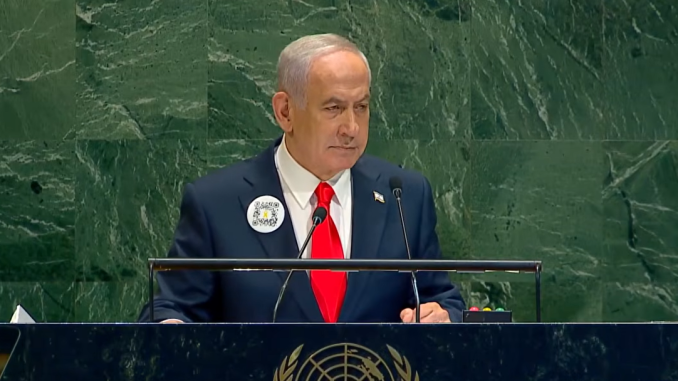 Netanyahu speaks before UN General Assembly. Image via Youtube

Leave a Reply
You must be logged in to post a comment.