
Peloni: Fascinating!
Am Thinker | January 7, 2026
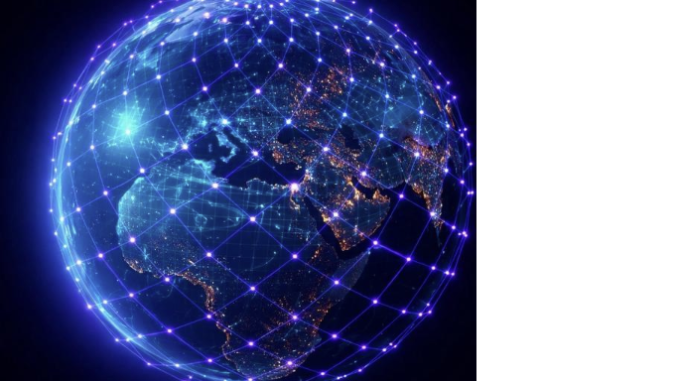 Image generated by ChatGPT.
In March last year, China unveiled a cable-cutting device capable of operating 4,000 meters underwater. This underscores a significant vulnerability that few consider: 99% of international data travels through about 600 subsea fiber optic cables, totaling nearly 1.48 million kilometers of cable susceptible to attack.
With China and Russia adopting strategies for multi-front warfare, the threat to infrastructure and communication cannot be ignored. Attacks will occur unexpectedly and are likely to involve hacking or be carried out through drones, robotic submarines, and similar methods. There is an urgent need for a resilient alternative network that will support — and during crises, replace — existing telecom systems.
Therefore, the world must seriously consider initiatives like the Outernet project, which plans to establish a network of 600 interconnected low-earth orbit satellites that could sustain global communication even if the cable network is damaged. Led by Munich-based Rivada Space Networks, the project aims to create “a second internet backbone in space.” There is no dependence on ground stations.
Rivada’s CEO, Declan Ganley, a telecom entrepreneur, has been working on a system to replace undersea cables for several years. He started the company after studying the challenges faced by emergency services during the 9/11 terror attacks. Having interacted with Chinese officials, he is very aware of the threat posed by communist China and its ambitions for global dominance.
The Chinese have shown strong interest in this new technology and have repeatedly asked Ganley to partner on the venture and launch the system from China, using Chinese satellites. At a meeting in Paris, a Chinese “business figure” offered him $7.5 billion and laid out his terms. Ganley resisted, so the Chinese resorted to lawfare: they filed 158 lawsuits, costing Rivada over $36 million and distracting it from the main goal of getting the satellites in space by early 2026.
Ganley, an Irish citizen born in the U.K.,* doesn’t seem like the type to give up. He started investing in stocks at age 14. When he left school, he decided to enter the business world. From working on construction sites and as a teaboy, he devised a plan to launch satellites by hiring Russian rockets. That didn’t work out, but his other ventures — buying Russian aluminum when the ruble was low and selling it high in Europe, forestry, and broadband networks — were successful. By his early twenties, when most young people are deciding on careers, he had earned enough money to think big.
Ganley warns about the threat from China. He points out that Chinese-made telecom equipment, from companies like Huawei, is legally obliged to share intelligence and information with the Chinese Communist Party (CCP). The U.S., he believes, mishandled radio spectrum allocation, forcing many mobile carriers to look for cheaper financing and technology. Taking advantage of this, the CCP subsidized Huawei and other manufacturers so their equipment and software could be sold cheaply and serve as a massive intelligence-gathering tool, compromising global networks.
>As a young businessman in Russia, Ganley directly witnessed the evil and oppression of communism, which motivated him to vow never to do business with China. He supports the development of the Outernet as a vital safeguard against sabotage for businesses and democracies. He regrets that the West moved manufacturing to China, kept energy prices higher than China’s, and lost control of its data networks.
Ganley’s concerns and warnings about the threat to subsea cables from China — and increasingly Russia — are reflected in the U.S.-China Economic and Security Review Commission’s 2025 report to Congress. The report includes cable cutting among “coercive military, economic, and influence operations short of war” — actions described as being in the “gray zone.”
A boxed article (pages 98–99) in Chapter 2 of the report describes three cases where vessels from China’s “shadow fleet” cut cables near Taiwan and the Baltic Sea, and a gas pipeline between Finland and Estonia. European investigators are quoted as saying that Russian agents were involved in some of the sabotage operations in the Baltic. The article states that China delayed repairing cables near Vietnam by not issuing permits. It also warns that, under the guise of carrying out repairs, China could install taps on undersea cables in the Pacific to compromise U.S. military communications.
Another report from Recorded Future, an American cybersecurity company, identified nine suspicious incidents in 2024-25. Four occurred in the Baltic region, causing eight cable damages, and five happened around Taiwan, leading to five disruptions. The report states that at least four of these incidents involved ships linked to China or Russia engaging in suspicious maneuvers. While it stops short of blaming Russia directly, it says that “Russia has almost certainly increased hybrid operations targeting European countries, including sabotage of critical infrastructure.”
China has the third-largest submarine fleet in the world, with more than 60 vessels, but it is only a few short of the leaders, the U.S. and Russia, which each have roughly 70. China plans to surpass America and Russia by 2030 in both conventional and nuclear submarines. The new cable-cutting device, which uses a high-speed diamond-coated spinning blade protected by strong shells to withstand high pressure in the deep, can be operated from submarines and even from shore. So, it is definitely a major threat.
Since 2023, nations have suspected China and Russia of targeting undersea cables to disrupt communication. However, even in 2023, data from Taiwan’s Chunghwa Telecom revealed that cables to Matsu Island — located near the Chinese mainland — had been cut 27 times over the previous five years. In 2024–25, more incidents involving China and Russia have come to light.
While Sweden, Lithuania, Estonia, and Germany have blamed China or Russia or called for them to join investigations, Taiwan jailed a Chinese captain in June last year for sabotaging a cable near Penghu Island. Prosecutors said his ship — which was in poor condition, had only one cargo record, and operated under multiple names — zig-zagged over the cable, dragging its anchor intentionally. In November 2024, the Chinese bulk carrier Yi Peng 3 was accused of cutting cables between Sweden and Lithuania and between Finland and Germany by dragging its anchor for 160 kilometers. The New Polar Bear, a Chinese feeder ship, was suspected of breaking the gas pipe between Finland and Estonia.
These actions follow the strategies outlined by Chinese colonels Qiao Liang and Wang Xiangsui in Unrestricted Warfare: China’s Master Plan to Destroy America. They describe future battlefields as being “virtually infinite.” The focus will be on avoiding direct conflict by targeting economic and financial systems, disrupting networks and infrastructure, and employing similar tactics within the “gray zone.” The Salt Typhoon data breaches from 2023 to 25 were part of this approach, targeting 200 companies across 80 countries. According to the New York Times, Chinese hackers may have stolen data from nearly every American.
Some analysts believe the sabotage of cables behind the cover of deniability — using ships with opaque ownership records and deploying maneuvers that could be mistaken for accidents — was China’s way of testing response times. Repairing a damaged cable costs millions of dollars and can take months, although built-in redundancy usually ensures that alternative routes restore connectivity much sooner.
In fact, it is redundancies that have kept cable-based networks operational since the first transatlantic cable briefly connected Valentia Island, Ireland, with Heart’s Content, Newfoundland, in early August 1858, and failed within three weeks. Rapid technological advances and alternative routing protocols have ensured that even the tsunamis of 2004 and 2011, which caused significant disruptions, did not result in total failures in the affected countries.
Now, with analysts saying that the announcement of China’s cable-cutting capabilities “should silence any doubts regarding the threat of intentional cuts,” the free world should consider the space-based redundancy that the Outernet offers — one that surpasses all ground-based backups.


After repeated setbacks, Nasa is sending four Artemis II astronauts around the moon and further from Earth than ever before
https://www.scmp.com/news/world/united-states-canada/article/3348724/historic-artemis-ii-moon-mission-lifts-amid-us-lunar-race-china