
by Majid Rafizadeh • Gatestone Institute • January 24, 2026 at 5:00 am
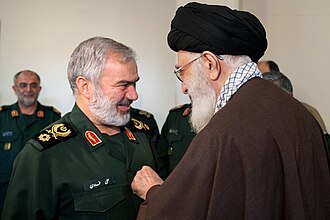 Ayatollah Seyyed Ali Khamenei Gives the Order of conquest to Brigadier General Ali Fadavi and four other commanders of the Islamic Revolutionary Guard who arrest American soldiers who attacked the Iranian borders in the Persian Gulf. By Khamenei.ir, CC BY 4.0, Wikipedia
- For decades, Iranian leaders grew accustomed to Western caution, diplomatic hedging, and carefully measured statements designed to avoid escalation. They learned that repression at home would provoke criticism but rarely consequences. They learned that terrorism abroad would be condemned but tolerated. They learned that nuclear deception would lead to negotiations, not punishment.
- Trump combines two instruments that authoritarian regimes fear more than anything else: open moral alignment with their victims and credible willingness to use force.
- Through words, Trump has broken a long-standing taboo in American policy. He has spoken directly to the Iranian people, not as passive subjects trapped behind borders, but as political actors whose struggle is important…. This matters. Authoritarian regimes depend on isolating their populations psychologically, convincing them that they are alone, forgotten, invisible. When the president of the United States openly recognizes their struggle, this wall of isolation cracks.
- Most importantly, military consequences were not just threats but were made explicit and carried out.
- For years, US presidents, for their own convenience, pretended that protests in Iran were just isolated economic grievances or temporary outbursts, and pretended that regime survival was the same as legitimacy.
- Any country that chooses to do business with the regime should understand that it is indirectly financing torture, executions, and crushing democratic aspirations.
- Military pressure must remain credible: deterrence saves lives. When a regime believes it can massacre protestors without consequence, it will do so. When it fears international retaliation, it hesitates. Trump’s explicit warnings regarding executions and escalation altered calculations in Tehran. When Trump hesitates, Iran resumes executions. Removing the mullahs’ fear would be a gift to the regime.
- Moral pressure must remain constant. The Iranian people must continue to hear that their struggle is seen, respected, and supported. Silence kills hope. Recognition strengthens it.
Never in its forty-six-year history, thanks to the Trump administration and Israel, has the Iranian regime been weaker. Never, since Ayatollah Ruhollah Khomeini’s 1979 Islamic Revolution, has the clerical system faced such a convergence of internal rebellion, economic collapse, military vulnerability, and psychological defeat. Never have the mullahs appeared so exposed and so afraid of their own population. This historic weakening is the outcome of sustained pressure and — above all — the courage of the Iranian people, who have risen against a system that has ruled them for generations through prisons and executions.
Continue Reading Article


“Weakening,” as the outcome of sustained pressure and the courage of the Iranian people, is not the same as” ending” the authoritarian reign of the mullahs once and for all.
To do so will require decisive military action, both overt and covert, by the US and/or Israel to secure freedom and justice for the Iranian people.
Sums it up perfectly…
It’s not a job assigned to Israel or the USA. They want to see it happen because they are being named as the premier targets of the Iranian regime. The rest of the world is happy to relax and watch the show. It’s time they pay for their tickets.