
Peloni: If this report is true, this is not a time to negotiate an extension of this repressive terror regime, but rather it should signal the time to eliminate this threat poised against the entire West once and for all.
Verified death toll from crackdown crosses 6,000, with estimates ranging up to 30K
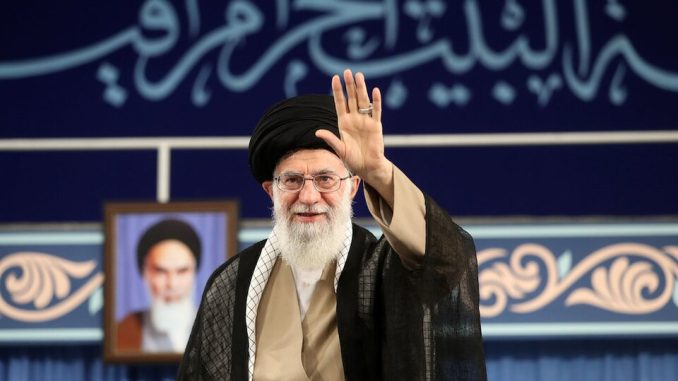 By Unknown author – english.khamenei.ir, CC BY 4.0, Wikipedia
U.S intelligence estimates that the Iranian regime is at its weakest point in decades, despite having apparently suppressed a massive wave of protests with unprecedented force, the full scale of which remains unclear amid the country’s ongoing internet shutdown.
American intelligence reports presented to President Donald Trump in recent weeks indicate that the regime’s hold on power is weakening, with it now being at its weakest point since the mullahs led the Islamic Revolution that overthrew the Shah in 1979, according to The New York Times (NYT).
Since then, the regime has survived the catastrophic Iran-Iraq War (1980-88), armed revolts and assassination campaigns by the radical left-wing Mujaheddin e-Khalq (MEK) terror group, as well as major protests in 2009 and 2022, among others.
A particularly shocking aspect of the protests is their wide geographical spread, the report stated, as the human rights group HRANA reported that 651 protest-related incidents were recorded across 200 cities in 31 provinces, including the Supreme Leader Ali Khamenei’s home city of Mashhad.
Trump has reportedly continued to weigh his options for a military strike, seeking an option that would be “decisive” rather than drag the U.S. and the broader region into a long escalation. The president postponed an attack two weeks ago, despite the regime crossing his “red line” and carrying out the largest mass killing of protesters in its history.
Various human rights groups based abroad have been trying to piece together information from inside the country to establish an official death toll, amid the ongoing internet shutdown.
The data collected by the Washington-based HRANA (Human Rights Activists in Iran) has been widely cited by various news outlets, being seen as a reasonable estimate for the minimum number of deaths.
In its latest report, the agency said that on the 30th day since the start of the protests, it had managed to verify 6,126 reported deaths, including 5,777 protesters, 86 children under the age of 18, 214 members of regime forces, and 49 civilians not engaged in protests.
However, HRANA is still investigating an additional 17,091 reports of death and the total number can only be estimated at this time.
One of the most recent high-profile estimates was reported by the Sunday Times, which cited two senior officials from the regime’s Health Ministry as saying that data collected by doctors and first responders indicated over 30,000 people were killed on January 8 and 9 alone, suggesting the overall toll could be significantly higher.
The Iranian regime has so far only acknowledged 3,117 deaths, claiming that 2,427 were civilians while the rest were “terrorists” and “rioters,” on whom it blames part of the civilian deaths.
HRANA also said it has recorded 41,880 arrests of protesters, 11,009 severely wounded protesters, and 245 cases where arrested protesters were forced to confess to ostensible crimes.
The NYT reported that the intensifying economic crisis, which provided the initial spark for the current wave of protests, has contributed to the weakening of the regime.
According to various reports, many Iranians are afraid to go to work amid the massive military presence on the streets, while HRANA said the regime continues to conduct arrests across the country, including about 300 citizens in the northern Semnan Province and 54 citizens in multiple cities, including Yazd, Zanjan, and Malard.
Further straining the economy is the internet shutdown, which, according to NetBlocks, has now continued for 18 days. The regime has also intensified measures against circumvention tools, however, the lack of internet has crippled large parts of the economy.
Iran’s communications minister said the cost of the internet shutdown amounts to “five trillion tomans per day” (approximately $35 million).
Zineb Riboua, research fellow at the Hudson Institute, wrote on ?, “The Islamic Republic is collapsing on its own anyway, some indicators like inflation, currency issues, water shortages, budget constraints, speak for themselves.”
Israeli Iran expert Raz Zimmt of the INSS think tank agreed. “Today more than ever, I am convinced that the Islamic Republic is approaching the end of the road as we have known it since the leadership changes of 1989,” he wrote on ?.
“The regime has no way to overcome the events of recent weeks, which have deepened both the legitimacy crisis and the economic crisis,” he argued, adding that the regime is likely already undergoing “an advanced process of gradual collapse.”


The Khameni regime needs to go NOW!!!