
Peloni: High stakes are at play in the F-35 Deal related to immense financial deals, military advancements, and threats from the Arab street. Will Washington ignore the stiffening of Riyadh’s hard line policies of late, or will the US hold the Saudi accountable for strengthening ties with America’s enemies against her Israel.
Jalal Tagreeb
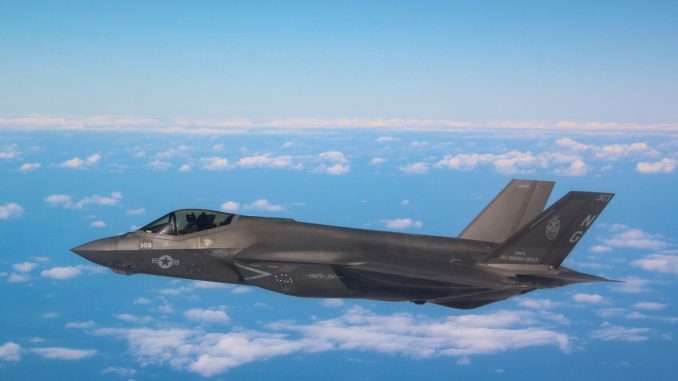 Marines from Marine Wing Fighter Attack Squadron (VMFA) 314 and Sailors from Electronic Attack Squadron (VAQ) 133 conduct integrated training missions. Navy photo by LT Francis Alvare. The appearance of U.S. Department of War (DoW) visual information does not imply or constitute DoW endorsement.
In a recent Youtube video analysis, Khaled Hassan, an Egyptian-British National Security & Foreign Policy Researcher and Council Member of President Herzog’s Voice of the People, delivers a strong warning about Saudi Arabia’s prospects of acquiring American F-35 fighter jets. Speaking directly to his audience, Hassan outlines what he describes as a critical miscalculation by Riyadh that threatens to derail the arms deal indefinitely.
His assessment, rooted in observations of recent diplomatic developments and shifting regional alliances, paints a troubling picture for the Kingdom’s military modernization plans. Hassan argues that despite the agreement reached during Crown Prince Mohammed bin Salman’s visit to Washington, a series of Saudi policy decisions—from forging military alliances with Pakistan and Turkey to launching vitriolic attacks against the United Arab Emirates—have fundamentally undermined the Kingdom’s standing in American eyes. Most crucially, he contends that Saudi Arabia has made the fatal error of attacking the Abraham Accords and, by extension, President Trump’s signature foreign policy achievement. This, Hassan insists, has transformed what should have been a straightforward arms transaction into a geopolitical impossibility. His conclusion is unequivocal: unless Saudi Arabia normalizes relations with Israel, the F-35s will remain out of reach, regardless of any prior agreements or assurances.
The recent agreement between Saudi Arabia and the United States regarding the acquisition of F-35 fighter jets has become a source of growing concern in Riyadh. During Crown Prince Mohammed bin Salman’s visit to America, an understanding was reached for the Kingdom to obtain a certain number of these advanced aircraft. However, following the Yemen crisis and the deteriorating Saudi-Emirati relations, serious doubts have emerged about whether and when these jets will actually be delivered. This anxiety is well-founded, as the coming weeks are expected to witness intense negotiations between Saudi and American decision-makers over the F-35 deal, with the Saudis seeking reassurances and concrete commitments about the timeline and certainty of delivery.
The fundamental issue lies in understanding President Trump’s worldview and priorities. Trump consistently portrays himself as “the peace president,” someone who brings peace wherever he goes. Like most leaders, he seeks to establish a legacy that history will remember. His primary focus has been on Arab-Israeli peace agreements that would end conflicts in the Middle East, ensure Israeli security, and facilitate economic cooperation, business deals, oil transactions, and various commercial ventures. This vision represents the cornerstone of his foreign policy achievements in the region.
Trump’s commitment to this legacy is evident in his public statements and media coverage. He has openly declared that he deserves the Nobel Peace Prize for his work on the Abraham Accords, and he has consistently promised to expand these agreements to include additional countries. Articles from as recently as April 2025 confirm his determination to broaden the Abraham Accords while simultaneously dealing with Iran. Although no deal with Iran has materialized yet, America appears to be on a path toward confronting Tehran within days or weeks, with the resolution likely taking a decidedly military form.
Against this backdrop, Saudi Arabia’s recent trajectory represents a dramatic departure from what Trump envisions for the region. A Reuters report from mid-January 2026 revealed that a Pakistani minister announced an emerging military alliance between Pakistan, Saudi Arabia, and Turkey. This development carries profound implications. Pakistan is a nuclear power that manufactures its own weapons, and Saudi Arabia has now entered into a mutual defense agreement with Islamabad following Israel’s strike on Qatar. This defense pact has raised alarm bells in Washington, particularly because Pakistan is not a strong American ally and maintains powerful ties with China, which Trump himself views as America’s primary adversary.
The situation becomes even more problematic when examining Saudi Arabia’s recent campaign against the United Arab Emirates following the Yemen incidents. Saudi voices have launched aggressive attacks on the Emirates, accusing them of being Zionists, a functional state serving Israeli interests, and attempting alongside Israel to encircle the Kingdom. The rhetoric has included blatantly antisemitic language, with accusations that the Emiratis are Jews and traitors. This campaign has not gone unnoticed in Washington. Prominent American journalists and analysts, including Michael Rubin of the Middle East Forum, one of the oldest and most influential think tanks on Middle Eastern affairs with direct connections to Trump, have written extensively about these developments.
More recently, Barak Ravid of Axios, who maintains very close ties with the White House, published an article revealing that Saudi Arabia is conducting a comprehensive campaign not only against the Emirates but also against the Abraham Accords, against peace itself, and against President Trump’s vision for the region. This places Saudi Arabia in an extremely precarious position. By building a military alliance with Turkey and Pakistan, two countries with clear hostility toward Israel—Turkey’s antagonism is obvious, while Pakistan doesn’t even recognize Israel’s existence—the Kingdom is sending unmistakable signals about its strategic direction.
The nature of Saudi Arabia’s campaign compounds the problem significantly. By attacking and diminishing the Abraham Accords, Saudi Arabia is directly assaulting Trump personally and his historic achievement, the very accomplishment for which he claims to deserve the Nobel Peace Prize. This represents a monumentally foolish political miscalculation. In an effort to tarnish the UAE’s reputation by calling them Zionists and Jews, Saudi Arabia has crossed a line that directly challenges Trump’s personal legacy, his strategic direction, and his vision for peace in the region. This will create substantial difficulties for the Kingdom.
Israel has consistently lobbied the American government against providing F-35s to Saudi Arabia, arguing that without a peace agreement with Israel, these aircraft pose a security threat. The Israeli position has been clear: if Saudi Arabia possesses such advanced military capabilities, potential conflict could erupt, and these jets could be used against Israeli targets. Now, with prominent Saudi voices openly attacking peace initiatives and the State of Israel, this information inevitably reaches Israeli decision-makers and President Trump. They can point out that their warnings were prescient—that Saudi Arabia’s project resembles that of the Muslim Brotherhood, and the language currently being employed mirrors that of Hamas and other groups, showing disturbing similarities in their approach to Israel and their condemnation of those who made peace through the Abraham Accords.
All of this rhetoric will be used against Saudi Arabia. The most likely outcome, at minimum, is the indefinite postponement of any F-35 delivery to the Kingdom. The matter will probably be delayed until there is clarity about future developments. Perhaps the Pentagon and American decision-makers will conclude that Saudi Arabia is building an alliance with Pakistan and Turkey, seeking to create an Islamic coalition—essentially the definition of political Islam. They may view the Kingdom as embracing political Islam, extremism, and opposition to the Abraham Accords and peace, leading to a fundamental reassessment: if that’s the path Saudi Arabia chooses, then there can be no military cooperation, and no F-35s will be delivered.
This represents a dramatic reversal of fortune for Saudi Arabia. Where once the Kingdom was celebrated and welcomed as a nation free from the populist Nasserist rhetoric of perpetual war against Israel, it is now being viewed as an unreliable party that cannot be fully trusted. The contrast is stark and deeply concerning for Riyadh’s strategic interests.
In the coming weeks, developments will likely unfold rapidly. There may be communication or a visit by Saudi Defense Minister Prince Khalid bin Salman to America to discuss these issues comprehensively. However, the fundamental assessment remains unchanged: Saudi Arabia will not receive F-35 aircraft unless and until normalization with Israel occurs. The Kingdom has placed itself in a position where its recent political choices and inflammatory rhetoric have created obstacles to obtaining the advanced military technology it seeks. Trump’s focus on his peace legacy, combined with Israeli concerns and Saudi Arabia’s apparent alignment with forces opposed to regional normalization, makes the delivery of F-35s highly improbable in the current circumstances. The Kingdom must recognize that its recent trajectory runs directly counter to American strategic interests and Trump’s personal priorities, creating a situation where the promised jets remain perpetually out of reach.
Source: https://youtu.be/ZgJC8pIODoE?si=nsL8KSZ924B460hB
He now focuses on analyzing cultural and ideological contrasts between the West and the Middle East. Through his writings and translations, he aims to foster meaningful dialogue, encourage critical engagement with Islamic tradition, and promote intellectual honesty. His writings, debates, and a selection of his previously refuted Islamic arguments can be found here:


Leave a Reply
You must be logged in to post a comment.