
Defense and trade agreements between Turkey and Arab nations reduce dependence on US
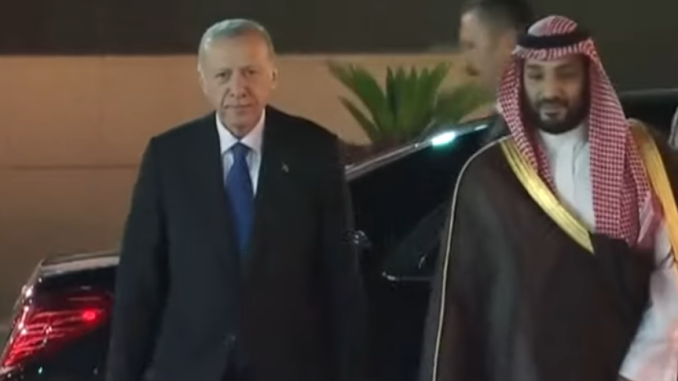 Erdogan and MBS meet in Jeddah, Saudi Arabia, Youtube
Turkish President Recep Tayyip Erdogan made back-to-back visits to Saudi Arabia and Egypt over two days this week, seeking to expand Turkish influence in the Middle East and North Africa.
Erdogan met with Egyptian President Abdel Fattah el-Sisi in Cairo on Wednesday, where the two countries signed cooperation agreements and voiced shared positions on several regional issues, including Gaza, Somaliland, and tensions between the United States and Iran.
Following the meeting, el-Sisi presented several memoranda of understanding and agreements that had been signed across a broad range of issues, including defense, tourism, investment, trade, health, and agriculture.
“We are all witnessing that the Türkiye-Egypt cooperation contributes to stability in our region” https://t.co/QWzD6sH5Vk pic.twitter.com/DrNTs7tBGB
— Presidency of the Republic of Türkiye (@trpresidency) February 4, 2026
Ties between the two countries remained strained after the 2013 ouster of Mohamed Morsi and Egypt’s subsequent crackdown on the Muslim Brotherhood, a period during which Erdogan’s government backed Morsi and sharply criticized el-Sisi.
However, growing concern over the strength of Israel and its willingness to engage in independent security operations, often without respect for national borders, has led the leaders of Turkey and Egypt to increasingly cooperate against what they perceived as Israeli military ascendancy in the region as a result of the Oct. 7 Gaza War and the 12-day Israel-Iran War last June.
The two leaders issued statements on Gaza, Sudan, Somaliland and Iran that demonstrated a unified stance, particularly against Israel.
In a joint declaration following the meeting, both governments affirmed their commitment to Syria’s sovereignty, unity, stability, and territorial integrity. They also condemned what they stated were Israeli violations of Syria’s sovereignty and integrity, stressing the need for Israel to adhere to the 1974 disengagement agreement.
Türkiye occupies 9,000 km² of Syria – 25× the size of Gaza. The world barely whispers. pic.twitter.com/4vZMZD8QGG
— Avi Kaner ??????? ??? (@AviKaner) February 3, 2026
Erdogan’s trip to Cairo came one day after a similar visit to Riyadh, Saudi Arabia, where he met with Crown Prince Mohammed bin Salman (MBS), the de facto leader of the kingdom. In that meeting, the two leaders spoke about their alignment on various regional issues, particularly the rejection of the IDF’s actions in Syria and Israel’s recognition of Somaliland.
The two leaders also announced their decision to “strengthen their cooperation” in several areas, including energy and defense. In particular, Saudi Arabia and Turkey may cooperate on the development of Turkey’s next-generation Kaan stealth fighter. Turkey has not only been pursuing the development of the aircraft as insurance against the possibility of being completely rejected from participating in the U.S.’s F-35 program, but also as proof of Turkey’s capabilities.
“Kaan is not just a fighter jet. Kaan is a symbol of Turkey’s engineering capabilities and independent defense will,” Erdogan said in a statement, cited by The Daily Sabah.
While U.S. President Donald Trump has told both Saudi Arabia and Turkey he would work to enable their purchase of the American-made F-35, the final decision rests with Congress, and there is bipartisan caution about granting the countries access to the fifth-generation fighter. Developing their own stealth aircraft would allow both nations to modernize their air forces while reducing reliance on the U.S. as an arms supplier.
According to Dr. Galia Lindenstrauss, senior researcher at the Institute for National Security Studies (INSS), Turkey has worked to improve relations with various countries in the region, partially to counter Israeli power and reduce its own dependence on the United States.
Lindenstrauss told Israel’s Ynet News, “Turkey has become a significant arms exporter, especially of drones, and Saudi Arabia actually not only buys drones from it, but they also do security cooperation to produce drones.” She said, “This fits into the agenda of the countries in the region who do not want to be dependent on the US and are a little afraid of going towards China and Russia and of an American counter-reaction.”
She also noted the desire on the part of these three countries, along with other regional actors, to place a restraint on Israeli military power.
“The war against Iran was perceived by all these countries as a dangerous [expression of] Israeli power, and therefore, there is a desire to restrain Israel,” Lindenstrauss said. “There is also the story of Israel’s recognition of Somaliland, which both Saudi Arabia and Egypt are unhappy with, each in its own way. The most unhappy is Turkey, but also Saudi Arabia and Egypt.”
According to Lindenstrauss, Turkey is eager to present itself as the solution for growing Israeli power and projection in the region.
“There is a convergence of interests here between Saudi Arabia, Turkey and Egypt that has not been there for a long time,” she noted. “This is a gathering against the policies of the UAE and Israel in the region, and also the story of the Turkish defense industry as one that provides a potential solution to the challenges of the countries.”
Last month, Murat Yesiltas, director of Security Studies at the SETA Foundation and a member of the Turkish Presidency’s Security and Foreign Policies Council, told Middle East Eye that Turkey is looking to deepen military cooperation with several nations in order to strengthen deterrence.
“The political posture on this issue naturally creates deterrence,” he said.
Yesiltas said Turkey would seek to strengthen ties with Egypt this year as shared interests between the two countries continue to grow.
He also predicted, “Saudi Arabia and Egypt could step forward and help stabilize the region.”
Additionally, Yesiltas noted that countries in the region are likely to view Israel as the main challenge to their interests.
Kadir Temiz, chairman of the Center for Middle Eastern Studies (Orsam), echoed this assessment, telling Middle East Eye that regional actors do not want Israel and the United States to be the only ones shaping the security framework in the region.
Erdogan’s visits to Cairo and Riyadh, therefore, appear aimed at building a regional alliance that counters the dynamics created by the Abraham Accords.
J. Micah Hancock
J. Micah Hancock is a current Master’s student at the Hebrew University, pursuing a degree in Jewish History. Previously, he studied Biblical studies and journalism in his B.A. in the United States. He joined All Israel News as a reporter in 2022, and currently lives near Jerusalem with his wife and children.


Leave a Reply
You must be logged in to post a comment.