
Iranian FM: ‘If negotiation process continues in this way, an agreed framework can be reached’
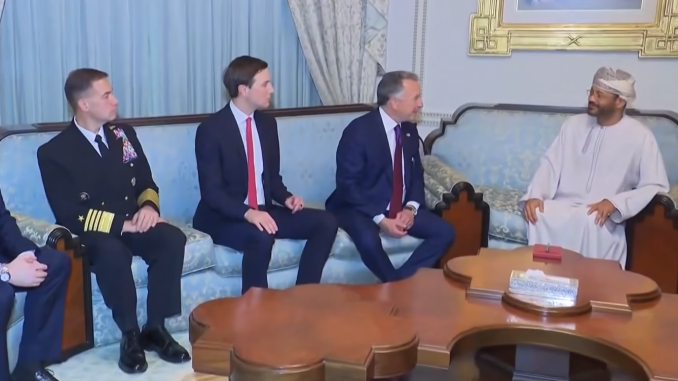 Screengrab via Youtube
Representatives from the United States and the Iranian regime convened in Oman’s capital, Muscat, on Friday, exchanging positions through the mediation of the Omani foreign minister in talks that appeared to focus more on outlining preconditions than on substantive negotiations.
Nevertheless, the talks appeared to take place in a positive atmosphere, and both sides agreed to meet again in the coming days, according to the news outlet Axios.
Following the talks, Iranian Foreign Minister Abbas Araghchi told reporters that the sides had agreed to meet again but were still working to build mutual trust, adding that a clear framework for the negotiations could only be established if this positive trend continues.
He added that the timing and location of the next meeting had not yet been decided. Araghchi also stressed that Tehran’s demand should be limited to the nuclear issue.
Very serious talks mediating between Iran and the US in Muscat today.
It was useful to clarify both Iranian and American thinking and identify areas for possible progress. We aim to reconvene in due course, with the results to be considered carefully in Tehran and Washington. pic.twitter.com/OWctzf2CXA— Badr Albusaidi – ??? ????????? (@badralbusaidi) February 6, 2026
Omani Foreign Minister Badr al-Busaidi said the discussion was “very serious,” and that “it was useful to clarify both Iranian and American thinking and identify areas for possible progress. We aim to reconvene in due course, with the results to be considered carefully in Tehran and Washington.”
Both statements suggest that the rounds of talks held on Friday were not substantive negotiations but focused primarily on preparations for potentially more serious discussions in the future.
Surprisingly, the American delegation led by Special Envoy Steve Witkoff was joined by the commander of the U.S. forces in the Middle East, CENTCOM Admiral Brad Cooper. After reports that Cooper would join on Friday morning, an Iranian diplomatic source told Reuters that the presence of military officials could jeopardize the talks.
Iran’s Foreign Minister Abbas Araghchi says after talks with the U.S. in Oman that “overall, it was a good start for the negotiations. It was decided that the talks will continue.”
Speaking with Iranian State TV, Araghchi said: “I don't want to judge too soon, but if the… pic.twitter.com/1KaHdfjWcD
— Ariel Oseran ????? ??????? (@ariel_oseran) February 6, 2026
Cooper’s presence was indeed “unusual” in regard to diplomatic negotiations with Iran, commented Jason Brodsky, policy director of the United Against Nuclear Iran think tank.
He also predicted: “The regime in Iran will say and do enough to earn another meeting. That’s the goal here with its friends the ‘mediators’ – to lure the U.S. into a process that thwarts military action. Tehran will say it will be flexible on the nuclear program, but on other non-nuclear topics, they will dig in.”
The U.S. and Israel have made clear they want the Iranian regime not just to end its nuclear program but to curb the ballistic missile program and stop supporting regional proxies.
Reza Pahlavi, the throne pretender and most prominent opposition leader against the regime, wrote on ?: “The only acceptable deal is one in which the Islamic Republic surrenders to the people of Iran. We are ready for such a deal and it will bring peace to the region and the world.”
The talks appeared to be on the brink of collapse overnight between Wednesday and Thursday, after Iran demanded the talks be held in a bilateral format, without foreign ministers from several countries in the region who also wanted to attend.
Despite their exclusion, Axios reported that at least nine countries in the region strongly urged the U.S. not to walk away from the diplomatic efforts, despite the new demands, as well as the “aggressive” actions by the Iranian military toward the U.S. on Wednesday.
Al Jazeera reported that mediators from Qatar, Turkey and Egypt presented the U.S. with a proposed framework for an agreement to effectively revive the failed 2015 JCPOA Iran nuclear deal.
It demands that Iran commit to enriching no uranium for three years – the remaining duration of U.S. President Donald Trump’s current term.
After that, it would commit to limiting enrichment to below1.5%, while the roughly 440 kg (970 lb) already enriched would be transferred to another country.
The proposal also reportedly includes an agreement that Iran would not transfer weapons and technologies to its proxies, along with a pledge not to initiate the use of ballistic missiles.


Remember, the US took hotel rooms when the went to negotiate with the Vietcong, who rented a villa for two years. First year was just discussion of thre shape of the conference table.
This is Iran’s playbook. They wiped the floor with Obama, granted, that was after Obama performed fellato on each and every one of them, so at least he got what he went for.
And Obama paid them $5b for that sex act. Could well be the most expensive blow job in American History.
And then there was Catsup boy Lurch Kerry. Talk about sending a hapless douce to do a man’s job.
It’s time be mean, not diplomatic. Show the chief negotiator, his house wives (all 4) and chldren and and show him a bank of Tomahawk missiles with the coordinates of his home, the home of the entire leadership locked in.