
Peloni: Israel’s Shield of Light Laser system is now functioning in the field as seen below. This technology gives Israel a clear and substantive advantage over all comers, which represents an important shift in battlefield capabilities, and these capabilities will only grow with time. As Yossi Baum explains, it is impossible to over emphasize the importance of this achievement.
Yossi Baum | X | March 1, 2026
?? ???? ?????? ??????? ?????? ?????? – ????? “??? ???” ????????.
????? ?????? ????? ?? ?? ???? ????? ????? ????? ????????, ?? ???????? – ????? ?? ????? – ????? ?? ??? ?? ????: ?????, ????? ????????, ??????, ?????? – ???? ?? ??? ?? ???? ????? ?????? – ??? ?????? ?????? ???????… pic.twitter.com/YD34i3KXQd
— ???? ???? (@YOSSIBAUM) March 2, 2026
It is impossible to exaggerate the significance of interception by laser – Israel’s “Magen Or” (“Shield of Light”) system.
This is a system that changes all the rules of the game in the field of air defense, with the potential — immediate or future — to neutralize every type of threat: missiles, ballistic missiles, UAVs, drones — including a massive wave of hundreds or thousands of drones — one of the most significant reference threats in the West today.
It is likely that later we will also see developments that will upgrade the capability of the laser beam and attempt to strike fighter jets that try to attack various targets. The potential of laser warfare appears almost limitless, with even a theoretical possibility of shifting from defense to offense, and it may completely change the future battlefield.
Israel is the one leading this revolutionary tool. Great honor.
by | Mar 1, 2026
For decades, there has been a common Hollywood theme that future wars would consist of robotic vehicles being zapped from the skies by potent energy beams. Enter Israel’s Iron Beam, which makes shooting down missiles 99.9% cheaper. Israel’s Iron Beam laser defense system vaporizes rockets, drones, and mortars for about $3.50 per shot—the cost of electricity. America’s Patriot missiles? $2-4 million each.
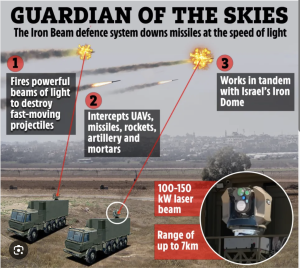
The weapon is designed to protect against short-range, low-altitude targets such as small drones, mortars, and short-range rockets — the type of inexpensive threats that are increasingly deployed in large numbers. A point that grows in relevance when you consider that future generations of drones could be as small as mosquitoes. Iron Beam has a range of six miles or 10 kilometers. However, its effectiveness is greatly reduced by adverse weather, dust, or smoke, limiting how and when the system can be used.
What links all these systems is the changing nature of the aerial threat. Small drones are cheap, expendable, and increasingly deployed in large numbers. Against this, traditional systems may successfully repel attacks, but at a cost. For instance, in Israel’s case, a large part of a US-allocated missile defense budget was spent replacing Tamir interceptors at a cost of $50,000 a pop. The economics of this aren’t sustainable, and by dropping the cost from potentially millions of dollars for a single Patriot launch to a few dollars, the rise of the battlefield laser is inevitable.
Israpundit is entirely dependent on readers support. Please help me continue educating people with the truth about what is going on in Israel and around the world.


I’m waiting for light sabers for hand to hand combat. May the Schwartz be with you.
https://www.cjh.org/jewsinspace/