
by Pierre Rehov • Gatestone Institute • March 17, 2026
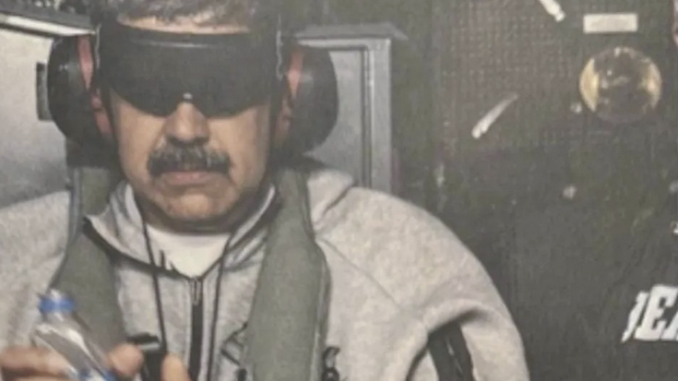 Once Venezuela’s President Nicolás Maduro disappeared, the country’s interim leadership and military elite simply recalculated their interests and began cooperating with Washington to preserve their positions. Unlike Venezuela’s military elite, whose loyalty ultimately depends on financial incentives, Iran’s security apparatus has always viewed itself as the armed guardian of a sacred Islamic revolutionary mission. Applying the Venezuelan model to Iran would not merely fail; it would risk creating a dangerous illusion of success while leaving the underlying ideological infrastructure untouched. Pictured: Maduro, in US custody, on board the USS Iwo Jima in the Caribbean Sea, on January 3, 2026. (Image source: The White House)
- Unlike Venezuela’s military elite, whose loyalty ultimately depends on financial incentives, Iran’s security apparatus has always viewed itself as the armed guardian of a sacred Islamic revolutionary mission.
- Iran, however, represents a fundamentally different political organism. Confusing the two systems could produce disastrous strategic errors. The Islamic Republic of Iran is not merely an authoritarian government cloaked in ideological language; it is an ideological state whose institutional architecture was deliberately constructed to preserve and expand a revolutionary doctrine.
- The Islamic Revolutionary Guard Corps (IRGC) commands roughly 190,000 personnel plus hundreds of thousands of reservists, controls vast business conglomerates spanning construction, energy and telecommunications, and oversees the Basij militia, a mass organization whose membership has been estimated in the millions and whose purpose is to violently enforce ideological conformity and suppress dissent.
- This resilience is characteristic of ideological regimes whose institutional design ensures survival beyond any single leader. The Islamic Republic itself endured the death of founding Supreme Leader Ayatollah Ruhollah Khomeini in 1989, transitioning smoothly to a new leadership structure under Ayatollah Ali Khamenei while preserving the same revolutionary framework.
- Applying the Venezuelan model to Iran would not merely fail; it would risk creating a dangerous illusion of success while leaving the underlying ideological infrastructure untouched. Some Western analysts have suggested that once sufficient military pressure weakens Tehran, negotiations could be opened with supposedly pragmatic factions inside the regime, allowing elements of the current political structure to remain in place in exchange for concessions on nuclear weapons development and regional aggression.
- Such thinking misunderstands the nature of ideological systems, which tend to treat compromise not as a strategic transformation but as a temporary tactic designed to preserve the revolution until circumstances change.
- Leaving the ideological framework of the Islamic Republic intact would therefore resemble leaving a malignant tumor inside the body after surgery: the symptoms might temporarily subside, but the underlying disease would continue to grow until it inevitably returns.
- The Venezuelan model succeeded because the regime it confronted was fundamentally pragmatic, corrupt and adaptable. Iran’s regime is none of those things. The Islamic Republic was designed to survive leadership crises, economic hardship, and external pressure precisely because its institutions are bound together by religious ideology rather than mere patronage. Any strategy that focuses only on removing individual leaders while preserving the ideological machinery that sustains them will ultimately fail.
- It is naive, however, and self-defeating if the Trump Administration imagines that unarmed civilians — with no outside assistance — can realistically prevail against heavily armed, determined state security forces. The wish may be understandable, but even more civilians than the 40,000 already slaughtered are bound to meet the same fate. The Trump Administration needs to direct and help them.
- If there is eventually an end to the violent suppression from the IRGC and the Basij, the international community should be prepared to support forces capable of building a new political order that is neither Islamist nor communist. Anything less would allow the same ideological machinery to regenerate under a different name, ensuring that the crisis would return once again — and that we will still be fighting essentially the same regime but with different ayatollahs five or ten years from now.
The spectacular American military operation that removed Venezuelan President Nicolás Maduro from power earlier this year has inevitably inspired comparisons among strategists searching for solutions to the Iran crisis.



Leave a Reply
You must be logged in to post a comment.