
Peloni: Notice that the Gulf members maintain their pre-war positions. Qatar remains ever the groveling submissive to its dominating Iranian neighbor. Oman remains closely alligned with its Iranian ally. UAE wants a way out from the capture and control of the radicals in Iran. And Saudi Arabia is willing to work with the radical Iranians remaining in power so long as it doesn’t affect Saudi interests.
By: Amb. Alberto M. Fernandez | MEMRI | April 10, 2026
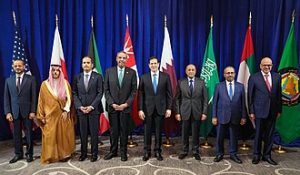 Secretary Marco Rubio meets with Foreign Ministers of the Gulf Cooperation Council Member States in New York City, New York, September 24, 2025. Photo by U.S. Department of State – Flickr, Public Domain, Wikipedia
The announcement of a ceasefire agreement between the U.S. and Iran, brokered by Pakistan, evoked mixed reactions from the Gulf states, reflecting their fundamental differences regarding the conflict. While Qatar and Oman, which maintained a pro-Iranian line throughout the war,[1] warmly welcomed the ceasefire agreement, other states expressed significant reservations.
The UAE refrained altogether from issuing an official welcome and strongly demanded clarifications, guarantees for the cessation of Iran’s aggression, compensation for the damages of the war, and the immediate and unconditional reopening of the Strait of Hormuz. Saudi Arabia took a dual approach: while the political leadership issued formal statements of support, the state press expressed considerable pessimism regarding the success of the ceasefire and the likelihood of a real and lasting change on the ground.
This report presents the positions of the various Gulf states on the ceasefire between the U.S. and Iran:
The UAE Did Not Welcome The Ceasefire, But Demanded Clarifications, Guarantees That Iran’s Attacks Would Cease, And Compensation
Unlike its neighbors in the Gulf, the UAE did not welcome the ceasefire agreement but rather focused on demanding clarifications regarding its provisions, as well as guarantees for the cessation of Iran’s hostilities and the unconditional opening of the Strait of Hormuz. Moreover, it called for Iran to be held accountable and liable for reparations, and for all the threats posted by Iran to be addressed, without exception.
A statement issued by the Emirati foreign ministry following the announcement of the ceasefire said that the UAE is “is working to obtain further clarifications regarding the provisions of the [ceasefire] agreement, so as to verify Iran’s full commitment to the immediate cessation of all hostilities in the region and to the complete and unconditional reopening of the Strait of Hormuz.” The ministry clarified further that “the unprovoked Iranian attacks targeting infrastructure, energy facilities, and civilian sites over the past 40 days – which included 2,819 ballistic and cruise missiles, as well as drones – and the resulting loss of life and property damage, necessitate a firm position, including ensuring that Iran is held accountable and fully liable for damages and reparations.”
The statement emphasized “the need for a comprehensive and sustained approach that addresses Iran’s full range of threats, including its nuclear capabilities, ballistic missiles, drones, military capabilities, and affiliated proxies and terrorist groups, while ending threats to freedom of navigation, as well as economic warfare and piracy in the Strait of Hormuz.” It also stressed “the need for Iran’s full compliance with United Nations Security Council Resolution 2817, adopted on March 11, 2026, which condemned the Iranian attacks and demanded their immediate cessation.”[2]
Emirati officials took a similar line. Foreign Minister Abdullah bin Zayed, in phone calls he held after the announcement of the ceasefire with his Saudi counterpart Faisal bin Farhan and his Jordanian counterpart Ayman Safadi, stressed the “importance of ensuring Iran’s full commitment to the immediate cessation of all hostile activities in the region, to the full and unconditional reopening of the Strait of Hormuz, and to the termination of threats to freedom of navigation, international trade, the security of energy supplies, and the global economy.”[3]
Anwar Gargash, an advisor to the Emirati President, likewise underscored the need to take a firm stance toward Iran. Referring to the foreign ministry’s statement, he wrote on X that no one should be surprised by the frankness of the UAE’s positions regarding the Iranian aggression against the Gulf states, and added: “This clarity has become a necessity after the cruel and malicious [Iranian] aggression. The era of diplomatic niceties is over, and frankness has become essential. Our collective position regarding the characteristics of the next phase must be firm and clear, so as to strengthen stability and security in the region.”[4]
Similar messages were conveyed in Emirati press editorials. The state daily Al-Ittihad reiterated the foreign ministry statement almost verbatim.[5] The daily Al-Khalij said that the understandings that led to the ceasefire are based on “a fundamental condition, namely that keeping the Strait of Hormuz open to international shipping is an international red line that cannot be crossed without far-reaching consequences.” The daily stressed that, ahead of the upcoming negotiations between the sides, “key issues remain to be resolved, including the nuclear file, the future balance of power in the region, and the question of regional security and of Iran’s role within it…”[6]
Official Saudi Arabia Welcomes The Ceasefire, Saudi State Dailies Express Skepticism
Unlike the UAE, Saudi Arabia officially supported the Pakistan-brokered ceasefire between the U.S. and Iran. An official statement from the Saudi foreign ministry asserted that the kingdom welcomes the ceasefire while emphasizing that the Strait of Hormuz must remain open to navigation in accordance with international law. It also expressed hope that this ceasefire would “provide an opportunity to achieve a comprehensive and sustainable de-escalation, thereby enhancing regional security and halting any aggression or policies that infringe upon the sovereignty, security, and stability of the region’s countries.”[7]
This position was also conveyed in a phone call between Foreign Minister Faisal bin Farhan and his Iranian counterpart, Abbas Araghchi, during which the two discussed “ways to resolve the tensions in a manner that would help restore security and stability to the region,” according to a statement by the foreign ministry.[8]

However, in contrast to the official discourse, the Saudi press expressed deep skepticism regarding the ceasefire. An editorial in the daily Al-Riyadh welcomed it, but voiced pessimism as to its durability in light of the conflicting statements made by the two sides.[9] Similarly, a commentary in the state daily Okaz assessed that the success of the ceasefire depends on the extent to which the parties are serious about translating it into a permanent arrangement. “The fragility of the ceasefire,” it said, “lies in its temporary and conditional nature, since the core issues that led to the outbreak of the war have yet to be resolved… This means that any violation on the ground, even a very limited one, could lead to a rapid collapse and a return to square one – a scenario no one wishes for.”[10]
Okaz columnist Hamoud Abu Taleb expressed similar views: “These temporary lulls will not be effective, and reducing chronic issues to a new, isolated matter amounts to shirking responsibility and evading the truth. The region has faced ongoing security threats for nearly five decades, the sources of which are well known. Without a full and practical commitment to ending this behavior, negotiations and mediation will be useless. Moreover, if the security of the Gulf states is not a fundamental and integral part of the negotiations, this will be considered an unacceptable disregard for a key side in the crisis.”[11]
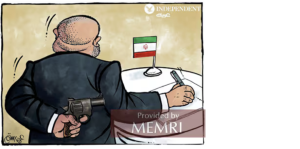 Cartoon in Saudi-owned online daily: Iran signs the ceasefire agreement while holding a gun behind its back (Independentarabia.com, April 7, 2026)
Qatar Strongly Supports The Ceasefire, Qatari Emir Calls It “An Important Opportunity For Peace”
Qatar, which took a pro-Iranian line in the leadup to the war and during it, expressed strong support for the ceasefire both in official statements and the state media. The foreign ministry welcomed the ceasefire, describing it as “an initial step towards de-escalation” and underscoring “the importance of full commitment to the ceasefire agreement, which would ensure the consolidation of the truce and create conditions for dialogue.” It called “for the Islamic Republic of Iran to immediately cease all hostile acts and practices that undermine regional stability, and to respect the sovereignty of states, in order to ensure that such violations are not repeated.” The ministry also highlighted “the importance of ensuring the security of maritime routes and the freedom of navigation and international trade in accordance with the rules of international law.”[12]
The Qatari Emir, Tamim bin Hamad Aal Thani, said in a phone call with Turkish President Recep Tayyip Erdo?an that the ceasefire is “an important opportunity to achieve lasting peace and stability in the region.”[13]
Qatar’s state press also welcomed the ceasefire. The state daily Al-Arab described it as “a rare opportunity to catch our breath and redirect the region’s compass toward a more rational course,” and called for it to be used as “a genuine starting point toward stability.”[14] The state daily Al-Sharq said that “the current sensitive period requires full commitment to the ceasefire announcement,” and emphasized Qatar’s position “that serious and responsible dialogue, respect for the principles of international law, and good neighborliness are the pillars of resolving crises and saving the region and the world from their dangerous repercussions.”[15]
Oman Welcomes The Ceasefire, Calls For A Ceasefire In Lebanon As Well
Oman’s position was similar. Its foreign ministry likewise welcomed the ceasefire announcement and called to intensify efforts to find solutions “that address the root causes of the crisis” and achieve a lasting end to the war.[16]
The Oman daily actually echoed the position of Iran and Hizbullah, arguing that any ceasefire must include Lebanon, otherwise it would amount to a “dangerous illusion.” The editorial stated: “A ceasefire that disregards one of the most volatile fronts carries the seeds of its own failure… The matter is no longer Lebanon’s alone, despite the severity of what it is experiencing, but is a matter of overall regional stability. The Strait of Hormuz remains at the heart of the crisis, not only because it is a vital maritime route, but because it is the point where regional security intersects with the global economy. Any ceasefire that fails to calm the most burning fronts will not be able to restore the trust needed for reopening this vital route… Any agreement that leaves Lebanon burning will not create peace, but will [merely] write the preface to the next explosion.”[17]
[1] See MEMRI reports: Special Dispatch No. 12401 – Despite Iran’s Attacks On It, Oman Congratulates Mojtaba Khamenei On His Appointment As Iran’s Supreme Leader – March 11, 2026 Special Dispatch No. 12410 – Despite Iran’s Attacks On Arab Countries, Major Qatari Media Outlets – Chief Of Them Al-Jazeera – Continue To Serve As Propaganda Platforms For Iranian Regime – March 19, 2026; MEMRI Special Dispatch No. 12418, Qatar Announces Return To Normalcy – Apparently Due To Iranian Guarantees That It Will Not Be Targeted In Further Attacks, March 24, 2026; MEMRI Special Dispatch No. 12419, Articles In London-Based Qatari Press: The War Against Iran Is ‘The Vilest In History’; Trump Acts Like Hitler And Mussolini Or Like The Head Of A Terrorist Organization, March 25, 2026.
[2] Mofa.gov.ae, April 8, 2026.
[3] Al-Ittihad (UAE), April 9, 2026.
[4] X.com/AnwarGargash, April 9, 2026.
[5] Al-Ittihad (UAE), April 9, 2026.
[6] Al-Khalij (UAE), April 9, 2026.
[7] X.com/KSAmofaEN, April 8, 2026.
[8] X.com/KSAMOFA, April 9, 2026.
[9] Al-Riyadh (Saudi Arabia), April 9, 2026.
[10] Okaz (Saudi Arabia), April 9, 2026.
[11] Okaz (Saudi Arabia), April 9, 2026.
[12] Mofa.gov.qa, April 8, 2026.
[13] Al-Watan (Qatar), April 9, 2026.
[14] Al-Arab (Qatar), April 9, 2026.
[15] Al-Sharq (Qatar), April 9, 2026.
[16] X.com/FMofOman, April 8, 2026.
[17] Oman (Oman), April 9, 2026.


Leave a Reply
You must be logged in to post a comment.