
Peloni: The perception that there are moderates to be found among radicals is a defining flaw in the Western mind set. Radicalism has no moderates, because by defininition, it is opposed to moderation. This does not seem that this should be a difficult concept to grasp, but Western embrace of Islamists would argue against this notion.
by Pierre Rehov • April 12, 2026
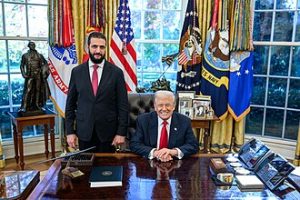 Pres. Trump Meets with Syrian Pres. Jolani. Photo by Donald Trump – Trump Truth Social, Public Domain, Wikipedia
- Regimes are destabilized but left standing, Jihadist ecosystems are weakened but not dismantled. Recycled figures from the same ideological mold are repackaged as partners. This sadly makes for half-finished wars presented as advisability.
- In Syria… Ahmed al-Sharaa, known under his former identity as Abu Mohammad al-Julani — a man once affiliated with Al-Qaeda and long listed with a $10 million American bounty on his head — was welcomed at the White House on November 10, 2025, and, in what was framed as a historic diplomatic opening, publicly described by Trump as a “strong leader.”
- To then legitimize these terrorists under the convenient fiction of ideological conversion is not merely contradictory; it signals to the entire region that time and patience are sufficient to outlast Western resolve.
- Ideologies do not just dissolve when their representatives adopt the codes of diplomacy. They simply put on suits and ties, prepare to say what Western leaders would like to hear and re-enter the international arena through a legitimacy granted by those who once sought to eradicate them. The former head of Romanian Intelligence, Ion Mihai Pacepa, who defected from the Soviet-bloc to the West in 1978, wrote as early as 2003:
- “In March 1978 I secretly brought Arafat to Bucharest for final instructions on how to behave in Washington. “You simply have to keep on pretending that you’ll break with terrorism and that you’ll recognize Israel — over, and over, and over,” Ceausescu told him for the umpteenth time. Ceausescu was euphoric over the prospect that both Arafat and he might be able to snag a Nobel Peace Prize with their fake displays of the olive branch.”
- The central flaw that continues to undermine Western policy seems to be the illusion that eliminating individuals is equivalent to dismantling the system that produces them.
- Trump’s position appears divided between two incompatible premises. On one side is a clear recognition that the Iranian regime is intrinsically hostile, driven by an expansionist vision anchored in a theology that elevates martyrdom above compromise and confrontation above coexistence. On the other side is the temptation — a recurring wish — to explore engagement with supposedly “less radical” elements within that same system, as though extremism were a matter of degree rather than a defining principle. This ambiguity is a strategic fault line. As long as Iran’s Islamic Revolutionary Guard Corps, the clerical hierarchy, and the ideological infrastructure remain intact, any figure presented as moderate operates within boundaries that preclude genuine transformation. What appears as moderation to Western observers instead often functions as tactical adaptation within an unchanged ideological framework.
- Half-measures, in this context, represent the most dangerous possible course. They combine the costs of intervention with the failure of restraint: destabilizing adversaries without removing their capacity to rebuild and, in doing so, often strengthening the very dynamics the half-measurists were seeking to contain.
- If… the objective is seriously to alter the dynamics that perpetuate a conflict — to dismantle the ideological regimes and frameworks that export instability across the region — then partial measures are indistinguishable from failure.
- American voters, particularly before midterm elections, are unlikely to engage with the subtleties of diplomatic maneuvering or the layered complexities of proxy warfare. Their judgment will rest on visible outcomes: on the coherence between declared objectives and tangible results. In that light, a strategy that delivers disruption without resolution risks being perceived not as prudence but as an abdication of purpose, just another American cut-and-run.
- There can be no rehabilitation of jihadists under new labels, no reliance on hypothetical “moderates” within revolutionary systems, and no acceptance of partial outcomes as substitutes for structural change. Anything less will ensure that the same threats will persist, reconfigured and reinforced, for the next round of conflict.
There is, in Washington, a recurring temptation: that the Middle East can be managed, contained, adjusted at the margins through economic pressure, surgical strikes, and the careful selection of supposedly “acceptable” figures drawn from within the very systems that generated the chaos. US President Donald Trump, whose instincts have often broken with this practice, now appears perilously close to reproducing it. The issue is not a lack of clarity— he understands the nature of the threat far better than most Western leaders — but the potential failure of an operation halted midway. Regimes are destabilized but left standing, Jihadist ecosystems are weakened but not dismantled. Recycled figures from the same ideological mold are repackaged as partners. This sadly makes for half-finished wars presented as advisability.


The full article presents us with the consequences if we refuse to accept the reality of the situation in Iran and other neighboring countries. If we are willing to concede to half-hearted measures, the results will be full-hearted attack as soon as they recover. In Israel, we have seen this too often to try to ignore.
Every war with our neighbors that is stopped by international pressure of one kind or another is rewarded by the next round, usually quite quickly.
A quick review of Israel’s wars with its neighbors shows this to be true. The latest skirmishes with Hamas and Hezbollah show this clearly.
The only major problem Israel faces is the fact that those defeated neighbors need reeducation, but Israel is not suitable for this task because it is too small and too busy recovering from all these missions to keep the neighbors within their own boundaries. This is a task for a bigger country like the EU or the US or even Russia or China. However, for as long as they are unwilling to contribute their obvious prowess, nothing will change.
The only glimmer of light at the end of the tunnel is that Israel wants to develop and manufacture its own weapons so that it cannot be so easily coerced into not finishing the job of defeating the attackers.
Thank you for this brave and truthful essay.
Our firends, the Yezidi have been suffering massacre and all other onging attempts to annhilate them – to this day. This tragedy against one of human kind’s oldest ancestors – is not even being covered. Some of our Yezidi communicty were direct victims of and servants for this ‘errorist- in -a -tie.