
Peloni: Entering into a deal with Iran goes against US interests as it perpetuates the national theme in Iran which created the threat which brought the US to war today. Existential threats can not be negotiated out of existence. They warrant and demand being ripped out of power, root, stem and leaf.
by Amir Taheri • Gatestone Institute • April 19, 2026
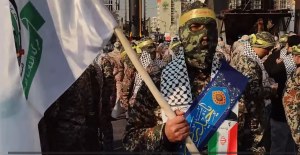 A reshuffling of cards that leaves Iran’s regime in place in an altered form would not change the genetics of an ideology built around the radical rejection of accepted international law. Picutured: Iran’s Revolutionary Guard Corps (IRGC). Screengrab via Youtube
- Under the system created by Ayatollah Ruhollah Khomeini and [Ayatollah Ali] Khamenei, even the chiefs of the Islamic Revolutionary Guard Corps are not allowed to hold staff meetings without prior approval of the Office of the Supreme Guide (“Beit-e Rahbari“) and the presence of his military advisers.
- Two things seem clear at this juncture. The Khomeini-Khamenei system cannot be rebuilt even if the new “Supreme Guide” Mojtaba Khamenei is really alive and kicking.
- The second thing is that a reshuffling of cards that leaves the regime in place in an altered form would not change the genetics of an ideology built around the radical rejection of accepted international law.
The ceasefire declared in the US-Israel war against Iran is set to end in the next couple of days amid conflicting views on what might happen next.
By the time of writing this piece, many observers thought that both sides might agree to an extension of the brittle truce for a further 45 days. In a world of a 24-hour news cycle, punctuated by tweets and video clips, that may sound like a long time.
In last June’s war against Iran, US President Donald Trump declared a ceasefire after 35 hours of bombing.
He had also declared “mission accomplished” in Venezuela after a 5-hour raid to arrest President Nicolás Maduro. When the second round of war against Iran seemed to stall, the president threatened to turn Iran back to the Stone Age in just 4 hours.
In the Islamabad peace talks last week, Vice President JD Vance decided that enough was enough after a 16-hour back-and-forth with Tehran’s emissaries, half of it spent on translation of what each side said.


The back-handed remark about Mojtaba Khamenei alive and kicking is strange when one considers that it is reported that he lost a leg. Kicking with only one leg to stand on is not easy.
Trump might be waging psychological warfare against the regime. They are fighting each other openly. Nobody is in charge, according Mahyar Tousi of Tousi TV. I am suspending judgement until it is clear the fat lady has sung.
https://classics.mit.edu/Tzu/artwar.html