
Peloni: The imposed ceasefire and restricted freedom of action forced on Israel has only emboldened the continued attacks on IDF forces. While this is being used as a conditional concession provided to Iran towards negotiations, the negotiation continue to show nothing from the Iranians but their resolve to not negotiate. No concessions should have been offered to Iran, and certainly not such concessions as have held Israel under exposed threat while rocket and drone alerts continue nearly uninterrupted. This continues to be an intolerable convenience offered to the obfuscating masters of terror in Tehran for nothing.
Arlene Kushner | April 29, 2026
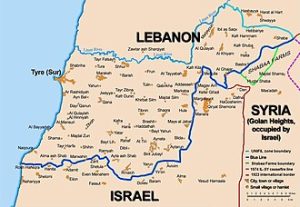 Map showing the Israeli-Lebanese border and the Litani River. Photo by 99of9 / * The map is made by Thomas Blomberg using the UNIFIL map, deployment as of July 2006 as source. – Self-published work by 99of9, CC BY-SA 2.5, Wikipedia
What’s happening with regard to Lebanon and Israel certainly fits that designation.
Israel had been acting decisively to take down or weaken Hezbollah, which, in support of Iran, had been launching rockets and drones at the north of Israel from inside of Lebanon. Among the actions the IDF had taken was establishment of a presence in southern Lebanon; the ultimate goal was to drive Hezbollah back beyond the Litani River, out of immediate range of northern Israel (although Hezbollah’s long-range missiles will still present a problem when launched from north of the Litani).
On April 17, President Trump announced a 10-day ceasefire. But it was between Israel and the government of Lebanon; Hezbollah was not a formal participant and challenged the legitimacy of the ceasefire. Israel was not involved in seeking that ceasefire, but acceded to it, I would say reluctantly, because Trump believed it was important as part of his push to resolve matters with Iran. The proviso from the Israeli side was that we retained the right to respond to violations by Hezbollah.
What ensued was a reduction – not a cessation – in the firing of drones (currently the most significant problem) and rockets by Hezbollah into northern Israel and into southern Lebanon where the IDF is stationed, with IDF attacks on Hezbollah on several occasions in response.
~~~~~~~~~~
Ten days ago, Israel announced a “Forward Defense Line” (“A-Tiri”): in southern Lebanon, along the border with Israel but not encompassing the full buffer zone.
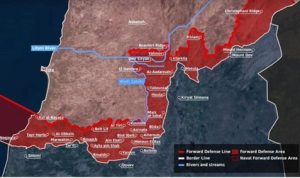 X @Times of Israel
Declared the IDF: “Five divisions, alongside Israeli Navy forces, are operating simultaneously south of the Forward Defense Line in southern Lebanon in order to dismantle Hezbollah terror infrastructure sites and to prevent direct threats to communities in northern Israel.”
No Hezbollah presence would be tolerated in this Forward Defense Area.
Trump’s response to this announcement was to declare that “Israel is prohibited from bombing Lebanon any longer.” The US, he said, will work with Lebanon separately to “deal with the Hezbollah situation in an appropriate manner.”
https://www.jpost.com/israel-news/defense-news/article-893510
This regrettable announcement by the president – who was seeking to generate a specific situation for his purposes – pushed the restrictions of the “ceasefire” further than anything Israel would accept. Our proviso going in was that we would continue to respond to all attacks.
On April 22, two Hezbollah operatives found in the Forward Defense Area were eliminated.
Israeli Defense Minister Israel Katz then declared that the military has been instructed by the prime minister and by himself to use “full force” in Lebanon – even during the ongoing ceasefire – from the air and from the ground, should Israeli troops face any threat.
https://www.instagram.com/reels/DXUYXj6ABX9/
~~~~~~~~~~
With regard to the diplomatic aspect of this “ceasefire,” two meetings have been held in Washington between the ambassadors to the US of the two countries – Israeli Ambassador to the US Yechiel Leiter and Lebanese Ambassador to the US Nada Hamadeh Moawad – with President Trump and Secretary of State Rubio presiding (descriptions of the precise procedure that was followed are vague). The US ambassadors to Israel and Lebanon were present.
Following the second meeting, Trump announced that the ceasefire, which was scheduled to expire this past Sunday, would be extended for another three weeks.
From left below, after second round of talks: US Ambassador to Israel Mike Huckabee, Israeli Ambassador to the US Yechiel Leiter, Vice President JD Vance, Secretary of State Marco Rubio, Lebanese Ambassador to the US Nada Hamadeh Moawad and US Ambassador to Lebanon Michel Issa.
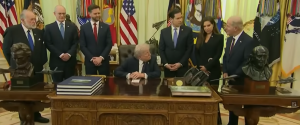 Screengrab via Youtube
~~~~~~~~~~
In a Truth Social post immediately following this announcement, Trump said he planned to host Prime Minister Benjamin Netanyahu and Lebanese President Joseph Aoun at the White House “in the near future.” My readers would be advised not to hold their collective breath.
He also said, “The United States is going to work with Lebanon in order to help it protect itself from Hezbollah.” I would dearly love to know what he had in his mind when saying this, as he is preoccupied with Iran and obviously does not intend to place American boots on the ground in Lebanon. But the mere fact that he said it is an acknowledgement that the government of Lebanon cannot or does not wish to (I would say both apply) take on Hezbollah.
In the meantime, Hezbollah attacks are intensifying again.
~~~~~~~~~~
Let us, then, take a look at the broader underlying situation.
Legally Israel and Lebanon are still at war. Whatever our difficulties with Egypt and Jordan, and there are plenty, there is a peace treaty with each, which while tenuous at times, has held. This is not the case with Lebanon.
Last week, while taking questions from a Lebanese journalist, Trump learned that according to Lebanese law contact with Israel is forbidden. He expressed surprise and indicated that he was sure this would change very soon (read: he will apply pressure in an attempt to secure a change). Whether he succeeds or not, this law is an indication of where Lebanon stands vis-à-vis Israel.
In the first map, above, at the south of the buffer zone you will see a line between Lebanon and Israel marked as the Blue Line. The line that delineates a border between two states is agreed upon mutually in a treaty – as is the case with Jordan and Egypt. The Blue Line, however, was established by the United Nations as a 120-km temporary “line of withdrawal” regarding a pull-back of Israel from Lebanon. Every so often Lebanon contests this line.
So we can see that there are reasons why negotiations between Israel and Lebanon might be productive, if approached with mutual good will. Except for the fact that there is a huge elephant in the room: Hezbollah. Negotiations between Israel and Lebanon would not resolve the issue of the presence inside of Lebanon of a major radical Islamist Iranian proxy bent on attacking Israel.
In 2006, when Israel pulled out of southern Lebanon, it was within the context of Security Council Resolution 1701, which called for disarmament of all armed groups in Lebanon, with no weapons or authority in the country other than that of the Lebanese state and its army. It also established UNIFIL, the United Nations Interim Force in Lebanon, which was responsible for helping the Lebanese military secure the border and stop the flow of weapons.
It was a major fiasco. Hezbollah drastically expanded its rocket arsenal by building weaponry and to a significant degree importing it. Over the course of close to 20 years, it became one of the most heavily armed non-state actors in the world, with an estimated 150,000 to 200,000 rockets and missiles. Israeli attacks have significantly degraded this arsenal, but Hezbollah works to replenish it to this day. Even during the “ceasefire” weapons are being smuggled from Syria.
~~~~~~~~~~
Journalist and author Jonathan Spyer holds a Ph.D. in International Relations and a Masters in Middle East Politics and is associated with the Misgav Institute for National Security and Zionist Strategy. Originally from London, he has been in Jerusalem for over 20 years and fought in Lebanon with the IDF in 2003. He recently wrote an insightful analysis of the situation in Lebanon. From that piece (emphasis added):
Spyer compares Lebanon to a vortex that draws Israel into its vacuum time and again, so that the “Lebanese mud” never gets to be finally scraped off of Israeli boots.
“…the long-collapsed sovereignty of Israel’s northern neighbor appears to have the capacity to produce never-ending travails for the residents of Israel’s northern communities, the fighting units of its army, and the Jewish state as a whole…
“Governments in Beirut lost the crucial monopoly over the means of violence in the country as early as 1969. In that year, the authorities signed an agreement with Palestinian militias, giving the latter the right to use the country as a launchpad for ‘armed struggle’ against Israel.
“Beirut has never regained this monopoly. Israel has been searching for an adequate response to this unfortunate reality ever since. The Palestinian nationalist militias are long gone…
“The Islamic regime in Iran, looking for an entry point into the Israel-Arab conflict for a mix of ideological and pragmatic reasons, found this point in collapsed Lebanon, and has been operating its proxy Hezbollah militia from the northern border ever since…
“For various reasons, Western policy vis-à-vis Lebanon has been to ignore or minimize this reality. European countries, the United States, and the key states of the Arab world maintain relations with the legally constituted government in Beirut as if it were sovereign.
“The Lebanese Armed Forces receive support and assistance from the West as if they were the holders of the monopoly of violence throughout the formal area of Lebanese sovereignty. Western media coverage of the country reinforces this illusion.
“Indeed, the current formal Lebanese government of President Joseph Aoun and Prime Minister Nawaf Salam is widely portrayed in Western and even some Israeli media as, if not yet fully in control, certainly representing a uniquely promising hope for the full return of normal governance in the country.
“THIS IS an illusion…
“The problem, glaring and obvious, was that these men, and Aoun and Salam the same, had and have neither the will nor the capacity to take on the Iran-implanted structure, which is the real holder of power in the country. All the declarations and obfuscation (and there are plenty of them) won’t change this crude, obvious fact.”
And so, says Spyer, his old battalion is gearing up for another long-term stint in Lebanon, for under current circumstances containing Hezbollah is likely the best, if not the only, option.
https://www.jpost.com/middle-east/article-894018
~~~~~~~~~~
And so it may well be that Trump, who favors negotiations over war, genuinely believes that a ceasefire might lead to a resolution of the problem of Hezbollah. But, lacking a depth comprehension of the dynamics at play here, he would be wrong. Sometimes the solution must be military. In fact, no genuine ceasefire is even possible.
Israel understands this. We are at a new juncture, post-October 7, resolute in our efforts to provide security for our people. There is no backing off. From what I am hearing, our troops in the field understand it as well, and are ready to go.
~~~~~~~~~~
It has been said by many, including some here in Israel, that whatever the drawbacks to the situation, the Israeli-Lebanese ceasefire is a move towards getting the two parties to communicate, and puts them on the same side, against the aggressor Hezbollah.
But this too appears to be an illusion, or an instance of wishful thinking. The Beirut government, dominated as it is by Hezbollah (which sits IN the government actually), is quite content to have Israel cease firing. But to cooperate actively with Israel and be seen taking a stand against Hezbollah would be quite another matter. Trump had spoken about a phone call between Netanyahu and Aoun, but the Lebanese president has been resistant. For all Trump’s capacity to make things happen, to the best of my knowledge such a call has not taken place. When one understands the dynamics here, it seems highly likely that Aoun would resent being pushed to take a stand against Hezbollah.
Ruthie Blum recently called attention to a statement of President Aoun that made his position quite clear. In a speech on April 17, he expressed gratitude for the ceasefire without mentioning Israel. Then he said:
“There will never be any agreement that infringes on our national rights, diminishes the dignity of our resisting people or abandons a single piece of the land of our nation. Our objective is clear and declared: to stop Israeli aggression against our land and our people, to obtain Israeli withdrawal, to extend state authority over all its land by its own forces, to ensure the return of prisoners and to enable our families to return to their homes and villages, in safety, freedom and dignity.”
This was right out of Hezbollah’s playbook, wrote Ruthie. “Aoun isn’t a potential partner as long as Hezbollah is setting his agenda, which means the officials convening in D.C. are wasting their breath and a lot of frequent-flyer miles.”
https://www.jns.org/opinion/column/dont-mistake-beirut-for-a-partner
~~~~~~~~~~
“IDF Chief of Staff Lt. Gen. Eyal Zamir says there ‘is no ceasefire’ in southern Lebanon as troops continue to operate against the threat of Hezbollah.
“He also says that the IDF ‘will not tolerate’ Hezbollah’s attacks, while adding that Israel will not leave its new security zone until the threat to Israel’s northern communities is removed.
“’In Lebanon, the mission assigned to us by the political echelon is to position ourselves along the line to prevent direct fire on the communities. We have achieved this; this is the line we are on. We may be required to remain on it.
“’We will not tolerate attacks and fire on our communities, and we will not leave until long-term security for the northern communities is ensured.’” (Emphasis added)
![Chief of Staff Eyal Zamir. By Eytan2009 - Own work, CC0, https://commons.wikimedia.org/w/index.php?curid=161268763 [Cropped]](https://www.israpundit.org/wp-content/uploads/2026/02/Screenshot-2026-02-04-081812-300x194.png) Chief of Staff Eyal Zamir. By Eytan2009 – Own work, CC0, Wikipedia
Chief of Staff Eyal Zamir. By Eytan2009 – Own work, CC0, Wikipedia
~~~~~~~~~~
I ask, as I always do, that you please pray.
©Arlene Kushner. This material is produced by independent journalist Arlene Kushner. Permission is granted for it to be reproduced only with proper attribution.


I was willing to grant Trump support for his plans and actions but this is going much too far. ordering Israel not to retaliate when attacked by Hezbollah is akin to telling the US Secret Service not to protect him when someone wants him dead. He should reread his own book.
As far as dealing with the Lebanese government is concerned, that is identical to dealing with Hezbollah: they are happy if Israel ceases fire but that does not mean that they will follow suit. Hezbollah is at least part of the government of Lebanon and Aoun not only can’t do as he pleases, he is simply a marionette calling himself President.
A peace deal with Lebanon would be wonderful but not under the existing conditions.